20 November 2010

Livingroom for more

dessert_final
Image from the restaurant's website


"…A Hendricks and ice for me"
"Would you like that with cucumber?"
"Yes please!" My heart skipped a happy beat.


Dining in a suburban restaurant I did not expect to find Hendricks Gin available, but that short discourse told me that I had been placed in good hands.


In my experience the further you go from the Melbourne CBD, the better the Asian food. The converse applies to European food, especially in the South Eastern suburbs. 


Go beyond Attica in Ripponlea and the imaginative, conceptual cooking seems to disappear until you reach the countryside, where The Royall Mail and Loam are edging into creative modern territory. The same can be said for what I recently heard described as 'Honest Food' – good ingredients delivered simply, using traditional techniques and served up with a whole bunch of integrity.


While the expensive, modern and adventurous is something I looked forward to about twice a year, it is the honest stuff that would entice me to leave my own kitchen more often. My two favourite exponents of this kind of thing unfortunately are far from my home: George Biron's Sunnybrae in Birregurra and Steve Cumper's Red Velvet Lounge in Cygnet, Tasmania. The tyranny of distance means that I don't dine at either often enough. But now I think I've found another to add to the list, and it's amazingly in the burbs.


By the suburbs I don't mean way out in the heartland of McMansions where Asian cooking reaches amazing highs at low price points. No, this venue is in Malvern, where the leafy streets are filled with meticulously restored and extended period homes, well serviced by public transport and a mere stone's throw from our Jewish heartland. My new happy place venue is Livingrooom.


Hugging a corner in Claremont Street, Livingroom stretches its verandahs wide over the pavement. Close to Malvern station and away from the din of bustling Glenferrie Road it squats low on the landscape surrounded by genteel shops and a doll hospital.


This is a locale that keeps a respectable distance from the youthful outlook of St.Kilda, Windsor and the tourist aspect of the CBD; an interesting spot to do business. And somehow Livingroom manages to face the challenge of entertaining the professional families and Empty Nesters residing in Armadale through to Caulfield with integrity from breakfast through to dinner service.

lamp_final


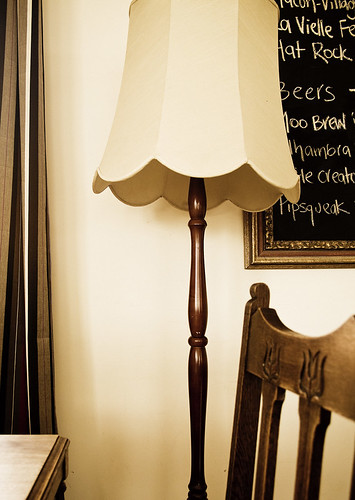
They do it by making their guests feel like they're visiting neighbours for a dinner party, or by day that they've dropped in at a girlfriend's for a gossip and a cuppa. On Saturday afternoon it's a place where a man of a certain age can just be alone with the newspapers or a group of middle aged men can grab an espresso before catching a train to the football. 

Walking the tightrope between various functions, Livingroom manages to be smart, bright, spacious and kid friendly from breakfast through to dinner and at night is as intimate as the dining room of a picket fenced, restored five bedroom Federation house, with parent's retreat and outdoor living area.


Inside, an eclectic arrangement of old domestic dining tables and chairs are delineated into two spaces by chandeliers in the lower, more formal area and red shaded pendant lights in an upper room that feels more café in style. This second space is dominated by the coffee machine, wine fridges and a toy box. On entry the Kitchen is visible and in it you will spy Head Chef Darren Daley.
pheasant_final


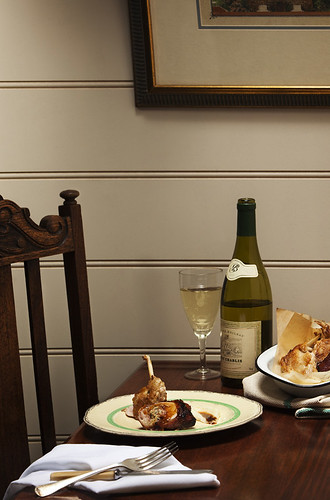
In 1999 Darren was recruited from London's Bibendum restaurant at the height of its popularity and prowess. He was one of a number of British Chefs lured to Melbourne to work at the Sofitel. At the time TV Masterchef judges, Gary Mehigan and George Calombaris were also employed there.


Darren however, is a quiet achiever. You won't find young Restaurant Critics fawning over Darren. He has not sought out their favour nor courted the limelight. He is not one of The Australian Food Twitterati. He does not have a big PR machine behind him, though I do suspect the PR hawks will be circling, hoping to get a piece of the action soon.


I've watched Darren's progression over the years. He has worked confidently and quietly since leaving The Sofitel by working at reputable venues. From being the lynch pin in revered gastropubs such as The Kingston in Richmond, to a stint at Guy Grossi's Mirka at Tolarno and then over to head up Sud's two venues, he has consistently produced a quality product, built on a passion for what he does best.


couch_final

I respect the honesty of his cooking. He takes an artisanal approach. I have watched him make his own sausages, his eyes mist over at the thought of slow cooked dishes and heard him talk with excitement of cha sui bao – Cantonese roast pork buns. In his kitchen, a passion for showcasing good produce is at the fore. And to add to that there is also an honesty in the service, where Darren's sister - a Sommelier in training – works alongside staff recruited from Maha and other reputable venues, who strike a chord between knowledgeable and unpretentious.


So from breakfast to dinner you will find polite subtlety, attention to detail and quality both in service and cooking. A brand new wine list is extensive, chosen by Alan Markham, the owner of Livingroom. This list, I would suggest is to some guests, a little intimidating. But in a thoughtful manner, tasting notes for the European and Australian selection prevents potential blushes.


To me, on a number of levels they have a difficult clientele to woo. If the menu were to sound too molecular or fanciful it would turn the conservative core off, but if it doesn't sound that little bit special, it won't entice those looking for the night out with a brag factor either. So faced with the tightrope of a dinner menu I honestly found it tough to make a decision what to eat. I was tempted by much, but initially thought perhaps it wasn't pushing my boundaries. I later realised that the written menu did not do the delicious creations justice. So I wondered if a certain amount of dumbing-down had been called for, so as not to scare the locals?


I would describe Darren's offering as Contemporary European, at times rustic. In fact on a recent trip to Paris, we found that Livingroom was in step with the regular hang-outs of city living Parisians, because here, it's all about flavor. The dishes are not excessively tricked up with gadgetry or gimicry, just strong traditional techniques. I feel Darren does his suppliers proud. From early evening, starting with diners of families and older folk, to couples having a night away from the kids, it is clear that the customers are well taken care of.

marrow_final


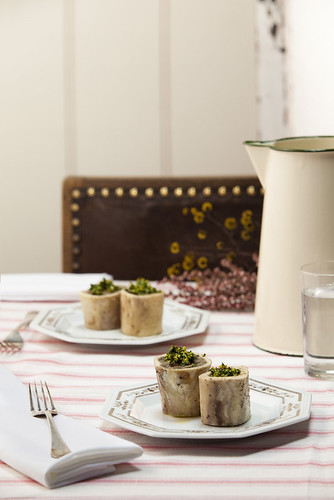
Amongst the entrees on the night we visited there were some excellent locally made charcuterie options from Siketa Meats, a wagyu bresoala dish and crowd pleasers such as fried zucchini flowers stuffed with lemon, ricotta and mint and a roasted pepper dressing. But this clientele also love the chicken livers with capers, parsley, witlof and Roquefort dressing.


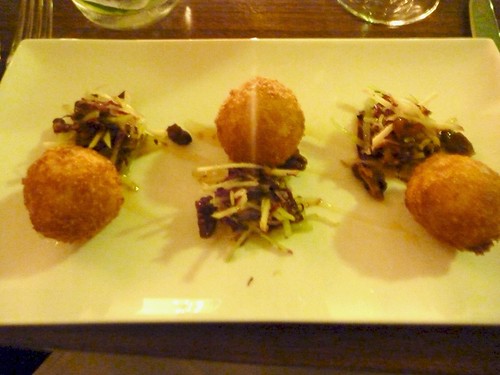
While polenta crusted sardines stirred Mr Sticki, he is a goats cheese buff, so went for the cheese in fritters with lemon thyme that was a roll call of his favourite ingrdients. The creamy texture and salt factor in the cheese was pleasantly offset by a piquant julienne of apple, radicchio, candied walnuts and truffled honey.


P1020156


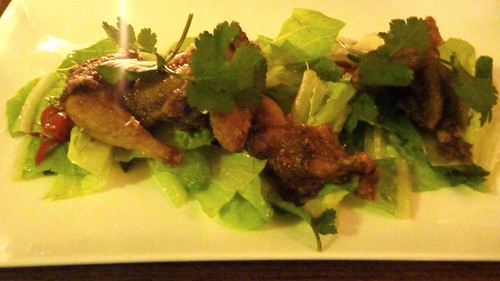
A five spice quail was reminiscent of dish I grew up with. Satisfyingly crisp fried, fleshy and subtly flavoured it works well with pickled chilli, mint and coriander. While comforting to me, I wondered whether the local clientele considered this Asian inspired offering exotic? But then I noticed in each course there was at least one dish that might appear challenging to the regulars and a number of items that some had not heard of such as, guanciale and scamorza.
P1020158a


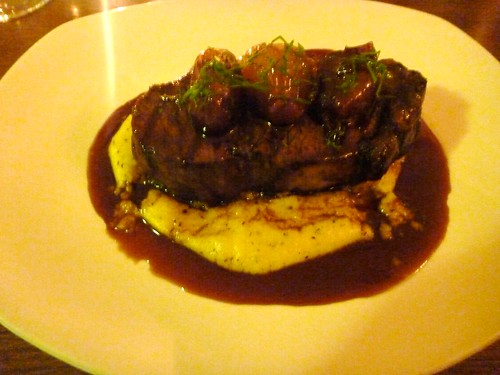
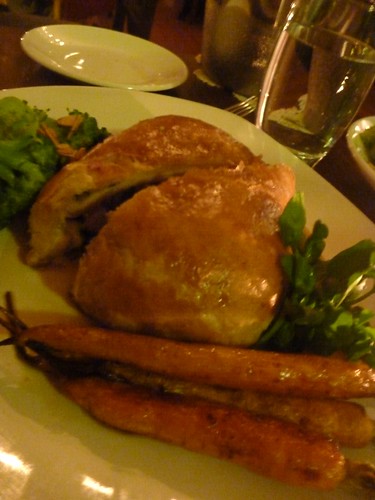
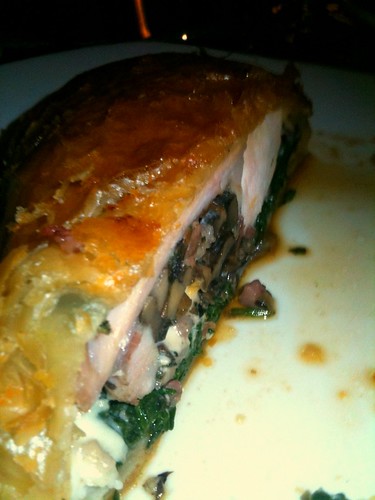
Scanning the mains, I toyed with the idea of Parsley and gorgonzola risotto with apple and rocket salad. I flirted with pan fried Mirror Dory with sautéed cavala nero, confit duck and red wine puy lentils. Mr Stickyfingers chose a Black Angus sirloin with soft buckwheat polenta and braised shallots - over the skirt steak with pommes frites, truffle salt and veal jus. Finally, after much deliberation I selected a rabbit wellington with spinach, mushroom, sage and gorgonzola farce. I'm a sucker for meat in pastry and I love rabbit.
P1020162


My main was very generous. Had not the beloved been on hand, I suspect I would barely have managed half. But that's just me. The contents had sufficient moisture while not making the pastry soggy. The gorgonzola gave the meat a hint of truffle like flavor, adding an unexpected depth to the dish. We could find no fault in the beautifully aged steak either. The shallots braised in wine were a delicious compliment to the deeply flavoured meltingly good meat.
P1020166Rabbit Wellington


At this point I must apologise for the crappy food photography. The dining scenario after the 8pm peak is moody and candlelit. It is the dinner party scenario of viewing your companions in beautiful, soft, candlelight that is unforgiving on food bloggers wielding a discrete camera that avoids flash.


As the night trickled on into the hour that gen Y usually start their evening, greed kicked in and we opted to share a dessert. While Mr coveted the Munster, Roquefort papillon and the Blairlaith Cheddar, despite hoping to leave room for more, there was no way that our bellies would allow us to man an assault on a cheese course. 


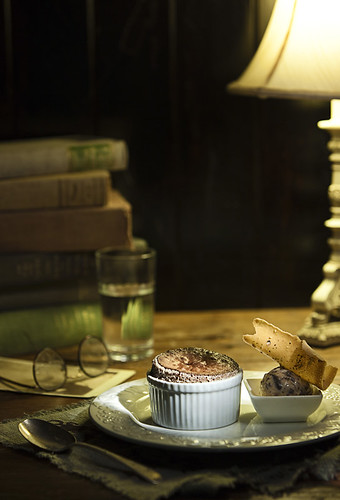
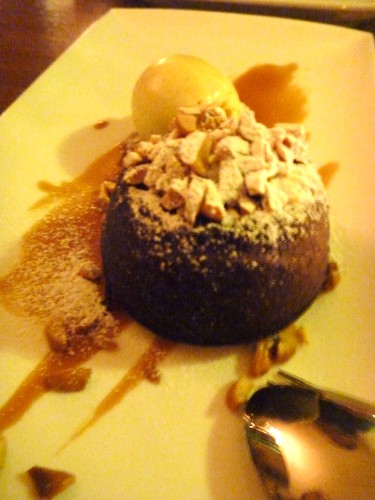
Our waitress nominated the chocolate and peanut fondant with vanilla bean icecream and salted caramel sauce, which totally hit the spot in a gooey, crunchy, sweet-but-not-sweet way. It was perfect in all respects. Like a couple of shuffleboard players we found ourselves dueling to scrape the last remnants from the plate.
P1020168


Later, rolling outside into the quiet night I knew that I would be back. Being in good hands found us sated on more than one level and happy to have found 'my kind of place' south of the Yarra …. and not so far from Chez Sticky. It's really no wonder that the locals love Livingroom.



door_final


Livingroom Restaurant and Cafe
12-18 Claremont Avenue,
Malvern Victoria, 3144 
(03) 9576 0356 | book via website | map & email


Livingroom Restaurant & Cafe on Urbanspoon
Enhanced by Zemanta

11 November 2010

Food is Art

P1150700
Sighted from the Erasmus Bridge in Rotterdam, Netherlands


The delicate ballet of blossoms falling off a tree
Had long gone unnoticed by me
I'm stunned by what now I finally see
It's amazing the wonders you can find
Just by stepping outside
There's a skip in my step a divine state of joy
In everything I do
Cause I am feeling new again
OF MONTREAL: 'Old Familiar Way'


We embarked on a month's journey to mark Mr Sticky's half century of life and I found myself on the path to further self discovery. We went to Europe: to London, Paris, Normandy, Brugge, Brussels and to visit family in Rotterdam. We ended the trip in Malaysia.

I wore out my feet but awakened the inner me. I reacquainted myself with what makes me tick. At heart I am an Artist and a Designer, I used to make fashion too. But the need to earn a living from scratch without the benefit of loans or family hand outs, and later the need to support Mr Sticky, made me forget all that.

More than twenty years ago I trained as an Artist and during this recent Grand Tour, found that I was newly inspired beyond compare to draw and write and build a visual diary of ideas. My youthful ideas floated up and broke the surface of my now commercially oriented mind. It left me full of idealistic wonder and an enormous amount of pent up creative energy.

Now on our return to Chez Sticky I try to link the new me, carving a more sustainable ethos with a desire to create again. How will I fit this into my life now back in Australia? I wonder? While cooking was once my creative outlet, I'm afraid that now it will not suffice. My job has a Creative title but it is the last thing that I am currently encouraged to be.

Binding so much of what we experienced while we were away was the artistry of food. From a Chef cooking in the dining room of his small restaurant in Rotterdam - serving a fixed course set menu of food sourced from a local farm, to rustic seasonal French produce steeped in a heritage of tradition, to a suburban London pub serving honest grub, a High Tea at London's oldest running hotel, to an old brewery cafe in Brussels and a tiny Salon de The serving traditional buckwheat galettes, we dined well. And of course there was the ultimate celebration at The Fat Duck.

Naturally I will post my thoughts on The Fat Duck, but it will take a few varied posts to discuss it. For that in itself was a journey, not just one of sustenance, it made the grey cells jiggle too. It was an exploration of the mind of a creative genius, Heston Blumenthal who appears to have also found himself riding that fine line between passion, art and commerce.


Enhanced by Zemanta

15 September 2010

Cheesy, I know


I couldn't resist posting this fake cheese ad by John Nolan. It's cheeky. Don't worry - no animals were harmed in the making of it - John Nolan Films are specialists at working with animatronics. Their work has featured in films such as Where The Wild Things Are, Skellig and HellboyII.  
Bookmark and Share
Enhanced by Zemanta

14 September 2010

Light at the end of the tunnel

Pepper Puss

Life, life is a pigsty. Life is a pigsty
And I’d been shifting gears all along my life
But I’m still the same underneath
This you surely knew
MORISSEY

It's been a peculiar year. I've been ill for nearly half of it. And working like a demon on hot coals for the remainder of the time, in an awkward and uncomfortable business culture.

This is the year my Aunts were diagnosed with bowel cancer and their brothers had polyps discovered in their colons. I underwent testing for a variety of things as a consequence.
 

Our dear friend Ben died suddenly in Bali. Then recently, I lost one of my oldest friends, my familiar and companion of 16years, a dear sweet cat named Pepper. 

I don't like to dwell on the bad, but I spent months barely able to draw breath this year, and was without a voice from the start of April until early August. There were weeks where my lung capacity was so reduced, that I was warned I might have a heart attack.

My body shut down. I was weak. I couldn't think. I couldn't speak. I was in no man's land. But my saving grace was Twitter.

Reading my Twitter stream of food loving tweeps' comments jollied me along and possibly prevented me from feeling depressed by my situation. The kindness of those who extended their commiserations touched my heart.

The Mental Oriental Parentals were otherwise occupied with their Grey Nomad lifestyle and Mr Sticki had compressed himself into a pirate music torrent and morphed into the laptop. From bed, I had to send him an email downstairs to attract his attention. So Twitter became my cultural and emotional umbilical chord.

From living vicariously through the planning of tweetups and the eat-n-tweet of Duckfest and Suckling Pigapalooza, to simply listening-in to the day to day of people's lives and the tweets accompanying food shows, it kept me hanging in there. From my sickbed, wearing an oxygen mask, I was still happily able to engage with the outside world.

Twitter worked for me when I couldn't concentrate on DVDs. Lacking focus, 140 character tweets were the maximum length I was capable of digesting at any given moment; perfect.

I thought of food often. Mr Sticki, the Trophy Husband - more accustomed to pleasing himself - was not initially programmed to take care of me, and at times forgot to feed me until late at night. But it didn't matter, I lacked an appetite.

I did manage to teach him some new dishes using Speak It an iPhone app that speaks aloud on behalf of the vocally dysfunctional. After six weeks working with a Speech Pathologist my vocal chords switched back on. And eventually Mr remembered that we were in possession of cookbooks. Things looked up from that point and he even ventured out to farmers' markets without me.

I'm back at work now. But I'm counting down the sleeps as in just a few weeks we will finally be on holiday. The beacon that is beckoning me towards the finish line is a lunch reservation in October at Heston Blumenthal's Fat Duck restaurant in England. Sigh. I'm referring to it as the #FatDuck50 trip, as it is The Trophy Husband's 50th birthday present.

The dilemma it has thrown up is how will I cope with the 12 course degustation? Eating small portions for months has shrunk my appetite considerably. Over the weekend I dined out on a two course meal plus a shared dessert, with aperitif and matched wine, only to leave feeling turgid and bilious. It was a feeling that intensified the following day. Mr Sticki felt full, yet fine. Only I felt that my gut was organizing a mutiny and enlisting various other organs in its quest to digest.

Should I train up and endeavour to increase my capacity? I don't think I want to. My father has elderly onset diabetes and I am very mindful of what's in my diet as a consequence.


The website of the Fat Duck recommends allowing four hours to eat the meal. Perhaps that will be sufficient to aid the digestion?


Bookmark and Share
Emergency "Twitter was down so I wrote my...Image via Wikipedia

Enhanced by Zemanta

12 September 2010

Roadblock: Perfection is unattainable

Hoi An Vn. P1010820


When you aim for perfection, you discover it's a moving target.
 
George Fisher


Seven years old and dressed in seersucker flares, sporting a London accent and the latest bowl cut hair fashion, I waited quietly as the adults chatted. I knew the mantra "children should be seen and not heard" so busied my mind by observing all around me. '

Planting my hands under my chin, I rested my elbows on the linen clad table in a restaurant nearby my little Chinese Grandfather's favourite Macau casino, The Lisboa. I observed the porcelain teapot and cups were trimmed in pink and the walls, a gaudy lemon. I smelt the heady combination of spices in the Portuguese influenced Chinese food.

Waiters in white jackets with brass buttons flew by us with plates of Meccanese food. The din of Cantonese chatter seemed to fade into the background as mesmerised, I watched their balletic movements as they burst in from the kitchen doorway into service, ricocheting haphazardly between the tables around me. It was human pinball without the benefit of levers.

The night ahead would see me witness Pelota (Jai Alai) for the first time in that casino – a fast, adrenaline filled sport where balls were hurled at a wall via a cane cage attached to the arms of the players. While I didn't see the point of the machismo and the danger, luckily I had the wherewithal to realize that this spectacle was part of the slowly eroding Portuguese heritage that infuses Macao. 

The players in their white garb and long sashes certainly captivated my mother as she hastily went to bet on the outcome of the game. After a relatively short time I tired of the testosterone fueled display and was returned to our hotel room.

Was it boredom or biliousness that drove me to ask to go to bed? I do not recall. What is etched into my mind was the fried rice that grandfather had ordered at the restaurant. It wasn't usual for him to order fried rice, but he made an exception for this one. And I had astounded everyone at the table by eating eight small rice bowls of it. So as a result, everything else paled into insignificance. 

I recall my parents' embarassment of my gluttony. My grandfather: proud. And I've yet to live it down. Even now, as a middle aged woman, my father likes to recount the story of his greedy little girl. 

My retort has become that it was the best I'd eaten. And from that point I pestered Mum to teach me how to cook it. But while our Chinese friends raved about her fried rice, I felt it never matched that particular one. 

Many years later, I watched my grandmother make it and discovered that she added fish sauce, which was the key secret to make it extra fragrant. Finally I had unlocked the unwritten code to recreating the dish.

 
P1090508

 
Recently I was pondering on the subject of why Asian food often tastes better in restaurants and is especially delectable in Asia. In fact I wondered why there was no perfect Char Kwei Teow in Melbourne or why some of my Twitter friends were on a quest to find the best Peking Duck

When I thought about the dishes I had faithfully recreated from my old and worn Asian cookbooks or from watching my family cook, I was confounded. While they all tasted delicious, to my mind they lacked a certain something. What was the 'je ne sais quoi?' 

While I've found that using farmer direct sourced produce lifts many European dishes to restaurant quality, it didn't give my Asian cooking the same edge. As in the fish sauce in the fried rice, there had to be something more to unlock the unwritten code.

That same week, I happily discovered a 1980's edition of my Mum's Chinese cooking Bible – The Hong Kong & China Gas Chinese Cookbook. I glued myself to it one Saturday and through its pages, relived some childhood memories. 


In the following days, I began to introduce some of my old favourites back into my cooking repertoire. And then I began to began to unravel my dilemma, discovering there are a series of keys to Asian cooking, unwritten rules, that affect the flavour.


Timing
In Asia, before the days of refrigeration, ingredients were bought immediately prior to cooking the meal and were skillfully transformed in an uncomplicated manner. In households generally there was extended family in the kitchen, making the production of items such as dumplings swift. So timing is a key. Although not the case here in Australia, in some parts of Asia this tradition continues.


MSG
Every recipe in my old Asian Cookbooks and in my newer Vietnamese cookbooks includes monosodium glutamate. It certainly does enhance the flavor, but given the negative health connotations, I don't use it myself and increasingly restaurants are reducing or removing it from their dishes. There is a marked difference in taste as a consequence.


Charcoal
Traditionally everything in Asia was cooked over charcoal burners. The flavor imparted to dishes either through ferocious heat or infused with smokiness is impossible to recreate on your standard contemporary European style stove. In Asia, many hawkers and some restaurants continue to use charcoal. Here, most Asian restaurants use gas. The volume of gas at my place is weak. It's just not acceptable for Asian cooking. So rather than put up with the mediocre, I find better results cooking on a butane camp stove turned up to full ferociousness than on my gas range.


Lard
What a delectable substance. It's the hidden fat in many Asian dishes, the fat that must not be named; an ingredient unwritten in most recipes although frequently used. Sometimes you'll find a recipe stipulates peanut oil, another essential flavor in Asian cooking. Both fats withstand the ferocious heat required for most dishes and also impart lashings of flavor. Again, for health reasons I have cut both from most of my cooking, using canola instead. 


Masterstock
Any professional practitioner of Asian cooking will have a pot of masterstock on the go constantly. Deep in richness and flavor, this will generally have a base stock that was started years ago. Chefs will also have other broths made from scratch to use in soups. The older a masterstock, the more it brings to a dish, so if you're using stock cubes or commercial tetra packs of stock in your dishes, they will never achieve the same result. The only exception I have observed has been Malaysian Hawkers, who not only use powdered commercial chicken stock but also flavor enhancers and even commercial Ketchup.


Equipment
Let's face it, modern equipment is not necessary in Asian cooking. Non-stick woks in particular are pointless as they can't deal with the heat required. Big heavy cast Iron woks heat up too slowly and hold the heat too long. A series of different sized lightweight woks, claypots and a steamer will do the trick.

Modern ovens don't do any favours to Asian recipes either, as we are forced to lie meat or bread down. Traditional Asian ovens are vertical so that bread can cling to the walls and the meat hangs vertically over a flame allowing for self basting as the fat renders downwards off the meat. It's one of the reasons Heston Blumenthal could not recreate the super crisp skin on his Peking Duck, without removing it and sewing it to a rack.


P1080890

 
There was a time where Chinese restaurant food in Hong Kong didn't hold a candle to the food served in my Paternal household. With a few exceptions, Grandmother's Vietnamese influenced Cantonese fare was always far superior. The exceptions being yum cha and specialty roasted meats that were customarily left to 'the experts' or were ordered in. 

In my father's childhood, my family enjoyed a large household with a generous retinue of staff. Restaurants were less popular and the best Chefs were quite possibly located heading up the kitchens of families like mine. In some instances, those Chefs had been raised in the household and had been taught recipes passed down within the family. 

But those days have long since gone. I have resigned myself to the fact that my home cooking will not match that of the dishes of my Grandmother and that occasionally I will indulge the MSG, the lard and the peanut oil when I dine out.

I now have the keys. I can't unlock their magic without certain compromises. And instead, as in a successful marriage, will accept the best outcome that I can manage .... within reason.


Bookmark and Share
Enhanced by Zemanta

04 April 2010

Excuse me while I vomit


People with eating disorders make dreadful dining companions. 

'Well that's stating the obvious', you're thinking.
But have you actually done it, and done it regularly? I have.


There's a strong vein of Bulimia that runs through my maternal bloodline so you can take it from me that it's awful to sit across a table from someone afflicted with this kind of mental disorder, and the torment that they suffer. They love food but their distorted self image means they torture themselves as a result of it.

I do think people with eating disorders truly love food. Yes, I do. But their need for control is greater and that is often manifested by purging and denial. It breaks my heart to see it.

I myself, push back on Bulimia every day. I know that genetically I have it within me to succumb to Body Dysmorphic Disorder, but I resist the nasty urge. Sometimes I catch myself looking at others and seeing a distorted image of them, then slap myself mentally and step back from my thoughts. But it's when I see myself that I most often feel revulsion. I then remind myself that I have a hormonal dysfunction that unless I go back on a course of synthetic hormones, will continue to keep me larger than average.

Of course there was a time when I let Body Dysmorphic Syndrome get the better of me. When instead of purging, I hit the extreme exercise trail. I exercised eighteen hours a week, existing on commercial 'diet meals' - about a third of the average meal. I said to people that I exercised a lot because I love to eat. But when I dined out on normal food, my gut reacted by having diahorrea. I thought at the time that I must have had IBS. But I was abusing my body and it was simply showing signs of the stress I was inflicting on it.

For me, the dysfunctional feelings well up from never ever having felt attractive, of always finding my image hideous in photos or reflected in a mirror. I have always felt overweight, even when I have been slim, even as a child of normal weight. 

But now, I refuse to collect my legacy of starving or purging. In stablising myself, I referred to a childhood weighted with Confucian, Taoist and Buddhist values. I asserted that as an intelligent person I did have the power to overcome this compulsion. Now my repugnance for food wastage has far greater emphasis than my potential for self abuse.

I've watched bone thin Bulimics at mealtimes scrutinize their dining companions with a critical eye while they eat, and that their need for control sees them order the biggest, fattiest meals, to then eat only a tablespoon of it. Being of normal appetite, I've been called a fat, lazy pig by the Bulimics in my family. I've watched their mood swings and the crankiness caused by a body that's physically stressed and felt the knife edge of their vicious taunts.

When you starve yourself, the body craves sugar. The Bulimic's overwhelming instinctive desire to eat sugary foods is caused by the body trying to find a way to survive when starved of proper sustenance. In my family it turned the Bulimics into sugar pushers. Thankfully I don't have a sweet tooth and couldn't be tempted in order to allay their guilt.

After many years of observation, my skin crawls when I see the tell-tale signs as they dart off to the toilet to purge between courses and after the meal. But because I really hate wasting decent food, most of all I despise their ploy of mashing their meal on the plate, not eating it, while others are actually chewing and swallowing. 

The wheezing and coughing that bulimics blame on asthma now rings hollow to me. I know that in fact they have puked so much that the hydrochloric acid has risen out of their gastrointestinal tract, causing reflux that burns their oesophagus and makes them cough. With that is the tell tale halitosis. I liken it to the smell of death on someone's breath.  

Osteoporosis and stress fractures aren't uncommon too. Frequent viral infections come from a weakened immune system that may be contributed to by their obsessive need to exercise, and just another part of the syndrome. In the Chinese culture it is common for women to abuse laxative based herbal teas. 

I've known Body Dysmorphics who have turned to alcohol in lieu of food too. Naturally that comes with yet another set of problems. My Nana smoked a cigarette whenever she wanted to eat. Now in my middle age, having survived so many, when I look in the eyes of a Bulimic I see a heart attack or total organ failure waiting to happen, because in some ways, to punish yourself and to inflict this severe form of self control is to have a death wish.

I've also witnessed bulimic men and women starve their families and keep them exercising at a clipping pace, sending out spiteful barbs that damage their kids' self image. I've seen middle class Australian families with access to good food, diagnosed as being malnourished and have felt overwrought for them. I've seen children terrified of enjoying food in case their Body Dysmorphic parent puts them down for being fat.

And now thanks to reality TV in the USA, Binge Eating Disorder (BED) is now also widely recognised. I have no doubt that the roots of BED are the same as Bulimia, it just comes without the purging. Sufferers need help to heal psychologically in order to move past the disorder. While I feel that there is a genetic predisposition to Body Dysmorphic Syndrome, it is circumstance, role models and potentially the media that contribute to the psychological influences that unleash the behaviour in a person.

As society becomes increasingly sophisticated in terms of technology, science is moving forwards towards the creation of a super race, where thanks to DNA testing and stem cell technology, people of wealth may well live into eternity. 

However, whilst science concentrates on bio mechanics, the science of the mind is considered less worthy of funding and research. Meanwhile cases of mental illness and depression are rising significantly. Will it be that natural selection in the future will evolve out of a class of people considered the most financially disadvantaged, coupled with a predisposition to mental illness?

It is a common assumption that many creative people have been raised in significantly dysfunctional families, that their urge to escape childhood distress drives the imagination, even as adults. In my observation of food bloggers, a number of us have emerged from these situations to vent and assert ourselves through food and through writing. 

When the question of 'Why we blog?' was raised as a topic recently at the Australian Food Bloggers Conference - EatDrinkBlog - passion was cited liberally as the driving force. We did not delve deeper however, for example, where does this passion for food come from?

My passion came from a childhood where solace from my bizarre life was sought in kitchens, whether in my own home or in those of the family friends who fostered me. The other source of this passion was via the observation of the theatre played out in restaurants. I'm aware that the need to nurture and feed others is strong in me because this, as a child, is where I claimed love by proxy.

My ability to write came from immersing myself in books, by fleeing the darkest corners of my life via my imagination. Fantasy worlds were a great escape, especially as a teenager in the lonely time after discovering the attempted suicide of one of my parents. The craft of wielding evocative words was spellbinding to me and held me close in a moment where I could not publicly breathe my sorrow. 

Food and words flow easily into blogging. Recipes surface in my mind to console and reward. I fight the urge to purge and to instead share and enjoy the bounty that we in Australia are fortunate to take for granted.

If you suffer Body Dysmorphic Syndrome, please don't be afraid to talk to a Psychologist about it. There are numerous resources from forums to groups run by former sufferers to help you to turn it around. It's better to move on than to damage yourself further and hurt others around you. My wish is that we break the cycle in order to avoid spreading this painful legacy.


Bookmark and Share
Enhanced by Zemanta

24 November 2009

My shameful gluttony


"Another story exists
about "stone soup", that in the United States of America, during the Great Depression, families were unable to put food on the table every day. It became a practice to place a large and porous rock in the bottom of the stock pot.


On days when there was food, the stone would absorb some of the flavor. On days when there was no food, the stone was boiled up, and the flavor would come out of the stone into the water, producing a weak soup, which was better than not eating.

This in theory is similar to China and Japan cooking using ceramic pots which adds flavour to the food after long term usage when the pot absorbed different flavours every time being used."

Wikipedia


It started with a comment on Twitter:

"Mr Sticki says I cook European/Asian/Fusion cooking is better than some restos,
but I'm sick of the taste of my own cooking. How did THAT happen?"


It's true, I had begun to loathe the thought of eating my own food. It's embarrassing. It's shameful. Just to clarify, I wasn't sick of eating. I wasn't even sick of cooking. But I wanted my meal to be a surprise to the palate. The kind of good surprise you get when someone cooks a lovely meal for you.


I had become afflicted with the malaise of the spoilt. I harbored the ugly conceit of the wealthy - or of those who need not worry about where the next meal is coming from. I longed for something beyond what was available - forgetting that what I already had was exemplary. In the void of abject consumerism, I had developed a sickening greed, an avaricious obsession with the next great thing to eat. And I had forgotten the lessons of my youth.


Regrettably despairing of yet another home cooked meal for two, I set myself a challenge to cook a meal without tasting it during the cooking process. I would also avoid adding seasoning beyond what was in the garden. Worst case scenario, if it worked out crap I could fix it anyway. This is a game of the bored. I aimed to trick myself; to trick my palate.


As is the case often in our home, everything in that meal was either locally sourced produce, home-made or home grown. I would not be sourcing the finest European smallgoods made from pigs that had been hand fed Vietnamese lychees by nuns in a copse in Northern Spain and cured by a 104 year old Brazilian Bishop in a thousand year old smokehouse, built by gnomes.


There would be no truffles, nor expensive condiments. In short, there would be no gourmet exotica in the meal that would make online foodies rapturous. Despite of the lack of pretentiously labeled ingredients, I was blind to the fact that my kitchen contained a wealth of magnificent produce.


By my standards it was a simple meal: Hartdale Park venison fillets seared in a hot cast iron pan then rested for ten minutes, warmed through with beetroot and a reduction of juices made with a touch of sage, quince jelly and beetroot juice. Salad leaves and wild rocket were gathered from the garden along with more herbs. I tossed them with tomato and Meredith marinated chevre, a vinaigrette made with King Valley honey, mustard, oil and vinegar. Home grown potatoes were sliced, layered with thyme from the garden and baked in mornay of whole wheat flour, unpasteurised butter, Blue Bay Gruyere and raw milk.


I resisted the urge to taste anything while cooking. I was adamant that the flavours would be a surprise to me. No salt, pepper, dried spices or Asian condiments were used. Mr Sticki remarked at how fabulous the cheese sauce smelt. He had no doubts that this would taste good. And he was right. Call it a leap of faith on my behalf, but I won myself over.


The exercise came down to proving to myself that I had the technique nailed and that my olfactory senses were primed enough to judge without tasting. It also proved to me that while we expect great meals made from world renowned ingredients, it is also possible to make an exemplary tasting meal using a combination of the humble home sourced and the less fashionable, local produce, sourced farmer direct.


While I've always acknowledged this about meals in some of my favourite restaurants, I had a double standard for myself. I had presumed otherwise when it came to my home cooking. I shouldn't have, because it was one of the first lessons I learnt about cooking, watching my parents in the kitchen.

.

When I was a child, my parents shopped at wet markets overseas and at big fresh markets like the Queen Victoria Market in Melbourne. They rose early and we'd be there, armed with wheelie bags at 6:30am, listening to stall holders shouting out the day's specials. It was exciting and fascinating. Subconsciously I absorbed a great deal of knowledge about produce in that time. Sometimes - while living with other families - the food I ate came from supermarkets, and when I eventually left home, so did mine.


My passion for eating was cultivated from the time I began eating solids, I wasn't fed packaged baby foods. At the time we lived in Hong Kong and I spent a great deal of time in the care of my paternal grandmother and Loong Por, the elderly Chinese Nanny who continued to live with my Grandparents long after she had raised my father.


My Chinese granny introduced me flavor. At yum cha she would peel the skin from dumplings and tell me to taste the filling on its own. She did this so that I could appreciate the sheer simplicity of the ingredient's flavor, without the added complication of understanding the various textures of the whole. I suspect that she also felt the slimy rice skin on some dim sum as not sufficiently nutritious for infants.


In Hong Kong during the Second World War, my family suffered along with the rest of the territory, when food was in short supply and many survived on the famous 'stone soup'. This dish constituted a soup made with a handful of weeds or herbs and sometimes thickened with arrowroot. A stone was placed in the bowl so as to cheat the mind into thinking some solids had been taken, by licking the solution from the stone. It was also considered that the stone would absorb some of the flavor and would continue to add to the soup on a daily basis. Although my family fared a little better than some at the time, being raised under these circumstances influenced my father's attitude to food as an adult.


As a child I ate whatever Mum and dad ate. My mother never made me separate meals. We always sat at the dining table and ate together. They also took me out to dine with them in restaurants - in Hong Kong - where it was the norm for children to be present - and later, when we moved to London - where it was not the case. From sitting in a high chair, or sometimes upon their coats piled so that I could reach the table, I grew accustomed to the etiquette and privilege of dining out.


Food was a ritual, a celebration, an exploration. Food was something that was constantly asserted as a wonderful gift that I was lucky to be partaking of. When I lived with my foster families I was a peculiarity, I sat quietly at the dining table and immersed myself in the meal. Their children on the other hand, watched TV while eating or fought amongst themselves, some scowling at their food and needing to be bribed by dessert to empty their plate.


When I lived with my Hungarian foster family, the lesson of the privilege of having food on the table was re-iterated. Whilst the children were indulged and not indoctrinated, I observed the reverence to food that the holocaust survivors in our midst paid to every meal, every snack.


I learnt that my new 'aunts and uncles' had suffered the loss of their children, spouses, siblings and parents in concentration camps, and that their own bodies had wasted from severe lack of food. They had gone without for the longest time and scavenged whatever they could. The psychological and physical scars had impacted to the point that now, living in 'The Lucky Country', their bodies continued to struggle to cope once again with eating wholesome food.

In hindsight I truly regret forgetting this lesson.


I personally did not begin cooking in earnest until I was sixteen. I was immature and naive, and desperate to be free of the dysfunctional home. But I did have the capacity to realise that I had been spoilt when it came to matters of the table. I had eaten game and offal cooked beautifully, I had experienced both haute cuisine and provincial dishes. Asian food and fusion I took for granted. So whilst I yearned to escape the madness of my family home, I was held back by my tastebuds.


In my parent's kitchen there were over one hundred cookbooks and even more cooking magazines. The room itself was designed so that a number of people could share the cooking. My Mum had at one stage held Chinese cooking classes in our kitchen, so it was a spacious room. My father had learnt the art of making Chinese roast meats from a master of the craft in Hong Kong and had qualified as a professional Baker and Patissier, all just for fun. He had also devoted a number of months learning the art of the Masala and regional Indian cooking.


With the realisation that culinary skills would be vital if I were to leave home, I began to read everything in the house that contained a recipe, discourses on world cuisine and culinary text books. I read the Time life world cookery collection that included magnificent photos and cultural anecdotes and histories from Europe, Africa and Asia. I read the entire series of magazines published by Fannie & John Craddock and some culinary classics from the sixties.


I immersed myself in the Larousse Gastronomique. Someone asked Mum "Why would she read Larousse at her age?" Mum, blithely, "She read the dictionary, the encyclopedia and the Bible because she was bored, so why not The Larousse?" I was precociously nerdy.


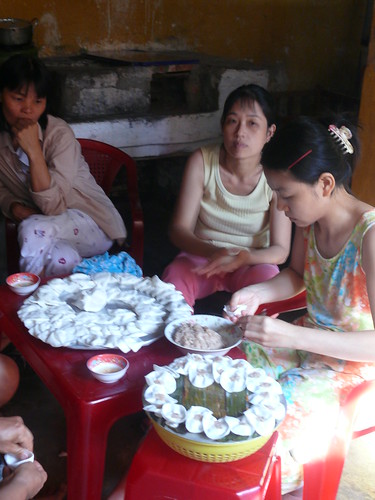
I watched cooking shows with my folks, stood at Mum's elbow watching her work her alchemy and observed my 'aunties', the women who fostered me when Mum was too ill to cope. When the Asian aunties got together to make dumplings I was in the thick of it. Whenever we ate out, I quizzed mum on the techniques.


When I first started cooking, Mum remarked that I would add about half of the seasonings in the pantry to my meals. My dishes were complicated and fanciful. The exuberance for heavily flavoured dishes gradually dissipated. My folks had always bought good quality produce and many things were made from scratch when I was small. Good cooking in their fabulous kitchen was easy and I discovered there was no need to overcomplicate the flavours.


When I moved out of home it was to a significantly more modest abode. My kitchen didn't even have a workspace. But I loved cooking. The nature of the tiny cooking space meant that I had to buy fresh practically daily. But when I moved to a slightly larger kitchen, with a pantry almost as big as the kitchen I began a love affair with the supermarket.


My friends would pile over to my place to eat my food and watch my TV. I loved it. There would be bodies slumped all over the lounge room floor, waiting expectantly to be fed. I hated the trash telly shows they watched, but I loved catering for others.


When I look back at that time I realize that I once again became heavy handed with seasonings. My pantry was filled with cans, packets and jars from all over the world. Rubs, oils, pastes and seasonings, cans of exotic ingredients and gourmet items purchased with the sole intention of punching flavor back into the tasteless 'fresh' produce I purchased at the local supermarket. At the time, cooking for me was all about putting flavor into meat and vegetables


Then one day I stopped in at the local greengrocer. The gentleman who ran the business turned out to, like me, be Eurasian, only he was half West Indian. His Chinese Aunt Rosie worked in the shop with him. As we swapped anecdotes, Auntie Rosie sidled up to me with a piece of orange. "Eat this now." She demanded. "It's local. You won't have eaten anything like it; so sweet" she clattered with a strong Hong Kong accent. As a respectful Oriental, I did as I was told.


She was right. The orange was intense. I shut my eyes. It felt like my eyeballs had ricocheted off the top of my cranium and then bounced back into place. It became apparent that my taste buds had been dormant since I left home and that fruit and vegetables always tasted this intense in top class restaurants, but never in my own kitchen.


I imagined that this must be what it was like to eat something after being long deprived of food. Immediately, I stopped buying fresh fruit and vegetable from the supermarket and went back to the greengrocer or to the local fresh market instead.


It wasn't until I began shopping at farmers markets that I experienced the same wonderment with meat, cheese, milk and eggs. Yes, eggs. I really didn't care for eggs before then. Fresh, non-supermarket bought eggs taste so different and are a breeze to poach. The flavour of rare breed meats and heritage vegetables, freshly harvested, leave supermarket produce in their wake and as I proved to myself, require hardly any seasoning. They keep for weeks and make everyone look like a star in the kitchen.


My cooking is no longer about dialing up flavours, but rather showcasing what is already there. Now it feels like an insult to the integrity of the produce to go overboard with the preparation. Shamefully in my recent conceit I had forgotten the great privilege it is to dine on this wonderful food.


The provenance of fresh produce sourced farmer direct is the result of passion, care and hard work. It has integrity. It is not palm oil and chemical loaded convenience food. The fruit and vegetables are not tasteless and genetically modified to withstand long freight trips, where they are jolted and knocked about. And they have not been bred to be picked green and warehoused for months before hitting the shelves after artificial ripening. The meat has been slow raised in happy conditions for flavor and butchered with respect. In order for the supermarket produce to turn over quickly and at the cheap prices demanded for their large profit margins, the meat has been raised to grow fast, have volume, but not density which affects the taste.


Looking at back at the recent boom era of consumerism, I see how I became greedy. How blasé I had become when others in the world were suffering from a global food crisis, while others faced war in their backyards. I lost sight of what is important and fell into the trap of expecting the next culinary thrill with the ability to show off here on the blog and on Twitter. What a pretentious twat!


To think that I was sick of eating my own cooking was pathetic. No, it was disgusting. With an embarrassment of riches at my fingertips I ought to have been joyous. But no, I behaved like a gluttonous brat. I had become the culinary embodiment of the consumer durable obsessed Paris Hilton. And I am thoroughly, cringingly, ashamed of myself.