Showing posts with label Asian Recipes. Show all posts

29 September 2008

Pick Mee. Hokkien Mee.


Dear Diary
, it is day five of our holiday and Stickyfingers is still dropping food into her cleavage.


Mr Stickyfingers' Malaysian Holiday Diary, May 08


Hawker food. It excites me. Towards my middle age, sex is sadly becoming a distant dream, but the thought of hunkering down beside a cart to eat a simply prepared dish - that's native to an Asian culture - makes me positively rapturous.


Prolonged rhapsodising causes dribbling. Waiting for my order starts me trembling. And then on its arrival I bend
in low over my dish, cup, bowl, plastic bag or paper and inhale deeply and rhythmically.


The first attempts to eat or drink are ham-fisted efforts just to get the comestible to my mouth. You see I tremble quite violently with excitement.
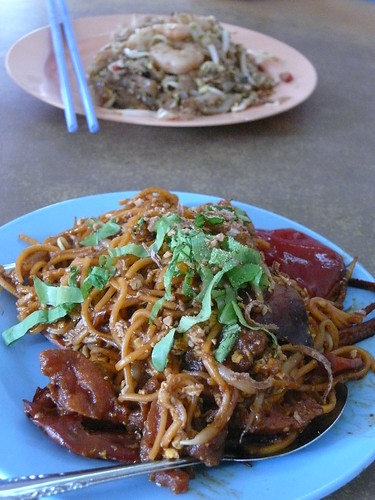
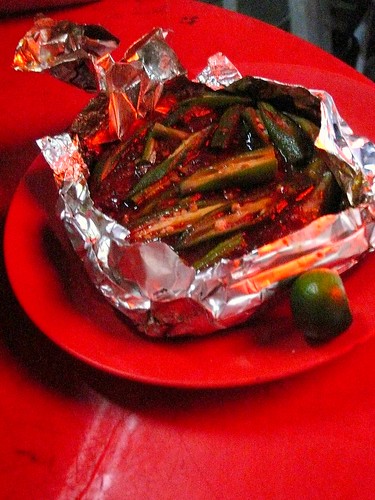


Quivering in my anticipation I botch any attempt at hand-mouth co-ordination. Plop! Food and drink hit my ample bosom, to grace me with yet another stain with which to match the faded one that I may have garnered earlier. In May I was so bad, I began to wonder if I should ask Mr Stickfingers to feed me my initial intake, before handing over the item as though to a small child?


Malaysian Hawker Food is definately at the top of my hawker food experiences. The range is enormous, never ending, and somehow the locals manage to graze all day on it without gaining weight. I want their metabolisms and bottomless pits of bellies, their ability to eat palm oil fried everything and coconut flavoured foods without having cholesterol issues and I want a gut and mouth that can withstand a lick of Hades infused chilli.
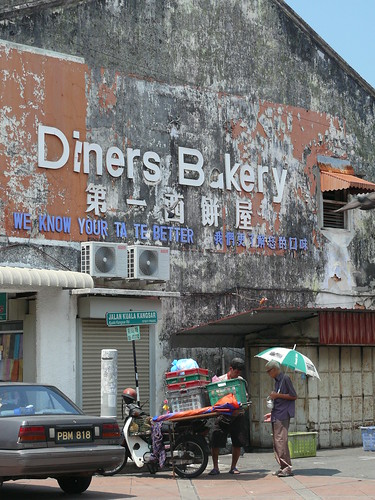


In Malaysia we eschewed restaurants in favour of hawker food. The lure of restaurants paled into insignificance beside dishes we could never eat back home. In fact, eating in restaurants felt oddly ostentatious there and removed from local culture. So to food courts and hawker centres we went.


Dripping with sweat by roadsides we slurped slippery noodles while hunkered on low plastic stools. We ate samosas at a cart outside a wet market, Kerupok from a cart on a beach, hot biscuits from the back of van parked outside a hotel, chestnuts from the back of a bike and heavenly barbecued chicken in an abandoned carpark late at night. Smoke billowing down a street led us to the best satay EVER and to Onion Roti Paratha, a firey Nonya fish made with sting ray and to claypot sausage rice.
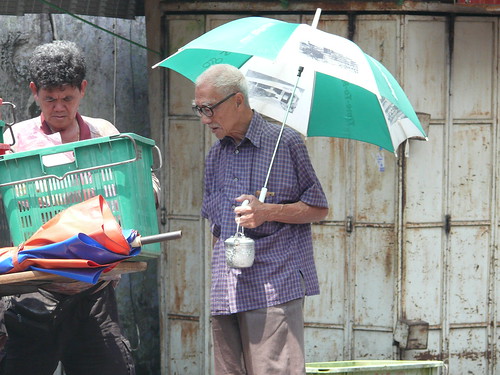


In Penang our appropriately named new friend, Chew Fa Ming, led us through a merry dance of delectable hawker treats, and frankly why wouldn't you? He seemed to know so many of the hawkers personally, selecting wonderful dishes for us,
and introducing us to fruit we had not seen before in our travels. What a Godsend! We were in heaven. Days later we were tramping around the back streets for wonderful Hainan Chicken Rice, Char Kway Teow, Mee Goreng, Dosai, Banana Naan, various Kuih and Murtabak.


Back at home I also cook Malaysian
hawker
food. You've seen my Satay, Rendang, Char kway Kak and Mee Goreng recipes, and although delicious, they will never match the flavour of charcoal cooked food or the taste of the char of a well seasoned wok, searing over jet blastingly ferocious heat.
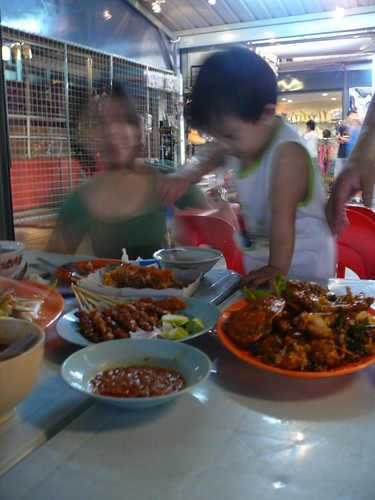


One of the reasons I love to cook hawker dishes is that it is quicker to pull together than many Western foods on a work night and because it is quick and intense, it can be quite healthy if you avoid their chosen fats palm oil and lard. Naturally the flavour suffers a little without the appropriate fats, but I do try to be healthy at home. Thankfully in Australia most of the produce is locally grown too, and it's easy to get Asian groceries in the urban sprawl.
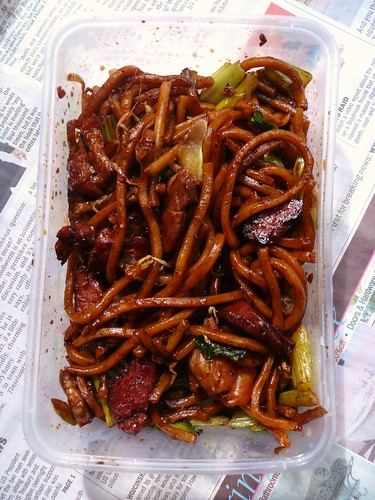


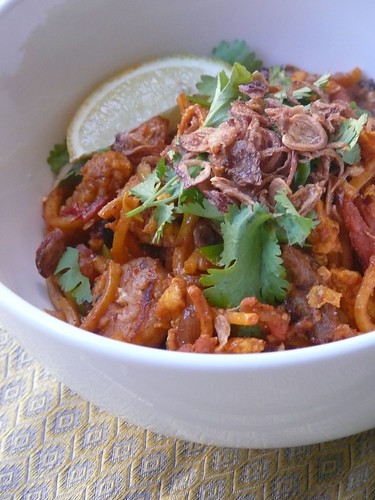
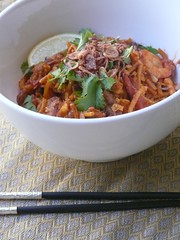
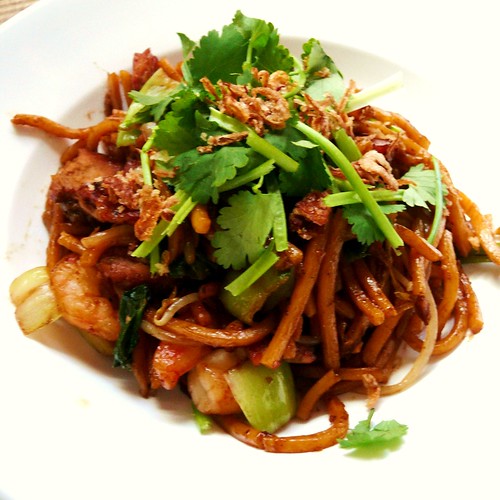
And then, there are the great leftovers. Here's my lunch - leftover Hokkien Mee. Basically the same ingredients as Mee Goreng, but substituting a dark soy based sauce for the potato and tomato curry sauce.


I love it when I open up a take away container of hawker noodles at an office and sniffing with enthusiasm, colleagues ask me where I bought my lunch? Once, a vegetarian was so enticed, as to prevail upon me for a taste of my Char Kway Teow, and loved it. But then gutted, acted as though I'd poisoned him when he found out it contained meat. He didn't tell me he was a vegetarian and you could plainly see it contained meat.
Go figure?


In the not too distant future I will again be packing the baby wipes to remove stains from t.shirts worn while eating more hawker food. This time we will be heading back to Vietnam and Thailand, with a side trip to Laos for a spot of Flashpacking. That's moderately more comfortable backpacking for old farts who love an adventure on a budget.


Mr Stickyfingers will most probably spend his birthday basking on a white sandy beach eating food on a stick,
cooked on a portable brazier
by a hawker. Can't wait.


Hokkien Mee


500g
/1 packet fresh Hokkien noodles
1 tablespoon oil
1 large clove garlic,
minced
150g sliced chicken breast
150g fresh prawns, peeled & deveined
150g squid, cut into bite sized pieces and scored

2 cups sliced bok choy or mustard greens
1 cup bean shoots
Sambal Oelek or Sriracha (chilli sauce)


Optional
fried tofu, sliced
Cha Sui cubes (BBQ Pork)
Chinese Sausage slices (roasted or wind dried)
Oriental Fish Cake, sliced

Garlic shoots, chopped into 15mm lengths


Sauce
2 & half tablespoons black soy sauce or Ketchup Manis
1
tablespoon light soy sauce
1 tablespoon Oyster sauce
2 teaspoons sugar
salt and pepper to taste
2 teaspoons cornflour
1 cup water

Serve with lime, extra chilli and Sambal Belanchan


Mix all sauce ingredients in a bowl and set aside.

Warm oil in a hot pan/wok and brown the chicken, add garlic, squid and prawns. Fry until golden, also aiming to char them a little. Add any of the optional items and heat through.

Throw in the noodles and fry until warmed through.

Heat the sauce briefly in the microwave until just warm, then stir into the noodles, distributing evenly.

Throw in the greens and bean shoots and add a couple of teaspoons of water if the sauce has been totally absorbed by the noodles. Cook until the vegetables are softened and bright green. Extra Ketchup Manis may be added to taste at this point, along with the chilli sauce or extra pepper. Sichuan pepper is excellent in this dish if you have it.

Serve garnished with coriander, lime and fried shallots. Place a bowl of Sambal Belanchan and chilli alongside the dish for extra seasoning.



27 June 2008

Rendang Daging


...in a cookery book about Indonesia’s regional foods published in 1967 by the then agriculture ministry titled Mustikarasa, rendang is a method of preparation in which the ingredients are cooked without any oil. So when the young man gets homesick he would eat some rendang and offer it to his new friends, popularizing the dish among non-West Sumatran people...
PLANET MOLE


I was recently asked
"Which spice paste should I buy to make Beef Rendang?".


I scoured the filing cabinet of culinaria lodged in the dark recesses of my brain's pantry. A drawer popped out and the file slid open to Ayam Brand and Asian Home Gourmet. But my conscience swaggered in and patronisingly said "Why use a packet when it is so easy to cook?". For a heartbeat I paused, then pushed my conscience behind a pile of eco-bags, bit my tongue and suggested Ayam brand.


The next day while looking at an immaculately marbled tray of beef ribs from Mt Bellevue, my conscience sang in full cry: "Rahn-dung, ramma-lama-rendang!". But this time I did not demur. Obligingly I fished out my mortar and pestle, fresh Asian aromatics and dispatched Mr Stickyfingers to procure a Kaffir lime leaf from the garden. Out too came the pressure cooker, because I didn't have the luxury of time.


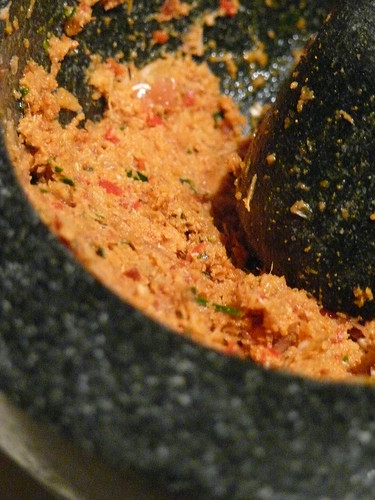
The rempah - spice paste - came together quickly in the stone mortar and pestle and the smell was so heavenly that I carried it over to Mr S for a sniff. The beef ribs were cleaved into bite sized chunks and browned in the new Scanpan. I was still gloating over the fact that I had saved $230 on that purchase and everything was now being cooked in it from Char Kway Teow to Pine Forest Mushrooms.


The browned meat went into the pressure cooker and after heating the rempah, that too went in along with coconut milk. Then I left the pressure cooker to do its magic.
In twenty minutes it was ready, a moist, melt in the mouth consistency and all the sauce was almost dry and coating the meat. Fabulous.


In went a cup of dessicated coconut, which soaked up the oil from the meat and thickened any viscous dregs of curry.
I plated it up beside roti and sambal kangkung. We ate. The rendang was succulent and so aromatic, with a sure fire kick of heat from the chilli. Better than any packet sauce, the flavours were clear and intense, with significantly less oil in the mix. The leftovers were even better a couple of days later.


My inner voice was right. I can understand why West Sumatrans ate it when homesick. Like a stirring memory of a beloved, it tickles the conscience and fills your senses with such utter delight that you just have to share it.


Rendang, although common in Malaysia and popular in Singapore, is an Indonesian dish from Padang in West Sumatra. It was originally brought to Malaysia by the Minankabau who migrated there to build a new life.

A matriarchal people numbering about four million, they are said to be the largest ethnic group in Indonesia. Eschewing male dominance and competition, their ethic promotes cooperation. One of their many maxims goes thus:


'One must nurture growth in humans, animals, and plants so that society will be strong.'

Here-here! What better than to nurture with spicy rendang?


MY RECIPE
Beef Rendang


(Chicken and goat meat work equally well in this dish)

Rempah:
5mm Turmeric root - grated
2cm Lemongrass stalk - chiffonade

2cm Ginger root - grated

2cm Galangal root - grated

2 medium sized cloves garlic

2 nasty little
fiery hot chillies
2 medium sized shallots

1 Kaffir Lime leaf - chiffonade
1 large pinch of salt flakes
Juice of 1 lime and pulp


500g beef - cut into bite sized chunks (topside/chuck/ribs/gravy beef
)
250ml coconut cream

1 cup of toasted dessicated coconut


Grind all aromatics in a mortar and pestle or blender with the salt until a paste is made. If using a blender you may need to add a splash of coconut milk to assist the forming of the paste. Heat paste in frypan until fragrant and place in a pressure cooker.


Brown meat the a frypan and drain off any fat. Place in pressure cooker with the rempah. Over low heat mix the two and add coconut milk, stirring until thoroughly incorporated. Seal pot and cook under pressure for about 20minutes.


Release pressure and check the meat. It should be falling off the bone and the sauce should be reasonably dry. If necessary add a splash more coconut milk or water to loosen the mixture. Stir in toasted dessicated coconut and serve with roti or coconut rice.


12 February 2008

Lunar New Year at Jade Kingdom


The Chinese New Year is celebrated on the first day of the First Moon of the lunar calendar. The corresponding date in the solar calendar varies from as early as January 21st to as late as February 19th. Chinese New Year traditionally signifies turning over a new leaf. To celebrate getting through the past year, to then put the past behind you as look optimistically into the future.

Socially, it is a time for family reunions, and for visiting friends and relatives. This holiday, more than any other Chinese holiday, stresses the importance of family ties. The Chinese New Year's Eve dinner gathering is the most important family occasion of the year. In the days to come the new year is ushered in with a succession of family feasts and the gathering of friends.


I am the first to admit that the Hong Kong Chinese side of my family is eccentric. Lunar New Year is our big annual celebration which usually nullifies Christmas and Birthdays, but this year it passed as more of a whimper. We did not hook up with my parents until the fifth day of the year of The Rat as they were busy with friends. And Dad decided when we did celebrate, we'd be eating Malaysian food. Here goes nothing, I thought.

But I was wrong.

My parents are mad keen Tai Chi enthusiasts and Dad is rapidly becoming a born again Buddhist - go figure? After many years of practice, my Grandfather had reached such a high level of Tai Chi expertise that he could apparently bring on a self induced coma when he was unwell, in order to recover. I suspect my father is aiming to tread the same path and is seeking Buddhist enlightenment. So he has immersed himself in the culture with a group of like minded retirees.

Enter into the picture a Buddhist who according to his friends is quite enlightened, and who magnificently toppled a battle with cancer. This man also happens to be a gifted Baba - Malay Chinese - Chef hailing from Kuala Lumpur. His name is Bill and he met my parents at their Tai Chi group.

So last night, Mr Stickyfingers and I beat a path to the unknown reaches of Heidelberg Heights - getting a little lost enroute - to Bill's unpretentious little venue. Had we not stopped at the traffic lights outside, we would have missed the place entirely. As it happened I noticed another Malaysian restaurant next door that had a roller door firmly shut over the facade and instantly presumed the owners must have gone back to the old country for a holiday. And then my eyes moved across to Jade Kingdom. Bingo!

We were greeted by my parents inside with cries of "Kung Hei Fat Choy!" and were introduced to Bill, the owner and occasional Chef of Jade Kingdom. Resplendent in a blue Batik shirt, he was fit and tanned. This is not the first of his ventures, my parents recall that they were also regulars at his place in Springvale Road, Glen Waverley, years before they met him.

In a sea of wood grain veneer, Melamine and vinyl, a Chinese Dragon puppet sat decorously in a corner. Gaudy modern Chinese
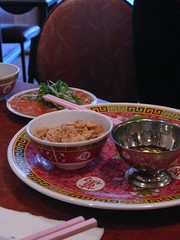
paper decorations were festively suspended from the ceiling. At our table my folks were snacking on achar - spicy pickled vegetables and candied walnuts. It was a good start. Both dishes had the required amount of crunch.


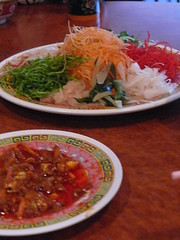
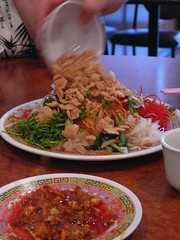
Next came Yu Sang also known in Mandarin as Yee Sheng. The name is a Homonym for the Chinese words for good luck and it is a sweet, sour, raw fish salad made up of many elements including daikon, shredded raw yam died to be colourful, carrot, pickled ginger and shallot, coriander, sesame, crispy flat noodles, pomelo, peanuts and sashimi grade salmon. I think this one also featured jellyfish. (If you want to make it yourself here's a recipe)

Now the popularity of this dish hails from its presentation as Lucky Raw Fish Salad
in 1963, in a restaurant in Singapore. It is said to have principally originated in Guangzhou, Southern China - aka the rice bowl of China - where raw fish salads were regularly made with fresh water fish such as carp. Although the fashion for the serving of the dish quickly migrated to Malaysia as a feature of New Years celebrations, it never made it to Hong Kong, where the locals considered that the waters were not clean enough to risk eating raw carp.

It is the tradition that the elements that make up the dish be piled up at the table with certain sayings pronounced at each stage. Then all at the table must dip in with their chopsticks to toss it together. It is said to be throwing luck up into the air, which is considered good fortune. It's a bit of contemporary hocus pocus, but there is obviously comfort in certain rituals. I just couldn't wait to dive in and eat it.

The flavours and textures of this dish present as a mouthful of fine citrus sweet and tangy string with the soft sliver of salmon wrapping itself around the palate while nuts and noodle chips provide crunch. It's very satisfying, especially with the slight heat you get from the sticky pickled ginger and shallots.


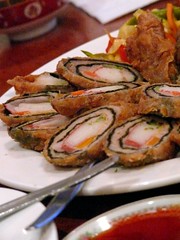
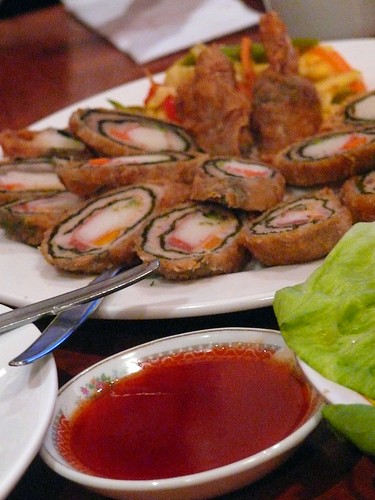
The next jaw dropping dish was a Fu Pei Goon. Fu Pei is a sheet of tofu which is skimmed off the top of a vat of beancurd and left to dry. Goon means roll, as in Spring Roll (Chun goon). The Fu Pei had been wrapped around fish paste and seaweed and carrot, then deep fried. Sliced on the diagonal, it was served with more pickles and a sweet dipping sauce.

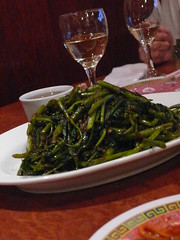
The comfort factor was provided by a huge mound of Sambal Balanchan KangKung. Kang Kung is the Water Convulvulous plant with long leaves and a hollow stem. In this dish it is tossed at high heat in a blend of garlic, dried, fermented shrimp paste and chilli. It is said that a good Malaysian restaurant can be judged by the quality of their Balanchan. This was certainly a ripper!

For me the dish of the night was the Nonya Fish. On the plate, all I could see was lettuce, decorative spring onion shreds and coriander supporting a yellow sauce flecked with red chilli. And then I noticed a fin. A succulent whole fish was buried in this thick, rich tamarind based sauce, made fiery with the chilli. The nose dripping factor was high as we broke into a sweat and chugged down mouthful after mouthful of this slippery sour hot concoction.

As I nursed a bulging stomach, more Tai Chi friends arrived and lurid pink coconut and lychee jellies were served. Dad was spoilt however, with a single serve of cold, sweet snow ear fungus soup with lotus seeds. I slurped the cool jelly happily and wondered whether I would ever eat again after feeling so magnificently full.


Jade Kingdom 233 Waiora Road, Heidelberg Heights, Victoria.
Ph. 03
9458 3188


13 January 2008

You Tarzan. Mee Goreng.


“A hippie is someone who looks like Tarzan, walks like Jane, and smells like Cheetah”
Ronald Reagan 1911-2004, 40th US President 1981- 89


Tarzan: [inside the smoke-filled Club Moonbeam in New York]
Smell like a Swahili swamp. Why people stay?

Jane: It's what they call having a good time.
Tarzan's New York Adventure, 1942


Melbourne,
1981. I was feeling a little lost in the world as my emotions spun around family dilemmas and the necessity of swallowing my feelings in order for the world to seem brighter. I reconciled myself to the pretence that on the surface of things, all would appear normal and undisturbed. Lost in thought I sat at a Laminex table in the midst of the clatter and bustle of Penang Coffee House in Hawthorn. The smells were peculiar to me and the people in the room noisy and exuberant.


Danny Ko tossed his woks with vigour - and no fear of getting tennis elbow - while sternly surveying the dining room, lit brightly and highlighted by the glow of neons. If a patron stayed too long after eating, Danny would glower at them until they jumped up to pay the bill. The table would be turned immediately to people waiting patiently outside on the street.


It was here, in the care of my Uncle Alan - a Hong Kong Chinese - and his
Singaporean wife Kitty, that I ate my first Mee Goreng. It was a complex seduction that has had me search time and time again for the holy grail of perfection. I now happily make a faithful version of Danny Ko's Mee Goreng and have visited him occasionally at his current venture Nudel & Wraps for a soul defining fix.


This is a dish of multiple textures and contrasting flavours.
A thick spicy tomato sauce clings to thick chewy noodles. Within the mix are pieces of fried egg, and a slurry of chewy ingredients highlighted with lime and finished with a crisp chiffonade of iceberg lettuce, garnished with coriander and fried shallots. The flavours are rich and tangy, your nostrils will tingle with the smell.


Mee Goreng in my opinion is the dish which most epitomises the Malaysian cultural fusion of races. It is a dish commonly served there by street hawkers from glass fronted carts. Although the fundamental flavour is always the same, the ingredients vary depending on the location and religious mores of the diner. Mee Goreng is a spicy Nonya dish and literally means fried noodle.


In Malaysia, Nonya's & BaBa's were the women and men of Peranakan families. The Peranakan were men of Chinese descent, most notably Fukien from Fujian who came to Malaysia as Seamen, Merchants and Labourers. They married local Malay ladies and immersed themselves in local life. Nonya food fuses the two cultures in a most delicious way.


Mee Goreng takes that heritage and folds in the other major cultural influence in Malaysia - Indian. The spice mix that defines this dish is pure Indian masala. The noodles are Chinese Hokkien style - thick, round egg noodles which soak up the sauce - also Chinese are the bean shoots and sliced fried beancurd (tofu). The spice mix, lime, tomato, potato and chilli reflect the trade routes of the Merchants who settled in Malaysia.


In parts of Malaysia Mee Goreng is served Halal as per the Muslim Indian tradition, where no pork is included, but for me, the best tasting ones always seem to contain lumps of deep fried pork fat and fried Lup Cheong (Chinese Wind Dried Sausage). Cooking in lard makes a difference too.


Fujian cooking incorporates seafood, so into the mix goes squid and prawns. Also native to Fujian cookery is a slight sweet and sour flavour, but not to the effect of the Thai or Cantonese clear sweet pineapple or palm and rock sugar based sauces, this is more of a tang and a sizzle.
Into the mix there can also go chicken and some people like to add Cha Sui (Chinese BBQ'd shoulder pork).


You start with the Masala, mixing a paste of chilli, a little tamarind and Indian garam (spice blend) in the wok at high heat, sometimes I add a touch of Belanchan too. Then comes the chicken, sausage and seafood. Then the bean shoots and the noodles. At this point some people add ketchup manis (Kecap Manis) and tomato sauce (Ketchup), I don't, but I throw in the tofu and sometimes, cooked cubes of potato.


Eggs are beaten, then you push the other ingredients in the wok to one side and briefly cook the eggs on their own before stirring through. Then I toss in coarsely chopped tomato and cook the whole lot down with little water. If it's not spicy enough I may add a glug of the lurid red ABC brand tomato chilli sauce that is popular in Malaysia, Vietnam and Indonesia.


You then plate it up. I top with coriander and
crisp deep fried shallots, but put the lettuce and extra lime wedges to one side so that they can be added at the diner's discretion. The pieces of lime are squeezed over the dish to enliven the flavour and heighten the tanginess. Then I pretend I'm Danny and yell at my guests - not!


It's something I just can't get enough of, and has got easier because if you can't be fussed making the spice mix - or haven't the room to store all those spices - Asian Home Gourmet makes an excellent blend in a sachet for the cheat's version that'll evoke the smell of the street on a hot night in Gurney Drive, Penang; tropical dining heaven.


With a waft of the dish I can hear my Uncle Alan's voice again, breaking my reverie, shouting above the raucous restaurant patrons "Me Tarzan, you Goreng" and my own voice responding "You Tarzan. Mee Goreng!".


Nudel & Wraps, 264 Blackburn Rd, Syndal, Victoria (no bookings)

Penang Coffee House, 395 Burwood Rd, Hawthorn, Victoria,
ph. +613 9819 2092


05 January 2008

Too hot to cook


As I looked across the river the sweat dribbled down the back of my neck. My face was red and blotchy with discomfort, my fingers swollen. Local women were dressed in long sleeves and trousers, socks, gloves and face masks under conical hats to prevent tanning. I felt hotter just looking at them.


The cold local draught beer offered temporary respite from the 80% humidity, 38degree C heat. While we waited for our White Rose dumplings and banana leaf grilled fish, I felt lucky. At least I was I was here, finally in Vietnam, the resting place of two of my great grandparents.


Last year in Hong Kong my paternal grandmother died aged 90. She had been born in China before the revolution and grew up in Vietnam, again before the revolution. As a teenager, after her mother died and her father remarried she was sent to live with her Aunts in Hong Kong in order to find a husband. She was one of the few lucky ones who escaped the deprivation, re-education and the horrors witnessed by family in both countries.


I was very close to my grandmother. She raised me as a baby - and later intermittently - as a child, in an intimate way that she had not had the chance to experience with her own children.


An elegant woman with a strong sense of style, manners and etiquette, she had a stare that could stop you dead in your tracks. The stories she told of her life were lush and exciting stories of a privilege in a wealthy Hong Kong Chinese family, under the care of the family patriach, my paternal Great Grandfather's older brother. Here they lived in a family community where her father in law, his wife and eight concubines, and the huge extended family resided on an enormous property and compound - with a swimming pool so large they used a row boat to get across it.


It was a life of indulgence where parties lasted for days and featured performances and fireworks. Where she had tailors and jewellers come to the house to service her needs and had her own particular perfume blended. When a new outfit was completed, she would go to a photographic studio and pose for a full length portrait in the ensemble.


She had five children and three nannies were employed to care for them. The household had numerous servants across three houses, one in Tai Po and one each on Hong Kong Island and Macau. When they took the yacht out a whole retinue of staff would accompany them and set up a picnic on shore wherever they dropped anchor.


She only ever once spoke to me of Vietnam and that was to say that she lived in a traditional Chinese house with a central courtyard, in an area surrounded by ethnic Chinese, where even the servants spoke Cantonese. Consequently she never learnt to speak Vietnamese.


Although I was hungry for information about her childhood, her memories were too painful to share. She had fought so hard with her father after my great grandmother's death, that she had never spoken to him again, and simply immersed herself in a new family with a husband who doted on her, erasing her years in Vietnam. I know she regretted her stubborness and it was that which later made her afraid of death and what may come in the after-life.


My grandmother was - in spite of having cooks and maids - a very good cook in her own right and directed the servants accordingly. Outside of the family, aside from in good restaurants, the Chinese food was never quite as good.


It hadn't occurred to me until last year that this was the one link to Vietnam that manifested physically in her. My grandfather laughingly had said the difference in her cooking was that she was partial to fish sauce. Because it's used in Cantonese cooking, it did not occur to me until later that he was inferring that this was a particularly Vietnamese affectation. She also refused to eat anything that she considered ugly - such as snake - in Chinese society this was considered very eccentric.


She kindly taught my western mother, who hung out in the kitchen with aunties and my grandmother's house keeper, and who went to the stinking wet markets in Hong Kong with them, gradually taking on the language and cooking skills.


Years later, it was acknowledged by Chinese family friends that Mum, although white, was the superior cook amongst their social circle and consequently she felt confident enough to set up a Chinese Cooking school. I too soaked up the techniques and recipes unconsciously, so much so that I consider Chinese cooking almost too easy and simple to serve to friends.


I had always had a compulsion to visit Vietnam. Two months after my Grandmother died I visited for the first time and felt instantly at home. These were more my kind of people than most of the 'fast lane' Hong Kong types that I had lived and worked with.


The Vietnamese I met had the same old Chinese Buddhist values loaded with Confucian philosophy and rituals of filial piety, that have shaped my nature. Their outlook was resilient, tenacious, cheeky and optimistic like my own. Their generosity under the circumstances was overwhelming.


The food in Vietnam was delightful and very much to my palate. In the moment that I learnt the difference between Vietnamese fish sauce and the pungent dark Thai version, I began to unravel the rationale behind my grandmother's fragrant cooking.


As I ate my way around the country learning as much as I could about the history, food and culture, I visited temples to pray for she and her mother. I felt it was my duty to make peace with the ancestors on her behalf.


Gradually the all encompassing grief which had paralysed my sense of hope and direction after losing her, slipped quietly away as a new understanding emerged.
I felt like a hitherto unknown part of my psyche had hatched in Vietnam and new doors in my mind began to open. Even in death my Grandmother had found a way to broaden my horizons.


Occasionally when I was twelve, my grandmother would give me Banh Cuon for breakfast - when my Grandfather wasn't pushing thick, sweet toast with tinned meat or pate on me. Banh Cuon is similar to Cheung Fun served at Yum Cha, and although I hadn't seen it outside of the home, I had not realised that it is a Vietnamese dish until I saw it in a Vietnamese Grocery shop.


Essentially it is a steamed rice flour pancake which is rolled up with minced pork and shitake mushrooms. Alternatively a topping of reconstituted dried shrimp and pork floss can be used for a simpler dish.


In the south of Vietnam it is served with all the herbs they garnish many dishes with, but in the North where it originates, I believe the accompaniment is cucumber, bean shoots, the ubiquitous meat loaf that resembles Mortadella and Nuoc Mam sauce.


On our increasingly hot days when I can't be bothered heating up the house, I like to eat Banh Cuon in a hybrid Cantonese way with red roasted meats.


I just go down to 'Little Saigon' in Victoria Street, Richmond, where I procure Cantonese roasted meats - duck, Cha Sui (red roasted shoulder pork) and Sui Cheung (A thick, long coil of sausage made with the same red marinade). I can make all these things well, but am lazy and time poor. If I can't be bothered making the pancake I buy freshly made ones, from my favourite Vietnamese Grocer Huy Huy, which are plain and simply garnished with some ground dried shrimp.


What goes with the rolls is dependent on my mood. Sometimes I chop a
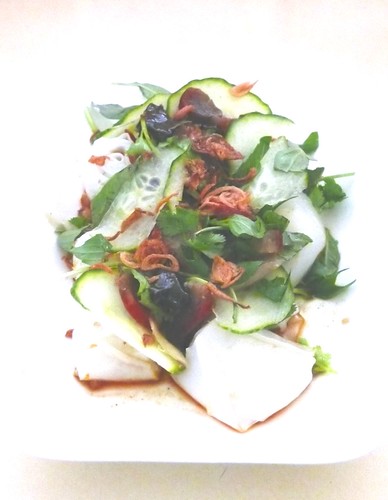
selection of whatever roast meat I fancy, lay them on the pancake and roll it up and steam them. If I'm lazy I top a u-shaped pre-made roll and nuke it briefly. Once hot I add some finely julienned young ginger, finely sliced spring onion, torn coriander and Thai basil. If I have duck in the mix I'll add shavings of cucumber and a few dots of Hoi Sin sauce and dress with warm Lao Sei mix (the dark soy based sauce that comes with the roast meat) heated with a couple of drops of Canola oil, or I'll dress it with Nuoc Cham.


The slippery texture of the rice pancake is infused around the edges with the warm dressing and is a geat vehicle the richness of the meat. The herbs offset the richness and for a bit of crunch I throw on some fried shallots. Perfect for the kind of day when the sweat is beading on the brow, served with a chilled Aloe Vera drink.


Banh Cuon
Fresh Rice Paper Pancakes

1 cup of Jasmine rice (rice flour will not work)
Pinch of salt
2 cups water
1 extra long bamboo cooking chopstick or foot long skewer


Soak the rice overnight (7+hours). Wash the rice at least three times, thoroughly draining the water each time.

Mix 1 cup of rice to 2 cups of water, plus a pinch of salt. Place in a food processor until a smooth, thin white batter forms. Rest batter for one hour. It will keep for four days maximum in this form.

In a small stock pot, place 7cm of water and then stretch a piece of white cotton or double piece of muslin over the top of the pot, securing with elastic. Bring the water to a rolling boil.

Using one ladleful of the batter
, spread across the fabric into a disc shape, using the bottom of the utensil to spread it. Cover and steam for 1 minute.

Using the extra long chopstick, insert the length of it under the pancake and gently lift it up off the fabric and place wet side up on a plate. Add meat or shrimp fillings and roll up, bend into a u shape if it's too long for your plate. (Optional) Return rolls to steam for a minute before dressing.


This is also the wrapping for the very popular rice paper rolls. If you're making a heap that you would like to fill later, cut a small tab of banana leaf and attach one to each pancake. This will make it easier to separate them down the track when you're ready to use them.