Showing posts with label Sustainable dining. Show all posts

15 May 2011

Stanley deserves a laurel


Ollie: "Every cloud has a silver lining."
Stan: "That's right. Any bird can build a nest but it isn't everyone that can lay an egg."
Stan Laurel and Oliver Hardy console a devious Lola.


I love a road trip. They usually turn up something random or a spontaneous revelation. And then there are the locals who eye you with suspicion as they park a heaving plate of God-knows-what in front of you. Love it.

Some years ago I found that Mr Sticki's country raised nephews grew up refusing to eat vegetables. I was shocked. They grew up in a part of country Victoria known for fruit and vegetable production, so there were plenty of opportunities to get into good food.

Then, in their teens, they were employed by the local supermarket. In order to work on the coveted check outs they found themselves in need of being able to identify all manner of vegetables. But they were bereft of such knowledge.

And the reality is that this is not uncommon in Australian regional towns today. In our most bucolic settings, most kids are not rosy cheeked from the benefits of magnificent fresh local produce. They prefer the tinned, commercially packaged nastiness that appears in many regional pub bistros.


There's a pervading attitude in the country that any packaged or convenience food offering from the city is preferential to rural produce. And yet when we city folk spend a few hours in the car destined for a holiday or day trip, we conversely expect to be rolling in luscious local food wonders, fresh from the producers.

So when I think of casual eating in the countryside, I hope for local regional produce, artisan goods, friendly service and simple convivial surrounds.

But that's my own particular fantasy bush escape.

We found it exists in France, but rarely does a regional Australian venue deliver such things. I'm not talking about über fine dining and experimental dishes that borrow from molecular cuisine. I know those experiences exist at the far end of a four hour drive.

What I hope for seems to crop up more often in the city. In places like South Melbourne's The Rising Sun Hotel where Ron O'Bryan is working his magic with farmer direct produce. There are country exceptions of course. The Stanley Pub, just outside Beechworth, is one of them.


My interest in this little pub was piqued by Brewer's Wife's post on her dining experience there. She mentioned lunch at The Stanley Pub showing an image of a pie on a fashionably long plate alongside a stretched limousine smear of mashed potato. The pie humorously appeared to have pretentions to fine dining. But rather than laugh, her verdict was that it was delicious and the venue pleasing.

So on a visit to Beechworth we made a detour to the tiny, historic hotel and found it to be cutely crouching under pretty wisteria vines beside a generous beer garden, function space and accommodation. As we pulled up, two scruffy middle aged men were muttering darkly, smoking cigarettes on the doorstep. Not knowing what to make of that, I hoped for the best.

We entered a brightly lit front bar featuring some wonderful artisan joinery and a well used dart board. To the right, the softly lit bistro emerged as a converted outdoor space, equipped with a JetMaster fireplace and in one corner, a wood fired oven.


Traditional French bistro style bare tables and starched linen napkins were set for about thirty seats. We were the last to arrive of eleven diners there that night. Service was smoothly taken care of by the owner and pedigreed Sommelier, Shane Harris.

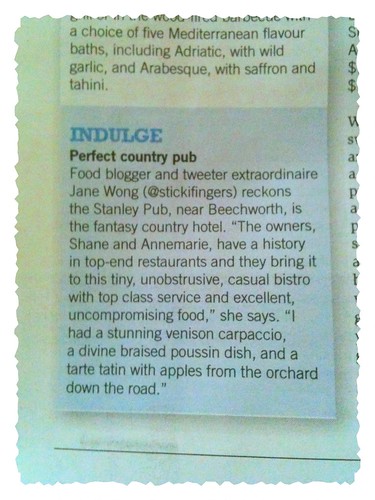
It later emerged that Shane, his wife Annemarie and chef Shauna Stockwell were veterans of Sydney high-end dining venues, with notches in their various hospitable belts that include Testsuya's, MG Garage and Pier, then later in this region north east Victorian area with Michael Ryan, pre Provenance, at Range.

As we settled in I breathed a deep sigh of relief. The menu selection was admirably small, concise and dotted with local produce; likewise, the wine list. Respect.

The dishes had classical leanings. I found it tough to make a decision on which to choose. An entree of rabbit and duck rillettes with peach chutney, beckoned. Oysters shucked to order with a Japanese dressing or zucchini flowers wistfully called to me.

Main courses featured the safe option of steak frites, but also skate, gnocchi and poussin. A side salad of figs, rocket, local walnuts and blue cheese sounded like an ideal lunch dish, the potatoes sounded heavenly too, but we chose the comforting seasonal vegetable dish of wilted spinach with kaiserfleisch.
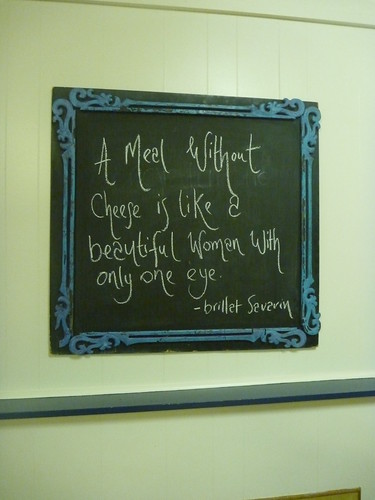


Four mains arrived at the table beside us. Two languished unattended, a large portion of poussin and the steak - two pieces topped with butter and a mound of green beans - classically served with obvious care.

A diner scuttled to the public bar beckoning to the two men who had been standing on the doorstep when we arrived. "You know your meals are here?" She said. Affirmative was the dismissive response. She returned to their table to eat.

After a time the men ambled into the bistro carrying the bowl of nuts they had been eating at the bar. "That looks a bit fancy", said one of the men with a heavy European accent.

"What gives?" Said Mr Sticki with a bemused smirk, "Looks as though those men have been dragged here against their will." They did indeed. And as soon as the mains were consumed, they returned to the bar with their bowl of nuts and fresh beers. The women continued on, shared a dessert and left without the men.

It was the sight of those main courses that made me realize three courses would be impossible for me to ingest. And I wanted the Tarte Tatin for dessert. So taking a mouthful of the delicious local Beechworth cider, I resolved to have two entrees and a glass of local Sangiovese


On the oval plate dotted with saucy whorls sat a snowy bavarois of local chevre that was earthy in flavour and silky in the mouth. The small mound of citrus and baby beets sat atop a disc of red jelly. The piquancy of that mound challenged the goaty creaminess and at times rendered it into a sheepish complement.
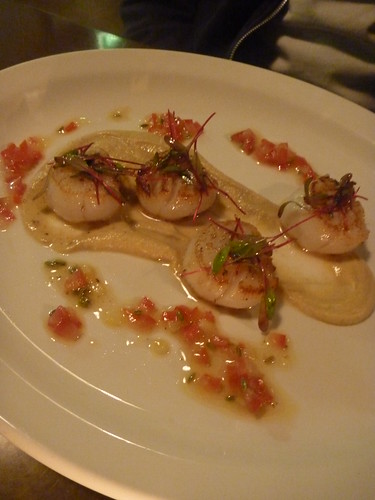


Mr Sticki's choice was a special of seared scallops. Cooked as they should be, still slightly translucent inside, four discs of roe-less scallop dressed in micro-herbs, squatted atop a bed of hoummus like four pretty girls on a picnic rug. A mirepoix of tomato with vaguely Middle Eastern flavours transformed the clean, sweetness of the scallops and rug of hummous into a flying carpet ride to another part of the world.


Next, my carpaccio of peppered venison was a floral textile. Like the circle skirt of a rockabilly sweetheart it was a sweep of burgundy checked with blue cheese cream and scattered with a web of petals. The skirt had a seared edge and a sticky mouth feel that launched a rich combination of tastes. Deeply satisfying and a good follow up to the bavarois the blue cheese brought an unexpectedly positive dimension to a flavor profile accented with sharp, hot pepper.

Three young women - local friends of Tim Witherow the Sous Chef - were being gently and capably guided through dining and wine choices by Shane. A big night out for a birthday, choices were made with careful consideration that they were about to embark on something truly special. I felt inspired by their anticipation and enthusiasm. Not a scrap of pretension entered their dialogue, such refreshing behaviour in the face of their city counterparts.
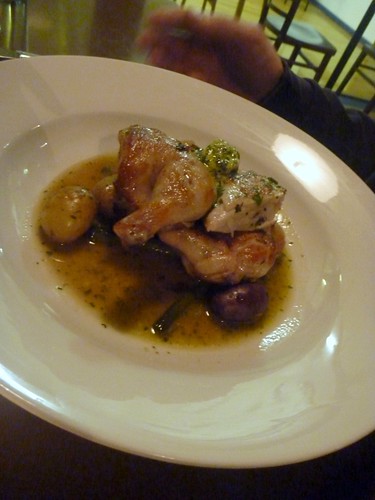


I gazed across the table at my beloved. Delicately chewing bones, Mr Sticki contemplated his serve of poussin with intensity. He seemed carried away by the moment. Golden pieces of bird lolled in the shallows of a thickened, clear braising liquor. A flotsam of herbs drifted from the sauce to embrace baby leeks, potatoes and shallots. It all looked so simple, but once I tried some for myself I too was plunged headlong into a pool of richness. This was a dish that stroked your hair and tucked you into bed with its nurturing gentleness.


After a rest, we moved on to dessert. Shane introduced us to a taste of the wonderful local biodynamic Pennyweight Gold. A lush sticky fortified of ripe white grapes, fortified with brandy spirit, and aged for several years in old oak hogs head barrels. It was created by one of the famous Rutherglen Morris clan, who have been producing excellent fortified wines for 150 years. Stephen Morris started Pennyweight Winery in 1982, producing biodynamic, lower alcohol wines in Beechworth and we stopped by the cellar door the following day.
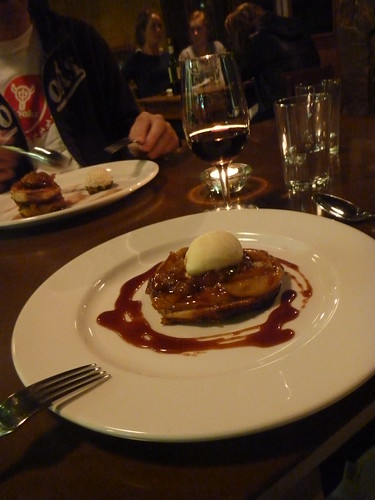


Shauna's tarte tatin was everything I had hoped for. Made with apples grown mere kilometers from the front door of the pub and plumbing the depth of buttery caramelisation I found it difficult to part with when the time came to swap with Mr Sticki. None the less, the pain perdu (French Toast) was also a marvel. Again featuring a local product – figs poached in muscat with fig ice cream.
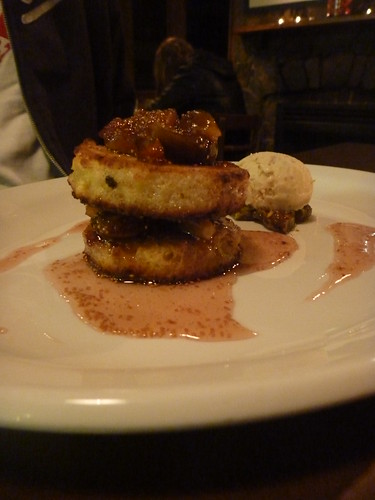


The night had me buzzing with the excitement of finding a country venue that lived up to my dream. As we drove down the pitch dark road to our Beechworth accommodation, I was gushing with admiration. I'm all for tree-changers following their passion in a rural setting. And I always hope that their efforts might trickle into the mind-set of the locals and the education of the palates of future generations. Here's to more of that in the future and to less frozen chicken parmigianas shipped from factories in the city to country pubs.


Myrtleford-Stanley Road, Stanley, Victoria, Australia
|  03 5728 6502  |  F: 03 5728 6602  |
 info@thestanley.com.au   |  Facebook  


By Dani Valent in The Sunday Age M magazine, 15 May 2011
The Stanley Pub on Urbanspoon
Enhanced by Zemanta

19 September 2009

Tasmania: The Red Velvet Lounge


The King will walk on Tupelo!

Tupelo-o-o! O Tupelo!

He carried the burden outa Tupelo!

Tupelo-o-o! Hey Tupelo!

You will reap just what you sow.


Tupelo Written by: Cave, Harvey, Adamson 1984


Slowly raising my sleep encrusted eyelids, I peered out across the doona. A smoky eyed youth dressed casually in torn stone washed jeans and a bared six pack stared back. His blonde frosted, spiky hair was nuzzled by a barefooted woman with a huge cork screw perm and they were draped decorously over an old Buick in a field: the ultimate ‘80s pin up couple in a black metal frame. Was I dreaming? Had I gone back in time?


No. It wasn’t 1984. It was 2009 and we were in a Southern Tasmanian B&B in The Huon’s beautiful Cygnet, fifty minutes drive south of Hobart. This is the town where my friend and chef, Steve Cumper has settled. Back in ‘84, Steve and I were probably rocking around the same Punk scene in St.Kilda, Pogo-ing on sticky carpet and watching a baby faced Nick Cave tear up the stage.


It was in this momentary time-warp however and later - standing in the ensuite’s marble patterned Formica time capsule of a shower cubicle – that I began to understand the mindset of the local customer who criticized Steve for daring to break from the formulaic pub approach to meals with his wonderful evening menu at The Red Velvet Lounge.


You see Cygnet is vaguely reminiscent of Victoria’s Daylesford in 1984. Early invaders - crusty folk singing, tea cozy wearing types - are gradually making way for a trickle of self funded retirees from the mainland settling into a tree-change, alongside a small gay community who’ve also recognized the town’s potential. But forming the core of the community are those born and raised in The Huon Valley, some perhaps frozen in another era - possibly also locked in a culinary limbo - and who I suspect may still be coming to grips with Steve’s efforts to create a contemporary menu supporting local and artisanal produce.


On the periphery of the community, former Chef and Sydney Morning Herald Restaurant Reviewer, Matthew Evans can be found acting out a Hugh Fearnley-Whittingstall scenario whilst being trailed by a film crew around his twee sounding property, Puggle Farm. In October, they will bring their footage of Cygnet to Australian TV viewers via SBS broadcasting.


In this picture, I imagine Steve Cumper to be Tasmania’s Alla Wolf Tasker - of Daylesford’s The Lake House - or an early version of Gourmet Traveller ‘National Treasure’ George Biron of Sunnybrae, tending his own farmlet and pushing the barrow of Sustainable, Organic, Local and Ethical (SOLE) food.


Back in '84 there was no way that I could afford to eat at a venue such as Alla’s or George’s. I couldn’t even afford the standard issue Punk studded leather motorcycle jacket. Steve couldn’t afford a car stereo so apparently had a cassette player taped to the dash of his old car.


In the eighties people my age who chose the ‘Alternative Lifestyle’ of local, biodynamic and artisanal food were presumed to be an unwashed hippie akin to Neil in The Young Ones, and not fit to dine in a fashionable restaurant. Now it’s all changed. Today SOLE food is becoming ‘de rigeur’ and Mr Sticky and I happily tucked into Steve’s special Friday evening meal at Red Velvet Lounge (RVL).


We came to RVL on what became our ‘Tasmania: Closed for the Weekend’ tour of the Apple Isle. Nearly everywhere we wanted to go was shut, in spite of advertising that they’d be open. Seems that those who could, had left Tassie for a break on the mainland. They must have flown out on one of those ridiculously cheap flights that had brought us there in the first place.


Consequently it was an unusually quiet night at RVL, with the subtle sounds of bossa nova from the stereo mingling with a few tables of polite chatter, until an aging folk music duo quietly settled on a couch in the corner of the room for guitar strumming, humming and harmonizing. There was a time where the folk music was the focus of this venue, not the food. But the balance has now changed. The diners we saw were indifferent to the music played at the front of the restaurant.


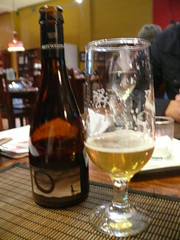
We found the service to be good at RVL. So often it is hard to manage this in regional venues, but I suspect that Steve’s nurturing nature knits this loyal group like a family. We began service with a couple of local beers, a Moo Brew from Moorilla and a ‘Cleansing Ale’ sighted on a chalkboard while considering the menu.


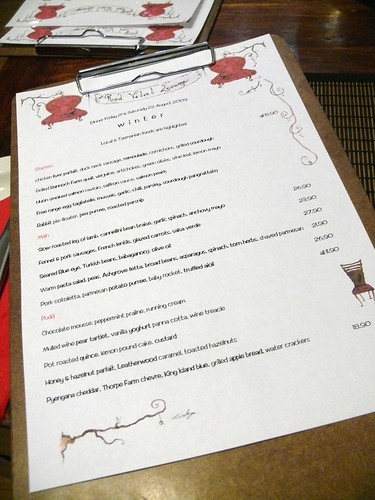
Although by day the Red Velvet Lounge is a small town café selling delicious wholesome daytime meals, suitable to vegan, vegetarian and omnivore alike, Friday and Saturday nights’ menu allows Steve to show off his prowess. Simple rustic sounding dishes - that won’t scare the natives - abound. But when you taste the food you realize that under the surface is a complex and imaginative array of meals that other chefs might be tempted to describe in four flowery lines of text. I love the restraint of description here. It allows you to discover the depths of Steve’s creativity orally with no major preconceptions to hinder the process.


Surveying the menu I wanted all the entrees on offer; we sampled three between us. I could not fault any of them. All wore a simple mantle that disguised the technical degree of difficulty combined with imagination that an experienced, meticulous chef can seemingly effortlessly pull off.


Between us we shared a rabbit pie floater with mushy peas and roasted parsnip which could have passed as a meal in-itself, as Steve doesn’t like to skimp on portions. There was no corner cutting here, a properly formed pie with lid sat picture perfect in the centre of the dish. Steve’s sour cream pastry was the perfect foil to the unctuous filling, offset beautifully by fluffy mushy peas and the sweetness of a roasted parsnip.


When it came time to swap plates, my nose was greeted by the wonderful aromas of the grilled Rannoch Farm quail. I lingered, inhaling it and then the saliva swarmed my palate until I just had to taste it. This was not a dish I anticipated in a regional restaurant but it was everything you would wish for – a fine mélange of fresh local flavours: delicate moist flesh with artichokes, punctuated with the tang and firmness of olives, then vine leaves and finally the verjuice, which made me think of Steve’s days with Maggie Beer in the Barossa.


Thirdly, we shared the duck neck sausage which was a thick, coarse, almost terrine like item, sliced and served with a wee jar of smooth, rich pâté, celeriac remoulade and some cornichons. The lot sat on a thin, long wooden board which was also graced by thick char-grilled slices of Steve’s famous bread, baked in the Restaurant’s original Scotch oven.


The pâté had Mr Sticky hooked, so silky and flavorsome was it. Perfectly rustic & slightly gamey, the total combination of textures and deep flavours in this entrée made it subtly sophisticated, and yet had me imagining that it would have been the ideal picnic dish for sitting by the water, watching the pod of whales that had recently graced the locals with a sighting.


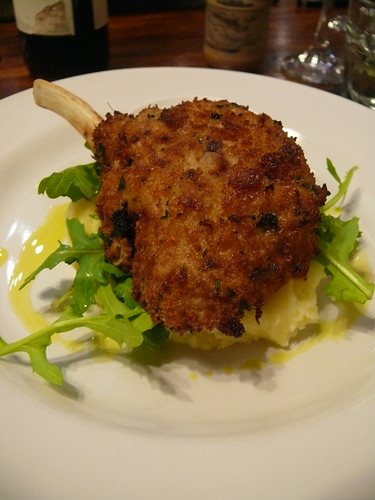
When the main courses arrived, I was feeling nearly full already. But we forged on. Before me sat an impressive thick cut, crumbed pork Cotoletta upon a mound of velvety parmesan enriched mashed potato. Greed took over. Slicing in, it was perfectly moist and satisfied my wicked desire for crunchy, crumbed and fried meat. Baby rocket rounded out the vegetable content and a wicked dish of aioli flecked with local truffles sat alongside, enriching the palate further.


It crossed my tongue with a sigh of satisfaction. Whilst the execution was technically perfect, what made this special was that the integrity of the high quality produce was not compromised or gussied up as to become pretentious. It was a homely Mittle European style dish and for those who might be wary of modern ways, did not make a song-and-dance about the skill required to produce and prepare it.


The slow roasted leg of lamb rendered Mr Sticky speechless with admiration. Slow cooked for five hours, then pressed and finished again in the oven, it was a melt in the mouth, rib-sticking piece of deliciousness. The seasoning added richness. The lamb lost none of the honesty of its flavor in the process and did not have the cloying fattiness that some lamb dishes suffer. With the Cassoulet like braise of Cannelini beans, spinach and another side - this time of anchovy mayonnaise - it was a hearty dish that I could see my beloved was almost loathe to part with as we swapped plates. In my opinion it was an exemplary dish, the likes of which one might have presumed ought to have earned RVL a place in the 09 Gourmet Traveller Food Guide had they tried it.


I was thankful that the restaurant was quiet that night, as it allowed Steve the chance to come out and chat. At this point, chatting excitedly - albeit with food still left on our plates - I was already in a food coma. Mr Sticki however was tempted to order dessert. His choice was the chocolate mousse with peppermint praline. He may have felt full, but this slipped down quickly, lubricated with cream.


I took one mouthful and it was a trip to chocolate heaven, smooth and rich, offset by the crunch of the crumbled sugary mint candy. It was elegant and unbound by gimicry. My coffee sufficed to end my meal. Enlivened by good conversation and a fine repast, I was thoroughly sated.


One of the things I admire and respect in Steve is his optimistic and humble nature. He keeps his head down and charts his own course without hype or braggadocio. Early in his career he worked at Melbourne’s famous Tsindos Bistrot, under Ray Tsindos, son of iconic Chef George Tsindos, the man who for 40 years brought Florentino’s high repute.


Later Steve joined Maggie Beer’s Pheasant Farm Restaurant in The Barossa Valley, at that time regarded as Australia’s equivalent to Alice Waters. Other highlights include launching Soul Mama with Paul Mathis, raising the reputations of the Zampelis Restaurant Group and later winning Vogue Entertaining’s Award for use of local produce at Tasmania’s Peppermint Bay Restaurant. Not that he’ll wave any of that in your face. Steve is a thinker, an artisan, a talented chef and family man with his feet planted firmly in the ground while he dreams up beautiful recipes.


Similarly the venue is humble. Like a big warm hug from Nana, the venue allows you to rest in the comfort of its vaguely retro bosom. A former double fronted General store, the café-cum-restaurant features a counter and display cases showcasing Steve’s breads, jams and preserves. An open kitchen is disguised at night by an enormous floor to ceiling red curtain. There is a wood combustion stove, leather couches and heavy tables and chairs. It walks a dignified line between a busy casual breakfast and lunch café for most of the week, and an approachable rustic restaurant on Friday and Saturday evenings that doesn’t intimidate the old school locals.


Evidently Steve’s taken the softly-softly approach here, evolving the venue’s approach gradually from Crusty-Wholefood café to City style dining. So it was no surprise when Cygnet locals told us “they went spare” when RVL closed for renovations, feeling bereft without Steve’s handmade bread, asking if he could continue to service them in spite of the closure. Also the Tree-changers declaring that RVL had “The best coffee for miles” who suffered in silence before they could again enjoy their ritual caffeine hit.


After enjoying both, I can totally understand their loyalty and why the people of Hobart and beyond will drive out of their way to eat Steve’s food. For at the heart of this place is a quiet, determined passion within a spirited thinker who cares not a jot for fashion, but for what is intrinsically good in the world. If you’re visiting Hobart, I highly recommend that you book a table there one night and see for yourself....and tell him Sticky sent you.


The Red Velvet Lounge

24 Mary Street, Cygnet, Tasmania, Australia
03 6295 0466


08 August 2008

SOLE Mama Forum


Introducing SOLE Mama - she's a sassy wench ain't she?


She's about sharing the love and pooling everyone’s resources to find the best value nutritional food you can locally for your family’s health, but not spending a fortune in the process.


She's a forum...a website...a blog.


But mostly she's about swapping ideas and knowledge.


She won't beat you around the head for not eating Sustainably, Organic, Local or Ethical, but if you're even remotely interested in that stuff, take her for a spin and join in the chat. Nestle in her comely bosom.


The Purple Goddess and I have entered the fray to build her, after hearing that there's a growing number of people want a cosy corner of the Internet to get ideas and information. SOLE Mama's free and just for fun. Here's how it works:


Forum - Open and free to use. Enabled to be viewed without signing up to comment.

Once registered (enter your email - too easy) chat and chew the fat. Swap recipes, nominate your locally sourced food suppliers, nut out
with your peeps how to convince the little tackers to eat their tucker. Get the inside knowledge on why your veggie patch is flinching when you go near it. Find grog that doesn't bring on an allergy. Get advice on how to stop setting your oven mitts on fire. Tell stories and meet people. We'll send you a quick e-newsletter that will fill you in regularly too. Down the track there will be menu planning etc.


Website - Open and free to peruse.
A work in progress in my spare time.

It supports the forum to explain SOLE Mama's ethic and to give anyone with an interest some background knowledge on what the elements of SOLE are.

In terms of suppliers, so far there is a list of Victorian delivery services of locally sourced fresh food - some of it organic.

Next will come all the listings of meat suppliers, any farmers Markets details I can lay my hands on, then farm gates and Grocers, wine, beer etc. Other states will roll out progressively as I acquire details.


Blog - an adjunct to the lot and as yet nothing meaty is lodged there.

It will be a spot for profiling suppliers, Heirloom and Heritage products, food artisans and wacky stuff you may have seen at the market but have no idea how to use. We'll also flag great stuff from the forum.


So please visit, if you have any interest in eating well at home, on a budget and perhaps growing a bit of tucker yourself. Or you want to put something back into the community and the planet, jump on in. It's going to be fun.


All are welcome whether consumers, producers or providers. Why not tell your friends to meet you there. The chat room is open too.


Oh and keep your eyes peeled for PG in the next edition
(September) of Notebook Magazine, when she is showcased herding the magazine crew around her SOLE food haunts.
Enjoy!


19 July 2008

Chanterelles? I nearly Blewitt


‘Are you content now?’ said the Caterpillar.

‘Well, I should like to be a little larger, sir, if you wouldn’t mind,’ said Alice: ‘three inches is such a wretched height to be.’

‘It is a very good height indeed!’ said the Caterpillar angrily, rearing itself upright as it spoke (it was exactly three inches high).

‘But I’m not used to it!’ pleaded poor Alice in a piteous tone. And she thought of herself, ‘I wish the creatures wouldn’t be so easily offended!’

‘You’ll get used to it in time,’ said the Caterpillar; and it put the hookah into its mouth and began smoking again.

This time Alice waited patiently until it chose to speak again. In a minute or two the Caterpillar took the hookah out of its mouth and yawned once or twice, and shook itself. Then it got down off the mushroom, and crawled away in the grass, merely remarking as it went, ‘One side will make you grow taller, and the other side will make you grow shorter.’

‘One side of what? The other side of what?’ thought Alice to herself.

‘Of the mushroom,’ said the Caterpillar, just as if she had asked it aloud; and in another moment it was out of sight.

LEWIS CARROL Alice in Wonderland


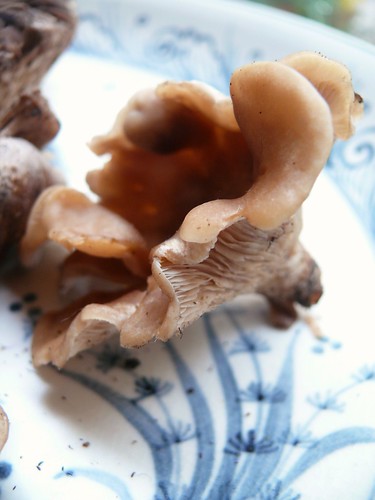
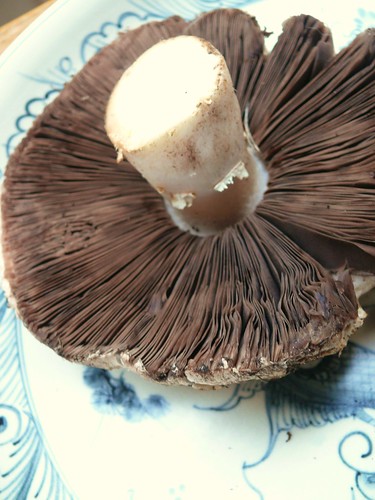
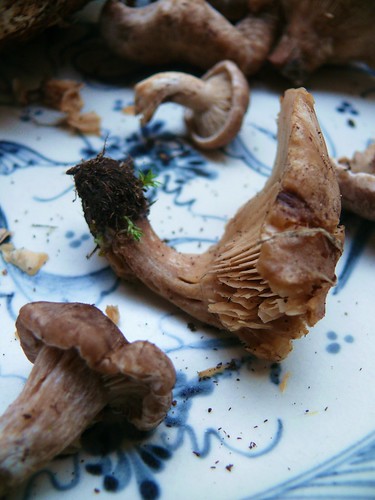
From Glenora Heritage Vegetables, Chanterelle's, Blewitt's and Cremini mushrooms


For more mushroom infatuation, visit Claire at
Melbourne Gastronome
and drool over her family's
mushroom ragu on wet polenta
.


30 June 2008

Blighty Ethical


According to Foodweek
ethical food purchases are now considered mainstream, with the British said to be leading the trend for ethical food shopping in Europe.


New research from international food and grocery expert IGD revealed that tens of millions of shoppers across Europe regularly consider factors such as organic, Fair Trade or local sourcing when making food purchasing decisions. Furthermore, British shoppers are significantly more likely to purchase ethically, IGD’s Ethical Shopping in Europe report shows.


“Until recently, ethical food shoppers were seen as niche,” said chief executive Joanne Denney-Finch. “Now as many as seven out of 10 Europeans we surveyed buy ethically at least some of the time, and a quarter are dedicated shoppers who consider two or more ethical factors when shopping.


“Priorities vary across Europe: the French are most interested in environmental issues; the Dutch are concerned about animal welfare; local sourcing is a priority for Poles whereas British shoppers are interested in a wide range of ethical issues. But there is immense growth potential for brands that can develop and emphasise ethical credentials, and tailor them to local markets at the appropriate time,” she added.


The report unveils strikingly different behaviours and priorities around Europe.


Britain is at the forefront of the ethical shopping market, with 41% incorporating more than one ethical issue into their buying decisions. British shoppers are most likely to follow through their interest in ethical products into actual purchases and in particular, more likely to buy free range or Fair Trade products.


One in three (34%) German or Dutch shoppers are dedicated ethical shoppers, while 31% of French shoppers are dedicated ethical shoppers. However, France has an additional 37% of shoppers who only sporadically buy ethical products. Fewer than one in seven Spaniards (12%) or Poles (14%) are dedicated ethical shoppers.


Price (54%) and availability (36%) are seen as key barriers to the further growth of ethical shopping across Europe.


“The current combination of rising commodity prices and the global credit crunch could slow the rise of ethical shopping but is unlikely to reverse it. Ethical shopping is based on deep-seated beliefs and people will not backtrack on these lightly,” said Denney-Finch.


“Increasingly, shoppers want products that combine ethical advantages, rather than a single issue. The challenge is for companies to communicate and label clearly to help shoppers navigate through this wide range of issues.”
Denney-Finch said that the European food and grocery industry is embracing ethical and sustainable practices, but there are clear opportunities for those who go further.


“The winning companies of tomorrow will combine value with sustainability and develop new products and services at a competitive price for increasingly eco-conscious and socially-conscious consumers.”

Foodweek online.


24 October 2007

SOLE Sista's


Deep Dish Dreams: Oh SOLE e mio

My post yesterday Oh SOLE e Mio turns out to have been a catalyst for chewing the fat on what we each do in our own way to eat and contribute to the planet in an ethical way. The conundrum and the expense are raised by two of my blogger friends.

It prompted The Grocer to write
Are You Ethicurean?. Here you'll find her thoughts on what a labyrinth you find yourself in, once you begin to eat your way down the path of social conscience.

The Purple Goddess has also thrown her hat in the ring with how to do it in the suburbs with S.O.L.E Foods.

I'd be curious to hear what you do.

To begin with, my aim in the long term will be to lobby government to assist in making ethical eating more accessible and affordable for all. I want better rebates for farmers willing to make changes to become sustainable and bio dynamic. I want to provide better education for family nutrition and will endeavour to enlist the mainstream media. I will encourage others to lobby supermarkets for a wider range of better produce, locally sourced and raised ethically.

As PG pointed out in yesterday's post's comments, we achieved national acceptance of recycling, so lets take things a step further for the sake of paving the way for a positive future for all.

05 October 2007

Dupleix Vs Torode trendspotters?

"John Torode has been living in London for 17 years and has become accustomed to how things are there. London has some exciting things happening on the food scene because there is money pouring in from Russia and for £200 you can eat some amazing things, but most of us can't afford that."


"More importantly in Australia we have great affordable food and can eat out several times a week and still eat well."


"In London, Nordic food is getting popular - thankfully light, clean, fresh flavours."


"Young English chefs are doing away with heavy food and are addressing British food in a lighter way......more casual.....like the Australian way of cooking. I think we actually have a lot to teach the British."


Jill Dupleix on John Torode’s assumptions of Australian dining.


I'm not sure what compelled me to turn on the TV when I did, but there was Jill Dupleix in the ubiquitous checkerboard mini apron that she sports on the cover of her latest cookbook, Lighten Up. She was cooking one of her light recipes and telling daytime talk host, Kerri-Anne Kennelly how she helped her husband, Terry Durack, lose five belt notches of weight or six stone. Then Kerri asked her about John Torode's recent comments about Australian food (see my post, John Torode - Hidden Agenda?). Jill's response is above.

Now I have been a big fan of Terry's since the hedonistic eighties and have always hoped that I could emulate him, though sadly I will never have his incisive wit. In Jill I saw someone who was instinctively able to reflect the zeitgeist through her work first in Advertising and later in food writing.


The current book is a reflection of this, to the point that on viewing her latest recipes, I wondered whether she had been looking over my shoulder whilst I cooked for Mr Stickyfingers. Or am I too just an early adopter of global market changes by eating low GI foods, doing away with big pasta meals, cutting back on the size of our meat and starch portions while consuming more vegies and oily fish and omitting trans fats, palm oil and corn syrup?


The thing is, I don’t think I am alone here, so it made me wonder, if this book is meant to be a groundbreaking approach to eating, whether in fact Australiais ahead of the UK, where she and Terry now reside? And I say this in spite of John Torode’s assertions that what Australia has to offer is “pretty tired”.


Over here there is a growing resistance to the Americanisation of our supermarkets and the loss of favourite local brands to global brands and house brands in the pursuit of better profit margins. We also have experienced a rise in food allergies, and more people are beginning to turn to our abundant fresh produce over processed foods.

So using the marketing part of my brain, I was also curious as to what the whizz-bang £200 London restaurants are offering? I suppose some of these restaurants are featuring Molecular Gastronomy, which on our local scene is attracting the Melbourne Foodanista’s, some of whom are not really there for the food. Given the expensive machines and labour intensive techniques required, Molecular dishes don’t come cheap.


Trend spotters acknowledge that this movement has risen to prominence on the back of the apocalyptic global mood, in the wake of the rise of fundamentalism, the threat of global Terrorism and increased knowledge of Global warming. By the same token fashion is reflecting the post-apocalyptic phase of the eighties where the general sentiment was that we would either die of HIV or nuclear fallout.


Somewhere in the middle ground between the rustic trend supported by Gordon Ramsay, Rick Stein and Antonio Carluccio and ‘The Molecular’ came the East/West Fusion and the confused Global menu. Fusion done at it’s best is now accepted as an inspired and healthy fine dining choice. But the other phase, the crude global mish mash of cultures where menus listed poorly crafted versions of Laksa alongside pizza, nacho’s, tagines, sushi, grills and risotto is sadly still in existence at some of our more mainstream venues. People who favour this style of eating will never comprehend Molecular Gastronomy.


The global phase that is emerging now turns it’s back on hedonism and pretention, and perhaps the laundering of Russian money? The term that was coined for this predicted trend ten years ago was ‘Think global; act local’ a process of thought that moves from the ‘all is lost’ perception to ‘how can I do my own little bit for the future?’ has finally hit.


The extension of this in dining sees support for producers of slow grown sustainable foods, rare breed meats and heritage vegetables coupled with low food miles. Again, this is something Mr Stickyfingers and I have incorporated into our diets over the last two years. Fortunately for us, this is readily available in inner Melbourne and by shopping carefully at farmer’s markets is affordable. However, once it hits the restaurant scene as a trend, prepare to pay haute cuisine prices. Fashion-wise, look for alternative textiles like hemp and a move away from synthetics to natural and sustainable fibres.


Although this is aptly being led through smaller café venues and home cooks, in Melbourne we actually have one restaurant contender in this ‘Locavore’ food league. The 100 Mile Café, is not extortionately expensive, but as the forerunner in this league it can’t afford to be. Like most trends it will make an initial splash and then move into the mainstream where, as my new friend, chef and witty blogger The Gobbler put it, “it is merely another weapon in their arsenal of getting bums on seats.”


Whatever the trends on offer, eating in Australia is progressive and is one of the few places in the world where we have affordable fresh produce that in some parts of the world costs and arm and a leg. With Jill Dupleix asserting to food writer Matt Preston that she and Terry just make ends meet living in Notting Hill - European assignments aside -perhaps it's time that they came home to the good life?