"During a recent raid on a wholesale centre in Guangzhou City, the capital of China's Guangdong province, a large quantity of fake eggs was seized. Their wholesale price is 0.15 yuan (S$0.03) each - half the price of a real egg.
Consumers have a hard time telling a genuine egg from a fake one. This is good news for unscrupulous entrepreneurs, who are even conducting three-day courses in the production of artificial eggs for less than S$150.
A reporter with Hong Kong-based Chinese magazine EastWeek enrolled in one such course. To create egg white, the instructor - a woman in her 20s - used assorted ingredients such as gelatin, an unknown powder, benzoic acid, coagulating material and even alum, which is normally used for industrial processes.
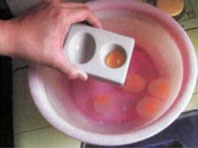
For egg yolk, some lemon-yellow colouring powder is mixed to a liquid and the concoction stirred. The liquid is then poured into a round-shaped plastic mould and mixed with so-called 'magic water', which contains calcium chloride. This gives the 'yolk' a thin outer membrane, firming it up.
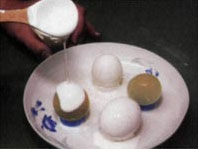
The egg is then shaped with a mould. The shell is not forgotten. Paraffin wax and an unidentified white liquid are poured onto the fake egg, which is then left to dry.
The artificial egg can be fried sunny-side up or steamed. Although bubbles appear on the white of the egg, those who have tasted it say the fake stuff tastes very much like the real thing. But experts warn of the danger of eating fake eggs. Not only do they not contain any nutrients, a Hong Kong Chinese University professor warned that long-term consumption of alum could cause dementia or mental disease."
Last week the above information arrived twice in my inbox and had been circulating by email amongst Asian friends. As soon as I read it, I smelt a rat. There are many stories emanating from China about falsified foods and consequently some of the people I know in Hong Kong have become quite cautious shoppers. But it was definitely on the nose for me.
I had a look at Hoax Slayer and there it was. In fact a Blogger was believed to have 'cracked' the myth and the scam. But it spoke reams to me about what is happening in the food scene.
I'm talking about the increasing popularity of Molecular Gastronomy. It involves the study of physical and chemical processes that occur in cooking. The term was coined in 1988 by Hungarian physicist Nicholas Kurti and French chemist Hervé This and has finally become fashionable. However this is not a fad that will appear on menus alongside local interpretations of Nacho's, Risotto and Laksa.
For two years the Molecular Gastronomy juggernaut that is El Bulli of Spain, has topped the San Pellegrino World's 50 Best Restaurants list. Chef Ferran Adrià Acosta and his huge kitchen brigade conjure astounding dishes like wizards. The result is conceptual and a play of chemistry, where traditional food textures and flavours are swapped, interplayed with scents not usual to culinaria and reconfigured to bewilder and hopefully fascinate the palate. If he wanted to I'm sure Mr Adrià could easily reassemble an egg, but it wouldn't be cheap.
For some cooks, having mastered the rudimentary and the traditional dishes of the culinary repertoire, there is comfort and mastery in the familiar. There is some interplay and twists on the familiar. For others there is boredom which I suppose is what inspires them to move on to more daring gastronomic feats, and hence we have the new fangled Molecular Gastronomy, a dining experience that globally has a small market.
As a conceptually driven experience of dining that requires large kitchen brigades and expensive machinery it has been available in Melbourne for the diner with deep pockets for a number of years. Most however have not been receptive of it, as often diners in Australia lean to the rustic over the conceptual and quality seems to be determined by traditional Haute Cuisine, while value is prized over innovation.
At Zuccini in 2001 the team found that there were not enough early adopters in Melbourne to sustain this stream of ambitious endeavours. When Ferran Adria came out to do our Food Fest circuits, people walked out of his sessions. At Reserve, George Calombaris tried to surf the wave but failed to find a market, and has since, successfully toned it down somewhat to infuse his ideas into the Greek cooking of his childhood cuisine at The Press Club. More recently Ray Capaldi and Robin Wickens are finding their way as the affluent diner is finally swayed by the fashion in international dining guides for venues such as El Bulli, Thomas Keller's French Laundry and Pierre Gagnaire's venues in Paris and Hong Kong.
But what about the home cook? For me, I no longer use recipes. I know from sight, smell and instinct how much of an ingredient to use without weights and measures, to get what I want and have accumulated 30 years of recipe reading and master classes in order to assimilate enough techniques to invent dishes. I know how to fuse the techniques of various cuisines with the ingredients of others and am proud of the results. I imagine that for the pros this must often be the case too.
But amongst all this I now have the desire to know just why certain things work and that all comes down to Chemistry. Although unlike Heston Blumenthal of Fat Duck, I have no desire to deconstruct a traditional dish and reconstruct it with a synthesis of other ingredients, like spheres of egg or pea, or even his famous egg and bacon ice cream, I do however want to know the reason how day to day culinary chemistry works.
Some of the questions that percolate in my mind are why is it if you add salad dressing ingredients in the wrong order it will separate and not emulsify? Why does it actually take a ton of sea salt to properly boil certain foods? What is the natural sugar content of certain produce and how much will they caramalise? Why is it that the humid evening air savaged my chocolate chilli souffle batter in a matter of minutes, but I was still able to rescue it - and how did I instinctively know what to do about it?
Sometimes with a little rumination I can figure it out for myself in terms of chemical reactions, but I'm also interested in micro-biology and the effects of bacteria and enzymes - to name but two items - on flavour and texture. The answers to those things I crave to learn. Ok, if you haven't figured it out by now, I'm a great big nerd.
On my wishlist is Harold McGee's incredible On Food & Cooking: The Science & Lore of the Kitchen, but I'm hoping to get that down the track. I content myself in the meantime by reading his New York Times Column, The Curious Cook instead. Perhaps one day I will Graduate to Herve This. But to begin with I am reading professor emeritus Robert L. Wolke's What Einstein Told His Cook 1 - Kitchen Science Explained and 2 - Further Adventures in Kitchen Science.
To use an Aussie analogy, Robert L. Wolke is the Dr Karl Kruszelniki of cooking. So far most of it confirms my own deductions with scientific evidence, such as that marinading will only affect the surface area of a piece of meat and not penetrate it - even if punctured. But there are other things such as why fish decompose faster than meat and even the molecular explanation behind producing emulsions.
I don't think that it will lead me to buying the cute molecular products now available for producing your own spheres and foams, but I hope that it will take me that step further in my culinary pursuits...
... Besides, the foam that topped Mr Stickyfingers' scallop raviolo last week at Toofeys reminded him of the cat sputum that typically accompanies a furball. I wonder what he'll make of dinner at Fenix next week?