Showing posts with label Food trends. Show all posts

26 April 2012

Making Money from your Food Blog


"Any intelligent fool can make things bigger and more complex... 

...It takes a touch of genius - and a lot of courage to move in the opposite direction."

Albert Einstein


Do you wish that your blog made money?  Monetizing your blog is known as pro-blogging.

Conferences that claim to teach you how to do this are an increasingly common money spinner. It reminds me of Pyramid schemes. Make money by teaching others to teach the same thing. Follow the hashtag streams from some of these events via twitter and it is evident that they’re not saying anything new or mind blowing. 


So here are my genuine tips. For free.

In life, if you want to make money, you either become an employee or you start an enterprise. Deriving income from a blog needs to be approached in the same way as beginning an enterprise. There are some blogs that have evolved seemingly naturally from being a hobby to an enterprise but they have a few things in common:

  • ·         The blogger was filling a popular yet unexplored niche
  • ·         They put in very long hours to achieve it
  • ·         They made sure they stood out from the crowd
  • ·         They are very credible and well researched
  • ·         They were good at self promotion beyond the blog


Early in my career I was fortunate to have mentors and in return, I do the same for others, including assisting with business planning and helping my clients to stay on goal. I also help with self promotion and personal branding. 

Some of this knowledge is what you need to build a blog that is a commercial enterprise.

In any enterprise my golden rule is “It’s not about you”. Every business services a customer. Therefore it is all about the customer’s needs and their point of view, not yours. This must permeate every decision you make.


Planning


The first step for anyone considering starting out is the business plan.
  1. Set your goals – what are you aiming to achieve? What amount of income do you realistically expect to achieve in the long term?
  2. Set your exit strategy – when you have achieved your goals what will you do next, sell out, merge with another or evolve to another level? In some cases the exit activity is to become a Blooker (to self publish a book based on your blog or secure a contract from a publisher)
  3. Define your focus – every business needs a specific focus. Every commercial blog needs a set theme. To have too many themes in a blog will not serve those who could monetise it. To stand out you also need to discover and fill a unique niche. If your blog does not offer a point of difference it becomes just one in the crowd
  4. Define the personality of your brand, ie. The look, the style of writing or ‘The Voice’ you use to communicate. Imagine your brand as a person, not necessarily yourself, in order to be objective about how it comes across to others
  5.  Identify your typical reader, what they want to read, find out how frequently they read blogs and how they discover them in the first place, find out what else they read and what social networks they use. Knowing this will ensure your content always has meaning and value for the reader
  6. Select a revenue stream by looking at how you can monetise your blog. This may come via eCommerce, subscription services, syndication, advertising or writing for brands and other websites. Decide what your fees will be, create a rate card of what you will charge. Use a system that measures your online influence/reach so that you can quantify your fees
  7.   Create a marketing strategy, no blog is going to attract readers or income in isolation so publicity is very important
  8. Create a calendar of activity for posts, marketing, advertising and publicity. This not only keeps you on track but is invaluable for showing investors or advertisers that you mean business
  9. Cost out in man hours and dollars what it will take to set up and to acquire the tools to achieve a high readership and interaction with followers. You may find that you need professional help in some areas which could require a financial loan or venture capital
  10. Ascertain whether you have the time and commitment to see it through, based on examining the previous steps of discovery


In this process, Step Ten can be the biggest hurdle of all. Many enterprises fail early on because they haven’t bothered to go through the groundwork of the business plan. Working on a plan can save you a lot of disappointment.

Remember that your plan is not cast in stone. Your blog can, and will, evolve organically, but make sure you take time to revisit that plan periodically to see if you are still on track.


Revenue


Probably the hardest question in a business plan for bloggers is determining Step Six, identifying a revenue stream. The answer usually will stem from the kind of niche you aim to fill.

ADS
There is the obvious such as advertising on your site, placing Google, FoodBuzz or Nuffnang ads etc, but this will not earn you a great deal. Another consideration is that the CMS of your blog needs to be flexible enough to allocate adequate real estate to ads while still maintaining easy navigation. If viewing is hampered by ads you will surely lose readers.


SUBSCRIBERS
There is already a successful commercial model in subscription services. Essentially the blogger offers their site as a paid advertorial space, with notification of updates distributed via a subscription email service. This model makes money from advertising and from commissioned advertorial posts. 

The reason the email subscription is involved is to assist in establishing who your readers are and demonstrating your reach online, by quantifying return on investment for Advertisers spending money on your blog. If you have associated social media accounts also with a large following or reach, this can further bump up your fees but you will need to be using an effective monitoring engine in order to measure the reach of your influence.

Some Pro-Bloggers are also charging readers a subscription fee. But as per the experience of newspapers moving into paywall territory, this model will impact on the numbers of readers. If you follow this path, the quality of your content ought to be professional magazine standard, and your site should not appear amateur in structure. There should be a pay-off for subscribers such as access to exclusive or premium events and non syndicated material.


PAID CONTENT
For Bloggers whose focus is solely reviewing, a potential revenue stream can come from aligning yourself with a cluster of PR agencies. By negotiating an annual retainer from the agency, you agree to place product reviews on your blog. This can be for products, services, events or venue reviews. 

First you must do your homework and look at the PR agencies and especially what their client list is like. Only approach agencies where there is synergy between your point of focus and their clients. By law you must also state if your posts are sponsored or advertorial.

Another alternative is if you already have a large following on your blog, you may be able to bring your klout to a brand by writing paid content for online journals and branded websites. The aim is that you will drive traffic to these other sites in exchange for payment and a backlink to your blog.


E-COMMERCE
In the cooking niche, you may have hard goods that you wish to sell. There are many e-commerce solutions available for your blog, as well as offsite, such as selling via Facebook or eBay. Small businesses are able to tap into a younger market and regional markets, where customers have the desire to find unique items outside of usual business hours. 

Appeal to their desire for convenience, offer good customer service and follow up on your sales to maintain cordial contact without the hard sell. This will increase your chances of repeat purchases and grow your reputation. If you’re involved in food selling, be mindful of the law, for example in OH&S, permits, licenses, transport and other handling regulations.

This is just a handful of examples of deriving revenue from food blogs. In all instances of the above, by law you must make it clear to readers if a post on your blog is sponsored or can be considered to be an advertorial. Of course there are also the usual business finance details to manage such as having an ABN, tax implications including charging GST. That’s best discussed with your Accountant.


Getting Known


Self promotion is the other major stumbling block for new businesses. After all, marketing and self promotion is a specialty area. The basic premise is utilising your personal brand for reputation building.

An analogy I use with my own clients is ‘wallflowers don’t get invited to dance’. Don’t expect to get discovered without any effort when there are billions of blogs online.

PERSONAL BRANDING
The first step is to write a short bio that introduces you. Use it as an opportunity to share your credentials and build trust. Next create a photo avatar or brandmark that people will associate with your personal brand. Create an email address just for that brand.

PUBLICITY
Publicity is super important – you need to let as many people as you can know that you exist online. Use personal networks, social networks and press releases. Build a profile on LinkedIn that will show your credentials. Join and participate in relevant LinkedIn professional groups, from Food Writing to Blogging.

BEING SOCIAL
It is also important to interact with fans through your comments section and social media. Chat is vital, as opposed to just broadcasting a link to your latest post. It is also vital to comment on other blogs. Use genuine interaction and contribution in your comments. Resorting to sock-puppetry is taboo and can destroy your reputation. Link farming isn’t as important as it used to be but it can be helpful to appear on blog directories and lists.

GUEST POSTS
Guest posting is important. This is either via inviting other popular bloggers to post on your site or to submit a post to another site, community or blog with a very large readership. It’s basically all about discovery. Submit pieces to traditional media - you may not be paid, but if your content is used, request a byline and a backlink to your blog. Also comment on traditional media stories that have relevance to your blog and always include a backlink to your own site.

CONNECT
If you use multiple social media accounts ensure that your avatar and bio, as well as the tone of voice, are consistent across all of them. Make it easy for readers to follow your other social accounts by adding social media buttons to your blog and always add share buttons so that you content can easily be distributed by your readers to a wider audience. Facebook plug-ins are also a great way to get your content noticed around the web.

CONTENT AGGREGATORS
If you are a food venue review blogger, you can publicise yourself by having a presence on social platforms that specialise in reviews, beyond the obvious Urbanspoon and Foodspotting sites, consider travel review and booking platforms, Local Area Marketing sites such as TruLocal, Restaurant booking platforms and geo-spatial social platforms such as Yelp and LinkedIn.

Non-review food blogs or product review food blogs should consider submitting posts to Food aggregators such as Tasteologie, Foodgawker and Tastespotting. Also consider having a photo offshoot on Pinterest if it is relevent to your subject matter.

Remember to maintain the same avatar and bio wherever you post on social networks so as to be recognised. In this way you are not only discovered by more people, you also build your reputation.


The Gristle


My character ‘Sticky of Deep Dish Dreams’ - aka Stickifingers - has been a great way to engage with other food lovers. One of the best aspects is meeting people offline, some of whom read my internet musings and a few have become firm friends. Blogging is a great hobby.

Over time I have achieved a wide reach of influence by using multiple social channels, including Tumblr, Twitter, Facebook, Instagram, Yelp, Tripadvisor and LinkedIn to name a few, and am regularly asked by commercial interests why I don’t monetise this blog. 

The answer is that I already have a career in Social Media Strategy that keeps me on my toes with its daily changing processes, etiquette and platforms. To monetise a blog is to create another career path. And I prefer to use what I know, to get others on a happier path.

So if can leave you with one thing to chew over, if you aim to monetize your food blog, to achieve success it will cease to be a hobby and become a job that requires a great deal of concerted effort.
Do you have the courage to take that step? Only you can know.


If you wish to check my credentials or to discuss professional matters,
you can reach me at this link.
Please note that press releases and promotional material sent to me there
will be treated as spam in accordance to Australian legislation, as per the statement in the sidebar on this blog.



30 June 2008

Blighty Ethical


According to Foodweek
ethical food purchases are now considered mainstream, with the British said to be leading the trend for ethical food shopping in Europe.


New research from international food and grocery expert IGD revealed that tens of millions of shoppers across Europe regularly consider factors such as organic, Fair Trade or local sourcing when making food purchasing decisions. Furthermore, British shoppers are significantly more likely to purchase ethically, IGD’s Ethical Shopping in Europe report shows.


“Until recently, ethical food shoppers were seen as niche,” said chief executive Joanne Denney-Finch. “Now as many as seven out of 10 Europeans we surveyed buy ethically at least some of the time, and a quarter are dedicated shoppers who consider two or more ethical factors when shopping.


“Priorities vary across Europe: the French are most interested in environmental issues; the Dutch are concerned about animal welfare; local sourcing is a priority for Poles whereas British shoppers are interested in a wide range of ethical issues. But there is immense growth potential for brands that can develop and emphasise ethical credentials, and tailor them to local markets at the appropriate time,” she added.


The report unveils strikingly different behaviours and priorities around Europe.


Britain is at the forefront of the ethical shopping market, with 41% incorporating more than one ethical issue into their buying decisions. British shoppers are most likely to follow through their interest in ethical products into actual purchases and in particular, more likely to buy free range or Fair Trade products.


One in three (34%) German or Dutch shoppers are dedicated ethical shoppers, while 31% of French shoppers are dedicated ethical shoppers. However, France has an additional 37% of shoppers who only sporadically buy ethical products. Fewer than one in seven Spaniards (12%) or Poles (14%) are dedicated ethical shoppers.


Price (54%) and availability (36%) are seen as key barriers to the further growth of ethical shopping across Europe.


“The current combination of rising commodity prices and the global credit crunch could slow the rise of ethical shopping but is unlikely to reverse it. Ethical shopping is based on deep-seated beliefs and people will not backtrack on these lightly,” said Denney-Finch.


“Increasingly, shoppers want products that combine ethical advantages, rather than a single issue. The challenge is for companies to communicate and label clearly to help shoppers navigate through this wide range of issues.”
Denney-Finch said that the European food and grocery industry is embracing ethical and sustainable practices, but there are clear opportunities for those who go further.


“The winning companies of tomorrow will combine value with sustainability and develop new products and services at a competitive price for increasingly eco-conscious and socially-conscious consumers.”

Foodweek online.


18 June 2008

Eating the national emblem


Poor old Skippy - what an utter nightmare.

One minute, he's bouncing happily through the outback, ears flapping, tail flopping, with not a care in the world.

The next, he's heralded as the latest superfood - delicious, nutritious and fabulously low fat - the natural solution to global warming, and 20.4 million Australians are being urged to "throw a few kanga bangers on the barbie".

JANE FRYER Mail Online


On the subject of one half of our national emblem, six species of kangaroo have died out and seven have become endangered since the arrival of Europeans in Australia. It's shocking. But the good news is, the remaining thirty-five species of kangaroo have proliferated, protected from their predators by the fences put up by farmers and pasturalists in order to feed the nation with traditional agrarian crops and beasts.


The populations of those 35 species have exploded thanks to better access to water, via dams and cattle watering points and from agricultural clearing creating increased grassland areas. Consequently there are now annual culls of kangaroos, as they have become a threat to the balance of rural life and are considered agricultural pests.


The number of each species that can be taken is set annually by state wildlife authorities after management plans have been approved by the federal government. This figure is around 15-20% of the total population, and is adjusted according to seasonal conditions.


Five species only of kangaroo are commercially harvested. Licensed practitioners, who have undertaken training in animal welfare, hygiene, and firearm competency are used. Harvesting is undertaken humanely by professional shooters. The Royal Society for the Prevention of Cruelty to Animals (RSPCA) indicate that the kangaroo industry is indeed operating in a humane manner. Kangaroo culling is according to them, considered one of the most humane forms of animal slaughter, "An animal killed instantly within its own environment is under less stress than domestic stock that have been herded, penned, transported".


Each kangaroo that is taken must be identified by a numbered, plastic, lockable tag issued by the state regulatory authority, and only tagged animals can be processed. In order to ensure there is no overexploitation of any species in any given area detailed reports are then made and evaluated on a seasonal basis.


Now, a report commissioned by Greenpeace claims that Aussies can dramatically reduce their carbon footprint by eating less beef and more ‘Roo’. In its favour, Kangaroos have no impact on the environment nor on carbon emissions. They need less food than sheep or cattle, are better adapted to drought and are far less damaging to the fragile topsoil than their sharply-hooved bovine counterparts.


While whole ecosystems are lost when forests are cleared to plant crops and toxic pesticides for maintaining crops also cause animal deaths, the kangaroo meat industry is sustainable and does not threaten the survival of the kangaroo or other native animal populations.


Unlike cattle and clearing land to grow grains and vegetables Kangaroos thrive in bushland. They do not need wheat in their diets and will not contribute to the global grain crisis caused by our growing demand for grain, beef, sheep and poultry. They also do not create greenhouse gases in the form of methane as cattle do.


As a food source, roo is not only delicious and healthful - being very lean, high in protein, iron and high in polyunsaturated fat - it is unfettered by the diseases associated with cattle and carries lower risks of food poisoning. And you know what? It tastes bloody good.


The Aborigines have been eating it for 40 000years and now it’s our turn to embrace it. In principal, treat it like venison, seared quickly then allowed a generous resting time for succulent meat. It has its own particular flavour which like prime beef needs only the slightest enhancement, but also stands up well to strong seasonings, whether you take an anglo - juniper, bay leaf and peppercorn - route or even a spicy curried approach.

For more information and recipes visit Kangaroo Industry Association of Australia


MY RECIPE

Lemongrass Kangaroo

Serves 2 for a main course, or more if sharing dishes

Deal breaker: Without a mortar and pestle and either fresh or frozen Lemongrass (Citronella) and Vietnamese Fish Sauce (Thai is way too pungent) this recipe will lack the necessary subtlety of flavour.


300g Kangaroo fillet

4cm of Lemongrass stalk

5 thin slices Galangal

5 thin slices Ginger

½ a small disc of light palm sugar

1tbs of Vietnamese Fish Sauce (not Thai)

½ tsp Kecap Manis

1tsp Cambodian Onion Paste

1tsp un-toasted sesame oil

3 tsp canola/peanut oil

1 small clove of garlic

4 Snake/Long beans

2tbs water

1tbs Xiao Xing wine

¼ red onion

1 small tomato

Salt & pepper

5 Mustard Green leaves (Gai Choy)


Lay some freezer film or plastic wrap over the kangaroo fillets and spread, flattening them out with the blunt edge of a cleaver as you would when making a schnitzel. Slice into bite sized strips and place in a plastic bag.


In a mortar and pestle pound slices of lemongrass, then add the galangal and then ginger. Bruise the spices, releasing the juices and break down the fibres.


Do. Not. Use. A blender.


Add Palm sugar. When assimilated into the mix add the fish sauce and Kecap Manis. Finally add the Onion Paste and un-toasted Sesame Oil and then tip into the bag with the meat. Massage marinade into the meat and chill for 90minutes.


Cut the snake beans on the diagonal into 2.5cm pieces and finely mince garlic by flattening under the blade of a cleaver. If you pull the cleaver across the board as you smash down on the clove with your fist, you will be left with a pulp, which you can easily chop finely.


Heat wok or skillet with 1tsp oil. When the oil is at smoking point throw in the beans and garlic, moving them quickly around the pan. Add a tablespoon of water to the pan and cook down until the water has evaporated. Remove from pan.


Do not clean wok. Heat 2tsp oil in the pan and when at smoking point add in the kangaroo fillets and marinade. Do not toss fillets, brown them. Kangaroo needs to be cooked very quickly because is very lean - like venison - and then rested. Over cooking will make it tough. When both sides begin to look charred, stir through the Xiao Xing wine and when the meat mixture has darkened remove from the pan to rest. Do not clean wok/pan.


Dice the tomato and finely slice onion, add both to the pan over medium heat to cook down. When the onion is cooked, place the beans and garlic back in the pan with a tablespoon of water. When they have warmed through mix in the kangaroo and season with salt and white pepper. Do not use black pepper - the galangal has sufficient bite (like horseradish) for the dish so black pepper would be overkill.


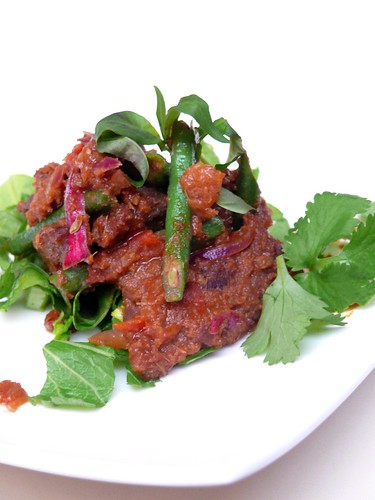
Slice Mustard Greens horizontally into 1.5cm strips. Place kangaroo mix from the wok onto the bed of greens and garnish with coriander and Thai basil if you have them. Serve with anything - rice or quinoa or mashed potatoes - whatever suits your mood.


01 June 2008

Aussie Chef's back GM Free Charter


Australia’s top chefs are opposed to serving genetically modified (GM) foods in their restaurants. They have endorsed a major initiative launched by Greenpeace, called the GM Free Chefs Charter.

More than 50 of Australia’s top chefs have endorsed Greenpeace’s GM Free Chefs Charter.

The charter calls for the thorough labelling of all food products containing GM ingredients and opposes the recent introduction of GM canola in New South Wales and Victoria.


“The decision to invest in the production of GM food crops worries me greatly as a chef and as a parent,” said Jared Ingersoll, owner and head chef of Danks Street Depot.

“I understand the need for the use of technology in agriculture as our farmers are faced with many challenges. However, I have grave concerns for the damage that could be caused if untested and poorly regulated GM food crops enter our food chain. All I ask is that there is a more transparent and independent way of looking into these technologies which takes into consideration people’s health together with the environmental and economic impacts.”

FOODWEEK


Watch the launch HERE - it's worth viewing. Jared raises the subject that once you have GM canola, it finds its way into many processed foods and GM grains end up in feed for cattle and poultry. Is this what we want for our culinary future?


From Greenpeace:

GM Free Chefs Charter

For the first time, genetically modified (GM) food crops will be grown in Australia. From May 2008 in New South Wales and Victoria, GM canola will be grown commercially and will enter our food supply.

As chefs and restaurateurs we aim to protect the quality, diversity and the flavour of food we serve. To do so we need to be positive that what we put on plates represents the best Australia has to offer. To do otherwise is to risk not only the well being of our clientele, but also the well being of our nation.

Because of the untested long-term risks associated with the growing and consumption of GM foods, we are strongly opposed to serving them - or ingredients derived from GM products - in our restaurants.

Statistics reveal that the majority of Australians do not want to eat GM foods and over recent years we have seen our customers’ growing concern about the origins, ethical treatment and corporate control of food.

Canola is used in an extensive number of food products, ranging from breakfast cereals to oil and margarine to bread. Once GM canola is grown on Australian soil, it will find its way into our diet as canola oil and meal. Even worse, we will not know that we are eating food that contains GM canola, because under current laws it will remain unlabelled.

In the US and the EU, and across the world the great growth area is in clean, green food products. We believe that it is not wise to give up our global, unrestricted GM free marketing advantage, particularly when the long term implications of GM food manufacture and consumption are not yet known.

Only two state governments, New South Wales and Victoria, have lifted their moratoria on growing GM canola – all other canola growing states have committed to maintaining their moratoria on environmental, health and economic grounds. We encourage the New South Wales and Victorian governments to join the other states and reverse their position for the benefit of the nation.

In the meantime, it is imperative that the federal government legislates for the labelling of all GM foods and food products derived through GM. This is essential so that Australians can make clear decisions about whether to buy GM free ingredients or not. The labelling should include all vegetable oils, starches, sugars, colourings, produce made with canola, processing aids and additives, as well as animal feed. It should also include the labelling of meat from animals that have eaten GM feed.

We are committed to Australia’s GM free status so GM free food can be prepared and enjoyed without hesitation across the country, by all Australians.


Chefs signed up:


New South Wales

Kimitaka Azuma of Azuma
Martin Boetz of Longrain Restaurant
Andrew Cibej of Vini
Serge Dansereau of Bathers’ Pavilion
Holly Davis, founder of Iku Wholefood
Peter Doyle of est. at Establishment Hotel
Alison Drover
Colin Fassnidge of Four in Hand Hotel
Margaret Fulton
Peter Gilmore of Quay Restaurant
Bill Granger of bills
Alex Herbert of Bird Cow Fish
Stephen Hodges of Fish Face
Ashley Hughes of Alio
Jared Ingersoll of Danks Street Depot
Carl Kenzler of Ritual Restaurant
James Kidman of Otto Ristorante
Lee Kwiez of Milsons Restaurant
Kylie Kwong of Billy Kwong
Chui Lee Luk of Claude’s
Christine Manfield of Universal Restaurant
Paul McGrath of Bistro Ortolan
Matthew Moran of ARIA Restaurant
Sean Moran of Sean’s Panaroma
Justin North of Bécasse Restaurant
Armando Percuoco of Buon Ricordo
Neil Perry of Rockpool
Dietmar Sawyere of Forty-One & Berowra Waters Inn
Jeremy Strode of Bistrode
Warren Turnbull of Assiette

Victoria

Stephanie Alexander
Marcus Allen of Interlude
Simon Arkless of Comme Kitchen
Michael Bacash of Bacash
Dwayne Bourke of The Argo & Clunes Hotel
Robert Castellani of Donovan’s
Dallas Cuddy of Verge
Neil Cunningham of Healesville Hotel
Dur-é Dara
Matt Dempsey of Pettavel Winery & Restaurant
Elizabeth Egan of Becco
Teage Ezard of ezard and Gingerboy
Geraud Fabre of France-Soir
Guy Grossi of Grossi Florentino & Mirka at Tolarno Hotel
Michael Lambie of Taxi Dining Room
Sam Lynch of Original Foods
Luke Palmer of Fork to Fork
Tobie Puttock of Fifteen Melbourne
Virginia Redmond of Cicciolina
Patrice Repellins of Koots
Chris Rodriguez of Grossi Florentino
Ben Shewry of Attica
Annie Smithers of Annie Smithers Bistrot
Joseph Vargetto of Oyster Little Bourke
Matthew Wilkinson of Circa, The Prince
Paul Wilson of The Botanical
Alla Wolf Tasker of Lake House

Western Australia

Ian Parmenter

South Australia

Maggie Beer

If you are a chef and would like to sign the charter,
please email:
chefscharter@au.greenpeace.org

If you're adding your name and would like me to list it on this post, please email me your details via my profile link.


Find out what's in your food with the Australian True Food Guide and see which popular supermarket items are GM free


22 January 2008

Cooking Karma aka Vegie-Gate


Cookbook Author Sues
Jessica and Jerry Seinfeld

for Copyright Infringement and Defamation

NEW YORK, Jan. 7
PRNewswire/Reuters


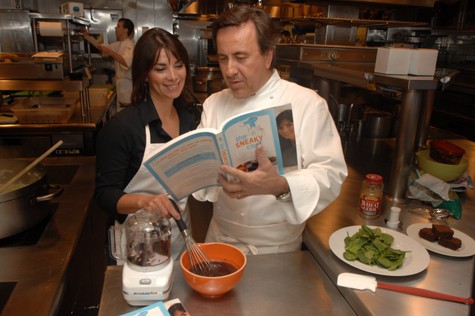
Attorneys for Missy Chase Lapine, author of "The Sneaky Chef," today filed a lawsuit against Jessica Seinfeld and Jerry Seinfeld for copyright and trademark infringement and defamation in Federal District Court in New York.


The lawsuit alleges that Jessica Seinfeld blatantly plagiarized Ms. Lapine's book, "The Sneaky Chef: Simple Strategies for Hiding Healthy Foods in Kids' Favorite Meals," a critically-acclaimed and commercially successful cookbook with an innovative approach to improving children's eating habits.

"The Sneaky Chef" shows parents how to, among other things, camouflage purees of carefully selected fruits and vegetables as ingredients in less healthy foods that kids like, such as cheeseburgers, pizza and brownies. Running Press Books, an imprint of Perseus Books, published "The Sneaky Chef" in April, 2007, generating positive reviews and quickly becoming a New York Times bestseller.

Six months later, in October, 2007, Jessica Seinfeld released a substantially similar book, "Deceptively Delicious: Simple Secrets to Getting Your Kids Eating Good Food."

Prior to the publication of "Deceptively Delicious," Ms. Lapine saw promotional material and alerted her publisher to the striking similarities between the two books, including cover art, subtitles, structure, design and overall look and feel.

Running Press, seeking to prevent any violation of Ms. Lapine's rights, brought the striking similarities to the attention of Jessica Seinfeld's publisher.

Jessica Seinfeld's publisher, which had earlier reviewed and passed up a book
proposal by Ms. Lapine, nonetheless published the book with only insignificant changes. The lawsuit lists detailed examples of identical language in the two books.

At the same time, Jerry Seinfeld went on a malicious campaign against Ms. Lapine, publicly calling her a "nut job" and "hysterical." On an appearance on 'Late Show with David Letterman' in October 2007, Mr. Seinfeld called Ms. Lapine a "wacko" who had been "waiting in the woodwork" for a chance to attack the Seinfelds. He also asserted, incorrectly, that the two books came out "at the same time." The lawsuit cites several examples of defamatory language by Mr. Seinfeld, apparently intended to intimidate Ms. Lapine.

"This action for copyright and trademark infringement and defamation arises from conduct that gives new meaning to the terms 'arrogance' and 'greed,'" states the lawsuit.

The lawsuit also points out that Ms. Lapine is the former publisher of Eating Well magazine, is on the faculty of the New School and has extensive experience in child nutrition. She also serves on the Children's Advisory Council of Morgan Stanley Children's Hospital of New York-Presbyterian, where "The Sneaky Chef" recipesare used with pediatric patients.

The lawsuit also notes that Ms. Lapine began researching methods for getting children to eat healthier foods five years before her book came out. She conducted numerous taste tests, focus groups and interviews, consulting extensively with leading nutritionists, pediatricians and chefs.

Ms. Lapine is represented by Marc E. Kasowitz and Mark P. Ressler of Kasowitz, Benson, Torres & Friedman, LLP.

SOURCE Marc Kasowitz,
Kasowitz, Benson, Torres & Friedman, LLP


It is proven that the power of celebrity and strong Media Public Relations can have a significant impact on the success of an idea. It is also a dead certain way in the USA to attract litigation. Jerry Seinfeld with his celebrity clout and Jessica with her PR background are now discovering this.

It seems their cook book's publicity backfired after an appearance on The Oprah Winfrey show, when as per usual Oprah was pushing all kinds of food that had been sitting under studio lights into her mouth voraciously. A number of viewers began to report the similarity between the two books, and as it turned out, Ms Lapine’s proposal had been circulating long before the Mrs Seinfeld nee Ms Sclar’s, but as it lacked the ‘Star power’ that the Seinfeld name wields, had seen some early rejections from Publishers.

Jerry Seinfeld’s attempt at damage control, or perhaps to garner further PR has resulted in a defamation suit. You can read the actual papers filed against the Seinfelds on The Smoking Gun.

Now I am not a fan of Jessica Seinfeld’s ideas or of her cookbook. I abhor both author’s concept of treating growing children like infants by feeding them pureed vegetables when they refuse to eat healthy foods. Hiding vegetables in other food? Hiding spinach in brownies and Kumara in hot chocolate? You’ve got to be kidding.

How is a child to learn about the texture in food and contrasts of taste when you pasteurise their diet to feature only what their unsophisticated palates and minds want? How do you expect a child to grow into a vegetable eating adult when they’ve never seen whole vegetables on their plate? How will that young mind react when believing that they hate vegetables, they find out that you’ve been duping them?

I think Oprah Winfrey was remiss in promoting Jessica’s book and helping to send it to the top of Amazon’s best selling list. Nutritionally, eating twice-cooked pureed food does not give much benefit in terms of fibre or dental and gastrointestinal health to a growing body.

OK, I admit I’m not a mother but I have had experience with obstreperous children and I know that you never give a child the upper hand over you. Their brains are developing, they do not know what’s good for them and as adults it is our task to teach them right from wrong.

The fun in food is in discovering new things and experimenting with colours, textures and flavours. The theatre of dining and the kitchen can be very entertaining for children and the earlier you involve them, the better equipped they will be to make healthy eating second nature.

But sadly I think there is a certain kind of parent who does not realise this, and I think that in the US especially, the demise of sitting down to a family meal at the dining table, away from TV and computers is contributing to the poor diets of children and teenagers.

By the way, neither party involved in the cat fight mentioned above is an innovator with their ‘hidden food’ books. Apparently they are predated by another author, Jane Kinderlehrer who earlier wrote Confessions of a Sneaky Organic Cook: Or, How to Make Your Family Healthy When They're Not Looking!(1972).

Get real people and get to know your kids better.
Read more at The New York Times.


13 January 2008

You Tarzan. Mee Goreng.


“A hippie is someone who looks like Tarzan, walks like Jane, and smells like Cheetah”
Ronald Reagan 1911-2004, 40th US President 1981- 89


Tarzan: [inside the smoke-filled Club Moonbeam in New York]
Smell like a Swahili swamp. Why people stay?

Jane: It's what they call having a good time.
Tarzan's New York Adventure, 1942


Melbourne,
1981. I was feeling a little lost in the world as my emotions spun around family dilemmas and the necessity of swallowing my feelings in order for the world to seem brighter. I reconciled myself to the pretence that on the surface of things, all would appear normal and undisturbed. Lost in thought I sat at a Laminex table in the midst of the clatter and bustle of Penang Coffee House in Hawthorn. The smells were peculiar to me and the people in the room noisy and exuberant.


Danny Ko tossed his woks with vigour - and no fear of getting tennis elbow - while sternly surveying the dining room, lit brightly and highlighted by the glow of neons. If a patron stayed too long after eating, Danny would glower at them until they jumped up to pay the bill. The table would be turned immediately to people waiting patiently outside on the street.


It was here, in the care of my Uncle Alan - a Hong Kong Chinese - and his
Singaporean wife Kitty, that I ate my first Mee Goreng. It was a complex seduction that has had me search time and time again for the holy grail of perfection. I now happily make a faithful version of Danny Ko's Mee Goreng and have visited him occasionally at his current venture Nudel & Wraps for a soul defining fix.


This is a dish of multiple textures and contrasting flavours.
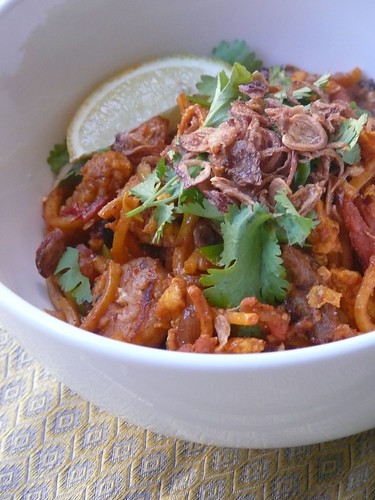
A thick spicy tomato sauce clings to thick chewy noodles. Within the mix are pieces of fried egg, and a slurry of chewy ingredients highlighted with lime and finished with a crisp chiffonade of iceberg lettuce, garnished with coriander and fried shallots. The flavours are rich and tangy, your nostrils will tingle with the smell.


Mee Goreng in my opinion is the dish which most epitomises the Malaysian cultural fusion of races. It is a dish commonly served there by street hawkers from glass fronted carts. Although the fundamental flavour is always the same, the ingredients vary depending on the location and religious mores of the diner. Mee Goreng is a spicy Nonya dish and literally means fried noodle.


In Malaysia, Nonya's & BaBa's were the women and men of Peranakan families. The Peranakan were men of Chinese descent, most notably Fukien from Fujian who came to Malaysia as Seamen, Merchants and Labourers. They married local Malay ladies and immersed themselves in local life. Nonya food fuses the two cultures in a most delicious way.


Mee Goreng takes that heritage and folds in the other major cultural influence in Malaysia - Indian. The spice mix that defines this dish is pure Indian masala. The noodles are Chinese Hokkien style - thick, round egg noodles which soak up the sauce - also Chinese are the bean shoots and sliced fried beancurd (tofu). The spice mix, lime, tomato, potato and chilli reflect the trade routes of the Merchants who settled in Malaysia.


In parts of Malaysia Mee Goreng is served Halal as per the Muslim Indian tradition, where no pork is included, but for me, the best tasting ones always seem to contain lumps of deep fried pork fat and fried Lup Cheong (Chinese Wind Dried Sausage). Cooking in lard makes a difference too.


Fujian cooking incorporates seafood, so into the mix goes squid and prawns. Also native to Fujian cookery is a slight sweet and sour flavour, but not to the effect of the Thai or Cantonese clear sweet pineapple or palm and rock sugar based sauces, this is more of a tang and a sizzle.
Into the mix there can also go chicken and some people like to add Cha Sui (Chinese BBQ'd shoulder pork).


You start with the Masala, mixing a paste of chilli, a little tamarind and Indian garam (spice blend) in the wok at high heat, sometimes I add a touch of Belanchan too. Then comes the chicken, sausage and seafood. Then the bean shoots and the noodles. At this point some people add ketchup manis (Kecap Manis) and tomato sauce (Ketchup), I don't, but I throw in the tofu and sometimes, cooked cubes of potato.


Eggs are beaten, then you push the other ingredients in the wok to one side and briefly cook the eggs on their own before stirring through. Then I toss in coarsely chopped tomato and cook the whole lot down with little water. If it's not spicy enough I may add a glug of the lurid red ABC brand tomato chilli sauce that is popular in Malaysia, Vietnam and Indonesia.


You then plate it up. I top with coriander and
crisp deep fried shallots, but put the lettuce and extra lime wedges to one side so that they can be added at the diner's discretion. The pieces of lime are squeezed over the dish to enliven the flavour and heighten the tanginess. Then I pretend I'm Danny and yell at my guests - not!


It's something I just can't get enough of, and has got easier because if you can't be fussed making the spice mix - or haven't the room to store all those spices - Asian Home Gourmet makes an excellent blend in a sachet for the cheat's version that'll evoke the smell of the street on a hot night in Gurney Drive, Penang; tropical dining heaven.


With a waft of the dish I can hear my Uncle Alan's voice again, breaking my reverie, shouting above the raucous restaurant patrons "Me Tarzan, you Goreng" and my own voice responding "You Tarzan. Mee Goreng!".


Nudel & Wraps, 264 Blackburn Rd, Syndal, Victoria (no bookings)

Penang Coffee House, 395 Burwood Rd, Hawthorn, Victoria,
ph. +613 9819 2092


10 December 2007

A Molecular Gastronomy Hoax


"During a recent raid
on a wholesale centre in Guangzhou City, the capital of China's Guangdong province, a large quantity of fake eggs was seized. Their wholesale price is 0.15 yuan (S$0.03) each - half the price of a real egg.


Consumers have a hard time telling a genuine egg from a fake one. This is good news for unscrupulous entrepreneurs, who are even conducting three-day courses in the production of artificial eggs for less than S$150.

A reporter with Hong Kong-based Chinese magazine EastWeek enrolled in one such course. To create egg white, the instructor - a woman in her 20s - used assorted ingredients such as gelatin, an unknown powder, benzoic acid, coagulating material and even alum, which is normally used for industrial processes.

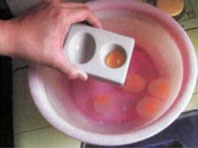
For egg yolk, some lemon-yellow colouring powder is mixed to a liquid and the concoction stirred. The liquid is then poured into a round-shaped plastic mould and mixed with so-called 'magic water', which contains calcium chloride. This gives the 'yolk' a thin outer membrane, firming it up.

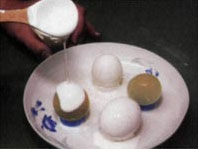
The egg is then shaped with a mould. The shell is not forgotten. Paraffin wax and an unidentified white liquid are poured onto the fake egg, which is then left to dry.

The artificial egg can be fried sunny-side up or steamed. Although bubbles appear on the white of the egg, those who have tasted it say the fake stuff tastes very much like the real thing. But experts warn of the danger of eating fake eggs. Not only do they not contain any nutrients, a Hong Kong Chinese University professor warned that long-term consumption of alum could cause dementia or mental disease."


Last week the above information arrived twice in my inbox and had been circulating by email amongst Asian friends. As soon as I read it, I smelt a rat. There are many stories emanating from China about falsified foods and consequently some of the people I know in Hong Kong have become quite cautious shoppers. But it was definitely on the nose for me.


I had a look at Hoax Slayer and there it was. In fact a Blogger was believed to have 'cracked' the myth and the scam. But it spoke reams to me about what is happening in the food scene.


I'm talking about the increasing popularity of Molecular Gastronomy. It involves
the study of physical and chemical processes that occur in cooking. The term was coined in 1988 by Hungarian physicist Nicholas Kurti and French chemist Hervé This and has finally become fashionable. However this is not a fad that will appear on menus alongside local interpretations of Nacho's, Risotto and Laksa.


For two years the Molecular Gastronomy juggernaut that is El Bulli of Spain, has topped the San Pellegrino World's 50 Best Restaurants list. Chef Ferran Adrià Acosta and his huge kitchen brigade conjure astounding dishes like wizards. The result is conceptual and a play of chemistry, where traditional food textures and flavours are swapped, interplayed with scents not usual to culinaria and reconfigured to bewilder and hopefully fascinate the palate. If he wanted to I'm sure Mr Adri
à could easily reassemble an egg, but it wouldn't be cheap.


For some cooks, having mastered the rudimentary and the traditional dishes of the culinary repertoire, there is comfort and mastery in the familiar. There is some interplay and twists on the familiar. For others there is boredom which I suppose is what inspires them to move on to more daring gastronomic feats, and hence we have the new fangled Molecular Gastronomy, a dining experience that globally has a small market.


As a conceptually driven experience of dining that requires large kitchen brigades and expensive machinery it has been available in Melbourne for the diner with deep pockets for a number of years. Most however have not been receptive of it, as often diners in Australia lean to the rustic over the conceptual and quality seems to be determined by traditional Haute Cuisine, while value is prized over innovation.


At Zuccini in 2001 the team found that there were not enough early adopters in Melbourne to sustain this stream of ambitious endeavours. When Ferran Adria came out to do our Food Fest circuits, people walked out of his sessions. At Reserve, George Calombaris tried to surf the wave but failed to find a market, and has since, successfully toned it down somewhat to infuse his ideas into the Greek cooking of his childhood cuisine at The Press Club. More recently Ray Capaldi and Robin Wickens are finding their way as the affluent diner is finally swayed by the fashion in international dining guides for venues such as El Bulli, Thomas Keller's French Laundry and Pierre Gagnaire's venues in Paris and Hong Kong.


But what about the home cook? For me, I no longer use recipes. I know from sight, smell and instinct how much of an ingredient to use without weights and measures, to get what I want and have accumulated 30 years of recipe reading and master classes in order to assimilate enough techniques to invent dishes. I know how to fuse the techniques of various cuisines with the ingredients of others and am proud of the results. I imagine that for the pros this must often be the case too.


But amongst all this I now have the desire to know just why certain things work and that all comes down to Chemistry. Although unlike Heston Blumenthal of Fat Duck, I have no desire to deconstruct a traditional dish and reconstruct it with a synthesis of other ingredients, like spheres of egg or pea, or even his famous egg and bacon ice cream, I do however want to know the reason how day to day culinary chemistry works.


Some of the questions that percolate in my mind are why is it if you add salad dressing ingredients in the wrong order it will separate and not emulsify? Why does it actually take a ton of sea salt to properly boil certain foods? What is the natural sugar content of certain produce and how much will they caramalise? Why is it that the humid evening air savaged my chocolate chilli souffle batter in a matter of minutes, but I was still able to rescue it - and how did I instinctively know what to do about it?


Sometimes with a little rumination I can figure it out for myself in terms of chemical reactions, but I'm also interested in micro-biology and the effects of bacteria and enzymes - to name but two items - on flavour and texture. The answers to those things I crave to learn. Ok, if you haven't figured it out by now, I'm a great big nerd.


On my wishlist is Harold McGee's incredible On Food & Cooking: The Science & Lore of the Kitchen, but I'm hoping to get that down the track. I content myself in the meantime by reading his New York Times Column, The Curious Cook instead. Perhaps one day I will Graduate to Herve This. But to begin with I am reading professor emeritus Robert L. Wolke's What Einstein Told His Cook 1 - Kitchen Science Explained and 2 - Further Adventures in Kitchen Science.


To use an Aussie analogy, Robert L. Wolke is the Dr Karl Kruszelniki of cooking. So far most of it confirms my own deductions with scientific evidence, such as that marinading will only affect the surface area of a piece of meat and not penetrate it - even if punctured. But there are other things such as why fish decompose faster than meat and even the molecular explanation behind producing emulsions.


I don't think that it will lead me to buying the cute molecular products now available for producing your own spheres and foams, but I hope that it will take me that step further in my culinary pursuits...


... Besides, the foam that topped Mr Stickyfingers' scallop raviolo last week at Toofeys reminded him of the cat sputum that typically accompanies a furball. I wonder what he'll make of dinner at Fenix next week?


What do you think of Molecular Gastronomy?


09 November 2007

Maggie Beer's Kitchen


Things that make my kitchen special

by Maggie Beer
  • My red gum chopping boards
  • My rolling pin with ball bearings in the end
  • My long marble bench
  • My very old refrigerator – 2 door stainless steel that was made obsolete from the Pathology Department at the University
  • My coffee machine and coffee grinder
  • My iron pot hanger
  • My oscar food processor
  • A Zester that really works
  • My truffle shaver for that trip to Italy every now and then
  • Stainless steel sets of measuring cups and spoons
  • An Alessi timer


I dip a tiny little plastic ice cream spoon into a plastic pot. Salmon, cream and dill wash over my palate: go-ood. Another spoon, another pot: star anise and duck livers melt in my mouth leaving a smooth burgundy piece of agar with no flavour.


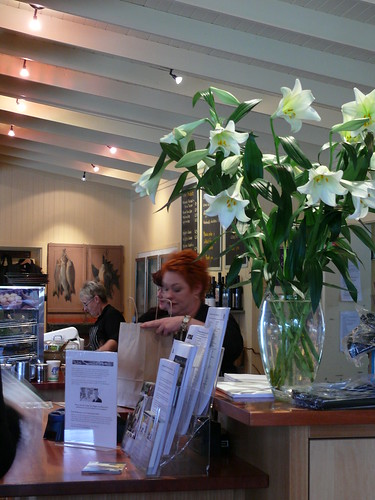
It’s 1.45pm on a Sunday in the Barossa Valley. Seventy people are crowded into Maggie Beer’s Pheasant Farm Shop provedore overlooking her dam. The sky is dark and the venue seems over run by buxom women of a certain age with short funky hair cuts and kooky glasses, some holding fort behind the counter, while others ride the crush of the room, tasting, reading jars and bottles, and flipping through Maggie’s latest cookbook. Clearly all are Maggie Beer Groupies.


At the bare wooden tables families sit with samplers of the simple fare on offer consisting of pastry, pậtés and terrines prepared by Maggie’s team. I wander, I look, I taste. Nothing new, everything here is available at my usual providores back home for cheaper than the prices marked here.


As we leave, a member of the staff announces that a cooking demonstration will be held next door and the women in our group are sucked back through the dense crowd into the newly opened vacuum that is Maggie’s kitchen studio, the place where filming of her cooking show ‘The Cook and the Chef’ with Simon Bryant, Executive Chef of the Adelaide Hilton, takes place. This is the room that replicates Maggie’s home kitchen for the purposes of taping the TV show. Instead of overrunning the Beer household, the studio space allows for the dozen people that make up a television crew for twelve hours of shooting in one session, in relative comfort and convenience.


Andrew, the staff member in Chef’s blacks, leaves the room to hustle for more attendees. Mr Stickyfingers wanders in with his mates, and leaping off my plywood stool I hand him my camera, race behind Maggie’s counter and pose for a few photos. When Andrew re-enters and assumes his position to give us the hard sell on verjuice, he tells the rest of the assembled audience that they are welcome to do likewise after the demonstration.


For me the buzz is just to be in this kitchen. I love the play of eccentricities and clash of cooking styles that the TV show brings to light. As a Eurasian raised on fine dining, Asian, Fusion and rustic Hungarian cuisine, I see my cooking style as encompassing both Maggie and Simon’s idiosyncratic leanings and I hungrily devour the shows regardless of whether there is any knowledge they can impart that I have not already been exposed to. The interplay of personalities is what carries me enthralled through their half hour session.


But here, in the studio, I find the class a huge yawn. It is evident that this is a selling tool for Maggie’s products and would most probably have lasted longer than ten minutes had Andrew been equipped with the appropriate selling tools of ‘Vino Cotta’, olive oil etc, etc. To his credit Andrew gives her latest book a good plug and tells us that the fabric covering is Scotchgarded against kitchen spills.


He goes on to enlighten us that since the launch of the book last week, Maggie is on an exhaustive 5week promotional tour, including an appearance on Kerrie-Anne Kennerley. Mr Stickyfingers jokes to the class that she is elbowing Kevin Rudd out of the way at election campaign trail engagements, receiving a rumble of laughter from the room.


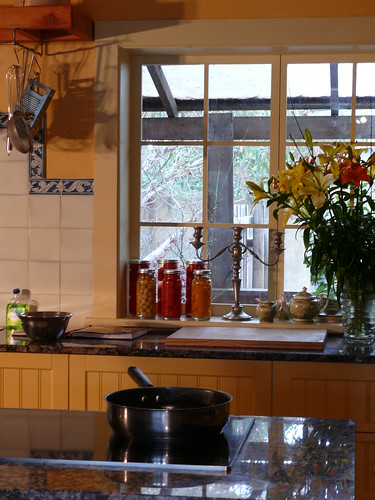
As Andrew roasts tiny pieces of fennel and tosses Swiss brown mushrooms through buerre noisette and splashes them with verjuice, my eyes drift unattentive of his efforts, distracted by the ABC TV Art Department’s dressing of the set. I see Kylie Kwong’s books on the shelf, artfully arranged Fowler’s Vacola bottles of preserved stone fruit and tomatoes, a large mixing bowl, utensils hanging from a range hood, jars of wooden spoons, bowls of nuts and garlic and a vase of fresh flowers. The sunny yellow walls are lit with a rig left behind by the film crew, to give - at Maggie’s suggestion - a more theatrical feel to the ensemble.


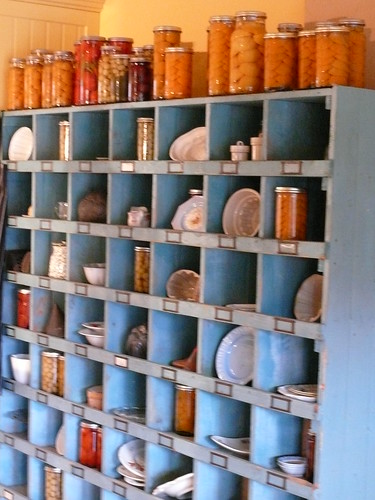
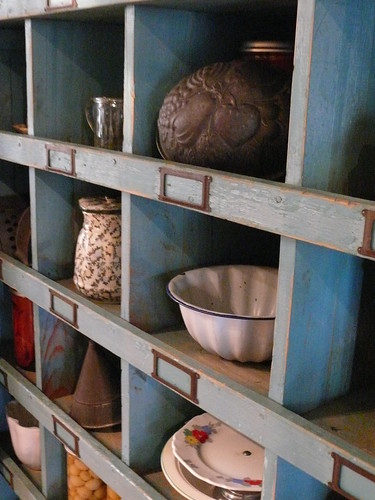
Again I am immune to the charms of the arrangement, having spent 20 years on photographic TV and film sets, but I am fascinated by both the attention to detail and the styling of the scenario. The rustic stripped cornflower blue shelves filled with jars, antique ceramics, jelly moulds and knick-knacks to the right are a cute touch, offsetting the yellow, cream and black surfaces, and the dark granite modern counter that has taken the place of Maggie’s long wooden kitchen bench at home.


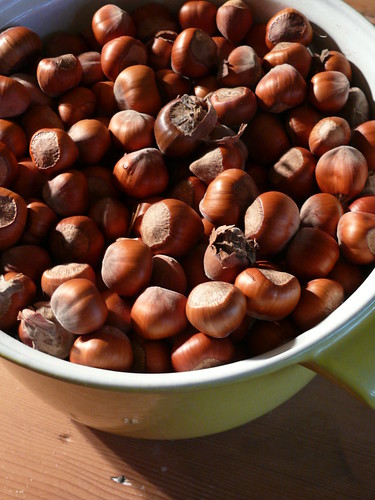
On an old kitchen table - painted cream - are a bowl of hazelnuts sitting companion to an old set of scales that appear to be purely decorative. I stare at the French doors that Maggie escapes through when Simon cooks off Chilli at ferocious temperatures and study the tiles under the rack of hanging utensils, which have taken the place of the rack of pots and pans, which hang over the centre bench in Maggie’s home kitchen.


Suddenly the cooking demonstration is over and the class swarms toward the granite counter to sample the fennel and mushrooms. The greediest of the viewers nudge their way in and linger, hovering to eat piece after piece, while behind them others are champing at the bit. My beloved and I play model and photographer again, until sighting another in our party with itchy feet we are forced to tear ourselves away.


Maggie’s marketing machine is still in full flight as we leave and the tourists are swarming for goodies they can most probably pick up closer to home. Some lament her decision to close her restaurant while others look at the chalkboard thinking that they couldn’t face yet another of The Barossa’s ubiquitous tasting platters.

We move on to Blond’s in Anguston - a slice of the city that takes advantage of the fantastic local produce - in a cute, rustic town. As well as being yet another regional provedore selling sublime Carême Pastry (Stephanie Alexander declared that she’d never make puff pastry again after trying their All Butter Puff Pastry made with unsalted Belgium butter), local Germanic smoked meats and small goods, pasta, Ortiz Anchovies, hand made pastas and the inevitable jars of pickles, jams, sauces etc they incorporate these goodies into their small menu.

Blond’s serves excellent coffee, cake, brekkie and light meals. It is here we finally take the edge off our hunger with simple dishes made with exceptional local produce, resting our palates after a rigorous morning that saw us sampling over 20 wines and looking for an afternoon siesta.


Blond Store & Coffee, 60 Murray Street, Angaston, South Australia


Maggie Beer’s Pheasant Farm Shop
Pheasant Farm Road - off Samuel Road, Seppeltsfield, South Australia