29 October 2008

Sho & tell. Using your noodle?


Stickyfingers to Pat Churchill: "I wonder whether the Chinese roast meat cabinet (sitting proudly in the exposed kitchen, holding roast duck, barbecued pork and roast pork) will now replace the trendy salumi cabinets as 'the new black' of culinary trends."


As I strode down the long gaming floor between the kilometre of Crown Casino's slot machines, I saw tons of scruffy people mesmerised by the lights, colours and panoply of noises
clustering in the air around them.


There was no smell of money in the perfectly climate controlled air. Elderly r
etirees queued for free deep fried snacks at brightly lit generic dining venues and a large group of Asians were cheering loudly at a table near Sho Noodle Bar. Others seemed linked by an invisible umbilical cord to their favourite poker machine.


I recalled years ago, when working on the launch campaign for 'The World of Entertainment' , that Lloyd Williams - the previous owner of the venue - had been considering enforcing a dress code "To keep the tyre-kickers out". Had he not been talked out of that plan the place would probably have been deserted, not enjoying its current popularity.


It had been a while since I had traversed this path. As a non-gambler there's very little interest for me on the gaming floor of a casino. I find no joy watching others spill away their hard earned plastic chips and coins, and somewhere from the recesses of my mind the statistics on attempted suicides at Packer's Pleasure Palace begin to rise to the surface. But human nature is what it is. I do not judge.


I was there at the invitation of Tara Bishop, a former colleague and now the Media Relations Manager, Food & Beverage and Hotels for Crown. After fielding slickly run PR nights for the mainstream media, ethnic press, travel and food websites, she was encouraged by Ed Charles to entertain a handful of bloggers as part of her media strategy to promote the newly opened Sho Noodle Bar.


I think possibly it was a good move on her part as the bloggers have mostly written glowing reports to a wider audience than the traditional media. A google search pulls up a few of them on the front page which is excellent for the venue. Perhaps this will break some unexplored ground and pave the way for more people to visit Sho, for this particular venue is a PR nightmare.


It was a logical thing. Opening an Asian restaurant that specialised in noodles, dumplings and the kinds of food that Chinese, Malaysians and Singaporeans love to eat at odd hours, right in the midst of where many congregate in Melbourne - especially when a number of them are tourists. Keeping it open until 4am on Saturday and Sunday morning would surely corner the market too.


So it should be an easy task to fill the place - no?
No.


When Crown Casino opened Sho Noodle Bar they were responding to a perceived need on the gaming floor. The venue houses other quality dining venues, but the ones on the gaming floor are generic.
Income is generated in casinos by turning cash over the tables and keeping the slot machines busy, and keeping punters on the gaming floor is vital. So enticing low to mid roller punters, many of whom are Asian, out of the venue onto the promenade to eat Asian food risks the chance of them not returning, of being distracted, and no gaming venue wants that.


So in came Pin Tan, a chef in from Penang - the food obsessed epi-centre of Malaysia - to be supervised by a newly appointed Swiss Culinary Director, Bruno Malzacher, who has worked in hotel catering, from Melbourne to Jordan, to Khazakstan and Japan. And at a cost of $6million, Sho Noodle Bar and Tea Salon was built smack bang in the middle of the gaming floor, with a fitout that borrows heavily from other successful casino dining venues.


Reinforcing the Casino's plan to extend dining options within the entertainment centre, I expect that not only is it hoped that it will service the existing clientele of middle class Asians, but that Sho will become a dining hub for Asiaphiles. Right now though, the place is far from bustling.
While only a handful of diners lurk in the dim light of the dining room, it would seem that much of the revenue is currently coming from dishes delivered to the High-Rollers gambling in the Mahogany Room and to their suites in the hotel.


Curious gamblers wander by and peer in casually. They enjoy the view, the free demonstration of noodle making and the Kung Fu tea spectacular. But by and large they are the people who will - when the tummy rumbles - grab a bowl of congee or rice and roast duck in the food court between gambling, not sit in a chi-chi venue to eat the same type of thing.


And herein lies the challenge, the logical idea is its own worst enemy. The average Asian punters consider it too tjuzzy and pricey for simple hawker fare and the non punters to whom it is more suited, will not wander the avenues of poker machines and gaming tables in order to cross its threshold.


What I see here
is symptomatic of many Asian venues run by Occidentals. Not enough understanding of the target market is employed in the planning of the venue. When you have an intimate knowledge of your clientele you can pre-empt what they desire. If your supposition is based on your own tatses, you'll miss the mark and no amount of marketing and PR will save the concept.


To me, Sho is another Gingerboy, be it with a pedigreed Asian chef at the helm. These places offer westerners the chance to eat as Asians do without going out of their comfort zone in terms of accoutrements.


But mention Gingerboy to your average Asian punter and you'll hear the words pretentious, over-priced and 'gwei-lo' fodder. In short it is a venue that appeals to those who would never dare set foot in a brightly lit, Laminex table clad, suburban Malaysian restaurant serving excellent food.
And although the Gingerboy style clientele have no qualms about paying twice as much as an Asian for the same meal, they're not particularly likely to wander into the belly of the casino to eat Pin Tan's Hawker Food, no matter how authentic it may be.


To explain the Asian mindset in relation to food one needs to delve into the culture. In Asian society, food plays a different role to that of Anglo culture. It's an obsession, but not in the reverential way that occidentals leave to 'Foodies'. It is a grass roots enjoyment of good ingredients, technique and heritage, that spans everyone. More like the French in its passion, though less parochially driven.


In this vein of appreciation, the majority of Orientals could care less what a venue looks like as long as it is well lit and the food is cooked with care and attention to detail. Even the wealthiest of Asians are as happy to sit at a Laminex table to eat off melamine dishes as they are to dine at linen clad tables with ivory chopsticks resting on silver holders.


Food is also very much tied into Asian celebrations, whether as a traditional banquet or corporate entertainment. At this level it is more about expense, show and ritual, one upmanship and showing off. Decorous dining establishments are favoured on these occasions and dishes served usually ring with auspicious names to bring good fortune to the occasion.


In between that you have a notion of value. Hawker food is grazing food and although unlike South East Asia, it is impossible to find a $3 noodle dish in Australia, the perception of how much one is willing to pay for grazing food is fixed in the Oriental mind as being cheap fare.


Sho Noodle Bar offers grazing food at prices above that which the average Asian punter is accustomed to paying for the same dishes. It serves them in surrounds that rip off other flashier venues overseas - which although attractive are not quite in the league of a traditional banquet venue - and that is confusing to the target market.


For the place to be populated by significantly more Asians, the decor would have to change radically and the prices would need to drop a little.
And in order to attract the non gambling food crowd, Tara needs to hype to the point where Sho is the hottest ticket in town. Unlike the restaurants on the promenade with their 'rockstar cum celebrity' chefs, this is no easy feat.


Perhaps if the fitout was an ultra modern industrial look decked out with large, bright decorative motifs, or instead of channelling
Atelier Robuchon they chose Momofuku Ko as their inspiration, you could have a hybrid venue that would entice all types, or may be not? In marketing you have to stick to your principle target market and with that will come others. I think in this case, sadly Crown tailored Sho to the wrong crowd.


In terms of the food, they're onto a good thing. Technically it was sound, included lard and a whisper of charcoal to the relevant dishes. You can eat the same sort of thing in the burbs, but if you're in the vicinity of the casino it's worth giving a try. I will return to try the Hainan Chicken Rice.


The roast meats on offer were average. I prefer the ones at Linx, and there was was some dissent during our tasting of the Beef Rendang which was essentially the Cantonese dish 'Ngau Larm' - braised gravy beef with a rich star anise and cassia bark gravy, into which had been added a fiery rempah. Sadly the elements of lemongrass and galangal were overpowered by the non-traditional elements and the chilli left us unable to taste the next course.


For a blow by blow account of the dining see my fellow bloggers accounts of the evening:

Pat, Thanh, Mellie & Dan, Jon, Neil, Elliot and Ed's video.

Perhaps for me it will be the kind of place where, as a local, I will drag friends post-theatre or even after an occasional flick at the cinema there.


I certainly hope others will entertain the idea of entering the dragon's lair of gambling to sample the offering, because Sho with its solid menu of Hawker Food favourites, a 38 seat dining counter, a range of 24 excellent Chinese teas on offer in the salon and spacious dining room, certainly has great potential to be the 'new black' of Melbourne's Asian dining scene.
And perhaps even a few gwei lo's palates will be educated in the process?


SHO Noodle Bar and Tea Salon
Located on the gaming floor next to the Maple Room

Crown Entertainment Complex,

8 Whiteman Street, Southbank, Melbourne


29 September 2008

Pick Mee. Hokkien Mee.


Dear Diary
, it is day five of our holiday and Stickyfingers is still dropping food into her cleavage.


Mr Stickyfingers' Malaysian Holiday Diary, May 08


Hawker food. It excites me. Towards my middle age, sex is sadly becoming a distant dream, but the thought of hunkering down beside a cart to eat a simply prepared dish - that's native to an Asian culture - makes me positively rapturous.


Prolonged rhapsodising causes dribbling. Waiting for my order starts me trembling. And then on its arrival I bend
in low over my dish, cup, bowl, plastic bag or paper and inhale deeply and rhythmically.


The first attempts to eat or drink are ham-fisted efforts just to get the comestible to my mouth. You see I tremble quite violently with excitement.


Quivering in my anticipation I botch any attempt at hand-mouth co-ordination. Plop! Food and drink hit my ample bosom, to grace me with yet another stain with which to match the faded one that I may have garnered earlier. In May I was so bad, I began to wonder if I should ask Mr Stickfingers to feed me my initial intake, before handing over the item as though to a small child?


Malaysian Hawker Food is definately at the top of my hawker food experiences. The range is enormous, never ending, and somehow the locals manage to graze all day on it without gaining weight. I want their metabolisms and bottomless pits of bellies, their ability to eat palm oil fried everything and coconut flavoured foods without having cholesterol issues and I want a gut and mouth that can withstand a lick of Hades infused chilli.


In Malaysia we eschewed restaurants in favour of hawker food. The lure of restaurants paled into insignificance beside dishes we could never eat back home. In fact, eating in restaurants felt oddly ostentatious there and removed from local culture. So to food courts and hawker centres we went.


Dripping with sweat by roadsides we slurped slippery noodles while hunkered on low plastic stools. We ate samosas at a cart outside a wet market, Kerupok from a cart on a beach, hot biscuits from the back of van parked outside a hotel, chestnuts from the back of a bike and heavenly barbecued chicken in an abandoned carpark late at night. Smoke billowing down a street led us to the best satay EVER and to Onion Roti Paratha, a firey Nonya fish made with sting ray and to claypot sausage rice.


In Penang our appropriately named new friend, Chew Fa Ming, led us through a merry dance of delectable hawker treats, and frankly why wouldn't you? He seemed to know so many of the hawkers personally, selecting wonderful dishes for us,
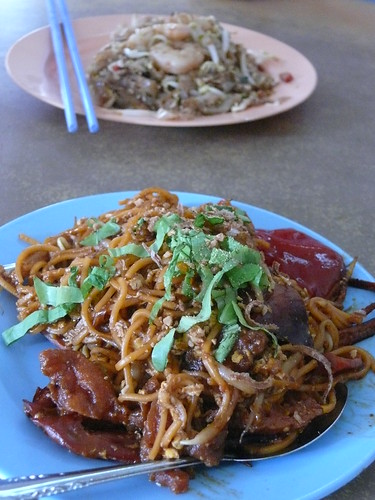
and introducing us to fruit we had not seen before in our travels. What a Godsend! We were in heaven. Days later we were tramping around the back streets for wonderful Hainan Chicken Rice, Char Kway Teow, Mee Goreng, Dosai, Banana Naan, various Kuih and Murtabak.


Back at home I also cook Malaysian
hawker
food. You've seen my Satay, Rendang, Char kway Kak and Mee Goreng recipes, and although delicious, they will never match the flavour of charcoal cooked food or the taste of the char of a well seasoned wok, searing over jet blastingly ferocious heat.


One of the reasons I love to cook hawker dishes is that it is quicker to pull together than many Western foods on a work night and because it is quick and intense, it can be quite healthy if you avoid their chosen fats palm oil and lard. Naturally the flavour suffers a little without the appropriate fats, but I do try to be healthy at home. Thankfully in Australia most of the produce is locally grown too, and it's easy to get Asian groceries in the urban sprawl.


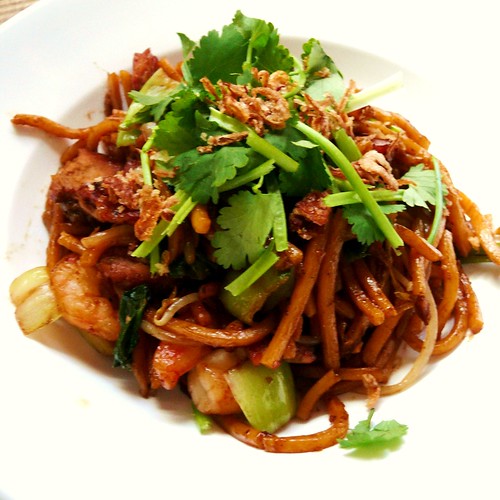
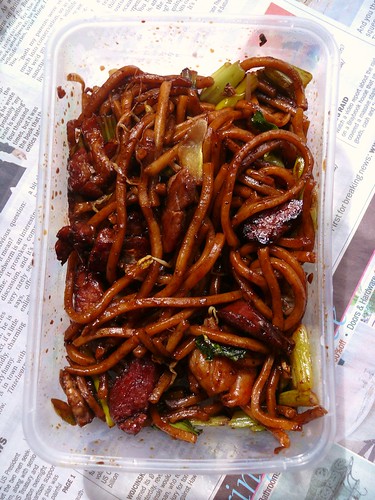
And then, there are the great leftovers. Here's my lunch - leftover Hokkien Mee. Basically the same ingredients as Mee Goreng, but substituting a dark soy based sauce for the potato and tomato curry sauce.


I love it when I open up a take away container of hawker noodles at an office and sniffing with enthusiasm, colleagues ask me where I bought my lunch? Once, a vegetarian was so enticed, as to prevail upon me for a taste of my Char Kway Teow, and loved it. But then gutted, acted as though I'd poisoned him when he found out it contained meat. He didn't tell me he was a vegetarian and you could plainly see it contained meat.
Go figure?


In the not too distant future I will again be packing the baby wipes to remove stains from t.shirts worn while eating more hawker food. This time we will be heading back to Vietnam and Thailand, with a side trip to Laos for a spot of Flashpacking. That's moderately more comfortable backpacking for old farts who love an adventure on a budget.


Mr Stickyfingers will most probably spend his birthday basking on a white sandy beach eating food on a stick,
cooked on a portable brazier
by a hawker. Can't wait.


Hokkien Mee


500g
/1 packet fresh Hokkien noodles
1 tablespoon oil
1 large clove garlic,
minced
150g sliced chicken breast
150g fresh prawns, peeled & deveined
150g squid, cut into bite sized pieces and scored

2 cups sliced bok choy or mustard greens
1 cup bean shoots
Sambal Oelek or Sriracha (chilli sauce)


Optional
fried tofu, sliced
Cha Sui cubes (BBQ Pork)
Chinese Sausage slices (roasted or wind dried)
Oriental Fish Cake, sliced

Garlic shoots, chopped into 15mm lengths


Sauce
2 & half tablespoons black soy sauce or Ketchup Manis
1
tablespoon light soy sauce
1 tablespoon Oyster sauce
2 teaspoons sugar
salt and pepper to taste
2 teaspoons cornflour
1 cup water

Serve with lime, extra chilli and Sambal Belanchan


Mix all sauce ingredients in a bowl and set aside.

Warm oil in a hot pan/wok and brown the chicken, add garlic, squid and prawns. Fry until golden, also aiming to char them a little. Add any of the optional items and heat through.

Throw in the noodles and fry until warmed through.

Heat the sauce briefly in the microwave until just warm, then stir into the noodles, distributing evenly.

Throw in the greens and bean shoots and add a couple of teaspoons of water if the sauce has been totally absorbed by the noodles. Cook until the vegetables are softened and bright green. Extra Ketchup Manis may be added to taste at this point, along with the chilli sauce or extra pepper. Sichuan pepper is excellent in this dish if you have it.

Serve garnished with coriander, lime and fried shallots. Place a bowl of Sambal Belanchan and chilli alongside the dish for extra seasoning.


21 September 2008

Bully Beef: David Vs Goliath


STEPHEN LONG: In Australia, in the food business, two retail giants dominate the supply chain. It's among the highest concentrations of retail power in the developed world.

Last month the competition watchdog delivered its report on grocery prices. It says the market is working.


GRAEME SAMUEL, ACCC CHAIRMAN: We characterise it as workably competitive.


STEPHEN LONG: But there's another story that hasn't been told. It's about buyers, sellers and power and how Coles and Woolworths are squeezing more and more concessions from suppliers.


DAVID KERR, REDLICH SMALLGOODS: It's extremely hard for a small supplier to do business with Coles or Woolworths. It's just almost impossible.


STEPHEN LONG: Is it driving efficiency or threatening the food bowl?


REG CLAIRS, WOOLWORTHS CEO 1993-98: I am immensely worried about the ultimate destiny of a lot of food manufacturers in this country.


EMILIO GOTTANI, GROWER: We're just a dying breed. Our use-by date's gone, you know. We're just finished.


STEPHEN LONG: Tonight, "Four Corners" shines a light on the retail duopoly and asks: What's the price we pay?

Australia is awash with supermarkets - more supermarkets per capita than America, nearly three times as many as Britain, and Coles and Woolworths own most of them. Together they control at least 70 per cent of the dry groceries; 60 per cent of the dairy market; and about half the fresh food.


GEOFF CUTLER, RETAIL CONSULTANT: I think it is generally agreed that this is the most severe concentration of power in the world.


STEPHEN LONG: It's not just supermarkets. The two retail giants touch us when we eat, when we drink and when we drive. They've got close to half the retail liquor market; more than 1100 petrol stations, hardware, variety stores, pubs and pokies.

Coles used to be the biggest. Now it's Woolworths.

Read more...


THE PRICE WE PAY. View it...

By Stephen Long, broadcast 1st September 2008
'Four Corners' program, Australian Broadcasting Commission


One Monday night in front of the telly...

Mr Stickyfingers: "From now on, let's stop shopping at Coles, Woolworths and their subsiduaries."

Me: "You're on." I said. How hard could it be?

"We barely buy anything there anyway."

And that's how it happened.


When the ABC 's Four Corners aired The Price We Pay by Stephen Long, a piece on the relationship between the two major Australian supermarket groups and small local producers, we were gutted by what we saw. It added to our friend's experiences and my own enquiries, showing that local producers were being sent to the wall by supermarkets and their offshoots in the liquor industry. It confirmed why more manufacturing is going to China instead and in its wake, our people are losing their jobs
.


"...Coles and Woolworth’s sell 70 per cent of the dry groceries and half the fresh food that Australians consume – among the highest concentrations of market power in the developed world.


Last month the competition watchdog the ACCC officially ticked this arrangement, insisting the market is working.


But the growth in supermarket muscle has come at a cost to many suppliers and small retailers. "Crippling" is how one industry analyst terms Coles’ and Woolies’ power over food producers; the regulator calls it "simply tough dealing".


"It’s just eating my farm away, we’re just finished," says a despairing pumpkin grower whose produce retails for as much as 10 times the price he gets for it. He scoffs at the ACCC’s view that the gap between farm gate prices and the checkout isn’t growing.


Don’t like pumpkin? How about an ice-cream story to illustrate supermarkets’ throat-hold? Four Corners meets an ice-cream maker who buys a lot of milk – and bizarrely he gets it cheaper from his local supermarket than from the wholesale processor. Why? Because the wholesaler has to accept ultra low prices from the supermarket - and compensates by inflating his price to smaller buyers, says the ice-cream man.


Or try sausage. One sausage-maker explains the choice he made when the supermarket told him he had to cut his supply price or get kicked off the shelf: "The only way we would do that was by using lesser quality meat product... and adding soy proteins and what some people might call 'fillings' to extend the product." He then volunteers to Four Corners that he wouldn’t even eat the product himself.


Suppliers can reel off a list of punishing "rebates" – fees - that they must pay supermarkets for product promotions, to get paid on time, or just for the privilege and opportunity of supplying goods. But few are bold enough to do so publicly.


Like suppliers to the big supermarkets, minnow retailers are fed up – but more outspoken. Small liquor merchants can get some beer and wine cheaper from supermarket-owned retail grog barns than they can from wholesalers. Some refuse to see this as competition: "In the 36 years I’ve been in our two shops I’ve had 12 armed hold-ups, 11 with a gun and one with a machete, and the biggest predator we face is this company here."


While Coles’ and Woolies’ market clout can translate into cheap prices for consumers, there are fears it may threaten the survival of Australia’s food industry. As reporter Stephen Long reveals, these concerns are held by eminent people at the very top of the food chain."


I had presumed in my indignation that by the following day, everyone would have been abuzz with these revelations. When everyone heard that Aussie Battlers were being forced to sell to the two supermarket majors at prices that didn't cover costs, and in turn having to pass on inflated prices to family run grocery or liquor businesses and farm gate shoppers, we would all be outraged.


I thought that consumers would be livid about finding out they were being cheated. After all, when you heard that Coles and Woolworths had vastly increased their profit margins on certain lines by arrogantly selling an inferior item that looked the same, cost the same but was actually a cheaper, no frills version of you were used to, you'd feel cheated - wouldn't you?


Surely when everyone heard that people were losing their farms, small factories, jobs at companies like SPC, Arnotts & Don Smallgoods, their shops - their livelihoods - to the stranglehold of two mega corporations, that also controlled Hardware, liquor, electronics, petrol sales, pubs and pokies, we would do something to put a stop to the rot .... right?


But I was wrong. So wrong. The whole thing seemed to be quietly swept under the rug like a dead spider when the 'relies' drop in for a cuppa.


And then the penny dropped. My day-job brain kicked in.


TV, Radio and Newspapers rely on income generated from placing advertising to survive. According to the Advertising Federation of Australia, last year $13.2billion dollars was spent in Australia on advertising. Without which, the media has less money to spend on content with which to entertain you. And with $2.3billion spent by advertisers on metropolitan papers alone, media companies are loathe to jeopardise their revenue by pissing off the companies who place thousands of ads.


So it's no wonder the public are now claiming to go to the internet for the truth, citing Bloggers as more truthful than the mainstream media because they're not treading on eggshells to protect the hand that feeds them. In fact, nothing feeds a Blogger but passion and the freedom to express themselves.


For three consecutive years Coles Myer was, according to Nielsen Media Research, Australia's top Advertiser with an estimated spend of $190million. Since the Myer business was sold off and Wesfarmers took over, the group has dropped down to third place behind the Australian Government and Telstra, but the spend, without the department store is still around $175million. By March next year the figures will show an increase in spend when Bunnings is bundled into the mix.


Last year Woolworths spent $115 million dollars advertising their Supermarkets plus Tandy, Foodland, Big W and Dick Smith. But those figures didn't include their spend on hardware interests, Food For Less, Flemings, Thomas Dux, AHG pubs and Pokies, Dan Murphy & BWS Liquor.


Bottom line: The big supermarkets are spending enough money in the media to be influencing what we hear about them.


So it was left to good old Aunty to spill the beans. But I doubt there was a journo in the mainstream media who was commissioned to follow it up with another juicy piece, exposing the underbelly of the major advertisers. There was probably no Editor who would have dared to sanction an irate opinion piece on the subject either. The ABC were even quite low key about it, and unless you were a regular viewer of Four Corners, this particular show may have flown under the radar.


That sucks. But as usual I am going forward in the only way I feel I can. The way to effect change is not to whinge and bitch while sitting on the fence, but to live it. So our household is boycotting any business owned by the big two chains.


This is particularly poignant for me as I have turned down work with one of those groups, so am definitely biting the hand that feeds. On SOLE Mama you can read about how Mr S and I are getting around relying on Coles, Safeway and their subsiduaries. It's actually quite easy, you just have to be bothered to do it.


Going to Coles or Safeway was the lazy route for me, so like any bad habit I want to rid my self of, I made the effort to change. I chose to shop at the independents instead. The topic's also up for discussion at the SOLE Mama Forum, where you'll find a list of Woolworth's and Coles companies' offshoots.


For various reasons, the supermarkets are already seeing a shift in public attitudes regarding them, and the most effective way to continue to ensure that they notice public displeasure, is with a noticeable decrease in consumer spend. In the next eighteen months they will both be ramping up their presence online with multi million dollars allocated to the process to boost their already flagging image in the public eye.


My suggestion to you is to support the Aussie battler and show the supermarkets that you won't complacently support their bullying tactics. What's more important? The wealth of a few at the expense of our children's future, or a fair go for all in the lucky country? Thankfully, we still do have a choice, for now.


View 'The Price We Pay' free, at The ABC's Video on Demand.

Dial up and broadband versions available.


28 August 2008

Do you know the way to Sunnybrae?


Do you know the way to San Jose?

I've been away so long. I may go wrong and lose my way.
Do you know the way to San Jose?
I’m going back to find some peace of mind in San Jose.


Kisch Tini stood resplendent in a leopard skin turban and matching one piece swimming costume in the shallows of Sorrento front beach. The light bouncing off the water glinted against ropes of gold jewelry nestling in her magnificent bosom and reflected the seascape in her bold framed sunglasses. With her feet sinking into the sand hiding gloriously scarlet toenails, and her jewel encrusted hands planted firmly on her generous hips, the dark tanned skin around her wrists was as wrinkled as an urban road map.


Tonight, Susi, her daughter in-law was making Paprikas. So Nana Tini was hurrying me, her ‘schweetie darlink’ and her ‘beeeeaudi-full grandsons’ out of the water to get across the road to Shirley, the house where I spent my childhood summers surrounded by Austro-Hungarian émigrés who had lost their children, siblings or parents in the Second World War. My not being Hungarian didn’t matter to them. I was, in my own way as alone in the world as they were, and like them, another stray to add into the collective like family, an honorary Magyar.


At Shirley, the dish of Paprikas evoked the fairy tale of the cooking pot that never emptied, that always had enough for whoever asked for a meal. At any time, a jumble of ‘relatives’ would pull up at the white, timber 1920’s beach house with gifts of food – goose or duck fat or livers, sourdough and dark rye bread, Kerueseut (Liptauer), Csabai (Salami), Preserved peppers, foraged or home grown items, pickles, home-made tomato paste, eggs, cheese, Kughelupf (Bundt cake)- whatever they had. And they were always greeted by Susi, with cries of “Can I offer you something to eat Mutsi? Some cake, a toast, something for you?”


For a crowd, Paprikas – Paprika Chicken with sour cream and caraway – served with Nokedli (Spaetzle) or sometimes Rakott Krumpli (Scalloped potatoes) with dill cucumber or zucchini salad was always on the menu. It was our comfort food. Our family fare. Food to be shared by people who did not judge, who loved openly, shouted boisterously at each other, who loved passionately and married many times; food that anchored us in our joys and our sentiments.


Whenever I feel that the world is slipping out from under my feet, I go instinctively to the fridge, pull out paprika paste and begin to make Paprikas. Only then, does the vortex of life’s complications begin to feel less claustrophobic as I fall into the rhythm of a tradition I have inherited from dear and generous souls.


It was with this embedded in my psyche, that on Sunday, when Bruce our waiter at Sunnybrae announced that George Biron was offering Paprikas as one of the main courses, a warm golden happiness shimmered from my heart.


I was already trembling with the excitement of being at Sunnybrae, talking to George, meeting Di, Angela and the rest of the gang, that I felt sure that I would surely spill my food down my front. George said to me “Have a drink, and calm yourself’.


The moment of calm came when Bruce brought to the table potato bread fresh from the wood oven, Sunnybrae’s extra virgin olive oil and a dish of their delicate home grown Alberquina olives. Sinking my teeth into the bread, I realized why Susi had always offered food whenever someone crossed the threshold. Focused on honest flavours, a crowd of jostling thoughts can easily dissipate in a primal and nurturing way.


Sunnybrae for me was like stepping into the home I’d always dreamed of but never had. It has innate warmth, a strength that comes from depth of friendship and an exuberance emanating from both Di and George’s personalities and skills, whether in the garden, artistically or culinary. It made me feel that I have not yet found the things in my heart that should ground me, that I am still a nomad on the path of my own discovery.


Just ninety minutes on the highway from our home, Birregurra was a simple drive, arriving at Sunnybrae in time for Sunday lunch. The meal stretched out over multiple courses with intermittent strolls in the garden, hanging out by the woodfired oven with Kenny the cat and a cuddle with another gorgeous black feline in the veggie patch. By the time we left we had been there six hours. We were of course, the last to leave and as the darkness crept in I went home with a happy heart.


For those who do not know of Sunnybrae, celebrated Chef George Biron and his partner Di quit the rat race for Birregurra many years ago and set up a country cottage with a dining room seating 65 and a purpose built kitchen for the restaurant and cooking classes.


George’s kitchen is charged with positivity. It’s light colourful and airy. Di has created a magnificent collage on one of the doors, there is a wonderful feature painting and the blue and yellow colour scheme in the room lifts the space from utilitarian to being a place to happily create. All hands on deck seem to work fluidly and there is an unspoken trust that sews it together.


Long before the current crop of feted Chef’s were recently anointed as forward thinking by the media for having kitchen gardens and small farms to grow their own fare, George was doing it for himself. Before Maggie Beer and Simon charmed TV audiences with regional fare and before the 100 Mile Café was an idea, George was there. In fact he could be referred to as Melbourne’s Godfather of SOLE.


In the Mittle European tradition he is a forager from way back, grows as much of his own food as possible with the remainder sourced locally within the region and from backyard artisans. Some produce is traded for others or for contra and the provenance of the food is exemplary.


George’s touch has reached many regional venues. Eight years ago they closed seven day operations at Sunnybrae’s restaurant and George instead began to consult, setting up kitchens for other venues, while Di focused on her Art. Time on the road takes its toll and Sunnybrae has such charisma that this year, luckily for us, George and Di decided to reopen. With slight modifications to the space service is open for lunch on Saturday and Sunday. Cooking classes are held on Monday.


So how was the Paprikas? Like everything that day, it was faultless. Two succulent pieces of chicken and their rich paprika sauce scented with caraway sat on the plate with delicate Nokedli. In one side dish, cucumber and peppers formed a classic accompaniment to the meat, along with another small bowl containing sour cream to melt into the sauce.


When Mr Sticky stopped eating, I realised with a sinking heart that as we always share whatever we eat, I was about to have to part with my plate of delicious sentiment midway through eating it. To lose it was indeed a tug, but the rabbit dish he had chosen was also exemplary. A robustly delicious rabbit fillet wrapped in juniper scented minced rabbit, bound with caul is one of George’s signature dishes. I mopped up the sauce with glee.


For full details of what we ate and what it cost, please visit the restaurant section of the forum at SOLE Mama called The Dining Room.


The sum of the courses easily made this the best meal I had eaten in a long time. To enjoy George and Angela’s food at Sunnybrae is to totally understand why it is I bang on about eschewing processed food, eating local produce direct from the producer and why some restaurants disappoint me.


A visit to Sunnybrae is a must for all who wish to grasp how good simple fare can truly be. Here you see ingredients we have forgotten how to cook and techniques that are honest. In fact to eat here is to have a reality check about how modern dining is too often full of hang ups and neuroses. The fresh food used at Sunnybrae is innately flavoursome and George strikes a respectful balance between the use of unusual produce and inspirational culinary execution, free of pretension and faddishness.


And while service front of house in bucolic environs is often forgettable, we had a marvelous time being taken care of by Bruce in the private room overlooking the courtyard and wood oven.


I strongly suggest you do yourself a favour and visit Sunnybrae. We’re planning to visit again soon. Who knows what nostalgic musings it will unearth in me next?


I've got lots of friends in San Jose
Do you know the way to San Jose?
Can't wait to get back to San Jose.


Sunnybrae Restaurant and Cooking School
Corner of Cape Otway Road & Lorne Rd, Birregurra, Australia
Ph: 052 36 2276


21 August 2008

Cheeses Geist! Please submit for the sake of our Cheesemakers...

Roquefort Carles from Will Studd's Cheese Slices
Photograph & Copyright by my talented friend Adrian Lander


Traditional consumption of raw milk


Domesticated animals were first used for milk eight to ten thousand years ago, as a genetic change effecting mostly people in Europe, the Middle East, and parts of Africa enabled them to digest milk as adults. Milk from domesticated animals then began to become important as a human food. With domestication and settlement, fewer wild animals were available; as groups of people roamed less, they hunted less, eating more grains and vegetables. In some cultures, milk replaced animal bones as the chief source of calcium and some other minerals.


In indigenous cultures where adults used milk, often it was used as cultured or clabbered milk. This is similar to homemade raw yogurt, and it is partially predigested-much of the lactose (milk sugar) has been broken down by bacterial action. This process must be accomplished over a period of several hours in the stomach when one drinks fresh milk; yogurt or clabbered milk is much more easily digested than fresh milk.


Adaptations in evolution are always the effects of particular causes. Humans developing the ability to digest milk into adulthood possessed a survival advantage; such change is the basis of evolution. Put simply, many human beings evolved the ability to easily digest raw milk because raw milk from healthy, grass-fed animals gave them an adaptive advantage; it made them stronger and more able to reproduce. Such milk remains a wonderful food that provides us with fat-soluble nutrients, calcium, and other minerals that are by and large in short supply in the modern diet.

NOURISHED MAGAZINE


It isn't legal to sell raw milk for consumption in Australia. It is legal to sell it for cosmetic purposes such as for taking a milk bath. It is not legal to make cheese from it, and yet some of the world's most sought after and oldest traditional artisanal cheese are made with raw milk.


The milk we drink and use in cheesemaking in Australia is required to be heat treated in order to kill certain bacteria. Many of the foodstuffs we eat today that are produced in commercial quantities have been heat treated and processed with chemicals. There is now a growing awareness that these foodstuffs are part of the cause of the growing numbers of allergies in our children today. In fact most people who are lactose intolerant can drink raw milk and eat raw milk cheeses with no ill effects.


Why? Because the human body evolved to have various gastrointrestinal bacteria in our gut to process and digest the food we eat. In turn our bodies have acquired the ability to draw nutrients and produce disease preventing antibodies from certain food. Modern society however has taken a path whereby it polices food and tells us that we can only eat food prepared in certain ways for the benefits of our health.


However in the case of raw milk, a number of credible scientific research projects have proved that it has a beneficial effect on the body and can reduce allergies in children. Those beneficial bacteria are removed when the milk is pasteurised.


Have you noticed that our dairy corporations now offer enriched milk? They now use oil as a carrier in milk, to try to restore the nutrients killed off in pasteurisation. But added synthetic nutrients are not easily absorbed by the body. Have you seen lactobacillus, acidophilus products in stores? These are some of the healthy bacteria in raw milk, but we are now encouraged to consume them in pill form, where once they were innate in our diets and raw milk products such as yoghurts and soft cheeses.


Once you understand these things it looks like a case of the tail wagging the dog. Why would anyone in their right mind choose synthetic over natural?


Food Standards Australia and New Zealand (FSANZ) have finally announced a review of domestic dairy processing standards that currently ban the production and sale of raw milk and the cheeses made with it.


Will Studd, whom some of you may have seen on the TV series Cheese Slices or from his excellent Cheese books, is founding director of Fromagent Australia and Calendar Cheese Company who import and distribute many of the wonderful Cheeses that come to table in Australia. He has been leading the battle tirelessly to change the code in relation to raw milk cheeses for twelve years. That's a hell of a lot of lobbying.


This opportunity to effect change may not come again for another ten years so it is vital that anyone who would like to liberate Australian Cheesemakers make a submission to FSANZ. That's you, as an individual, even if you have nothing to do with the food industry, even if you (heaven forbid) don't eat cheese. It's about the right of the consumer to choose what they consume and the support of traditional practices such as the production of raw milk cheeses and other products to ensure that they don't die out. Please, please, please?


Should you wish to read FSANZ discussion paper it is available to download from Will's website - here.


To make your submission I have received the following template (see below) from Will Studd via Kelly Donati of Slow Food Victoria that you can copy and paste and email. Slow Food Victoria will make their own submission. The deadline for public submissions is September 17, 2008.


Send to: Submissions@foodstandards.gov.au


Re: Proposal P1007 Primary Production & Processing Requirements for Raw Milk Products (Australia only)

I would like to register my support for an amendment to the code to bring Australia into line with other major international cheese manufacturing countries. My objections to the current standards that prohibit the production and sale of most cheese made from raw milk in Australia are as follows:

1. The purpose of the Standard is to guarantee safe cheese – however the assumption that pasteurisation as a single step will guarantee safety is not scientifically valid.

2. The single critical control point that guarantees safety for all cheese varieties is starter culture activity that creates a hostile environment to pathogens in the cheese. Starter culture activity comprises two biological components, the first is primary fermentation of milk sugar to organic acids during cheese making and the second is secondary fermentation/metabolism of organic acids, fat and protein during ripening. This principal is supported by scientific studies and accepted by all of the major cheese producing countries of the world i.e. European Union (EU), USA, and Canada.

3. The standard is anti-competitive and trade restrictive. The standard does not encourage world best practice in cheese/milk production and allows the use of milk of poor microbiological quality for cheese making.

4. The microbiological standards for cheese are overly onerous in relation to E.coli and have led to very questionable practices in domestic production. The standard is out of step with scientific studies and the microbiological standards applied in overseas countries.

5. The standard is a breach of Australia’s commitment to WTO Policy, as it cannot be justified on scientific grounds for food safety. WTO Article 5.1 requires members to 'ensure that their sanitary or phytosanitary measures are based on an assessment, as appropriate to the circumstance, of the risks to human, animal or plant life or health, taking into account risk assessment techniques developed by the relevant international organizations'. Article 5.2 states in the assessment of risks 'Members shall take into account available scientific evidence'. Article 5.4 states 'Members should, when determining the appropriate level of sanitary or phytosanitary protection, take into account the objective of minimizing trade effects'.

6. The Standard is overly prescriptive. It does not meet the Council of Australian Government (COAG) guidelines on primary production and processing standards that stipulate an objective of minimal effective regulation.

7. The standard is highly discriminatory. It provides for international exemptions such as Roquefort and Swiss cheese but denies Australian cheese makers a choice of making similar cheese from raw milk. Australian artisanal cheese makers deserve to have the opportunity to develop a significant point of difference to enable their products to survive in a competitive market.

8. Over the past two decades international artisan and farmhouse cheese production has enjoyed a significant growth in demand due to a revolution in consumer interest. Many of these cheeses are made from raw milk and are recognised as having an infinitely superior flavour and regional character when compared to similar cheeses made from pasteurised milk. However unlike their overseas counterparts Australian consumers have been denied a choice of cheeses made from raw milk.

9. There is no reason why cheese made from raw milk should represent a greater degree of risk than those produced from pasteurised milk provided recognised international guidelines are adopted in Australia.

Signed (Your name)

Address (Your address)


08 August 2008

SOLE Mama Forum


Introducing SOLE Mama - she's a sassy wench ain't she?


She's about sharing the love and pooling everyone’s resources to find the best value nutritional food you can locally for your family’s health, but not spending a fortune in the process.


She's a forum...a website...a blog.


But mostly she's about swapping ideas and knowledge.


She won't beat you around the head for not eating Sustainably, Organic, Local or Ethical, but if you're even remotely interested in that stuff, take her for a spin and join in the chat. Nestle in her comely bosom.


The Purple Goddess and I have entered the fray to build her, after hearing that there's a growing number of people want a cosy corner of the Internet to get ideas and information. SOLE Mama's free and just for fun. Here's how it works:


Forum - Open and free to use. Enabled to be viewed without signing up to comment.

Once registered (enter your email - too easy) chat and chew the fat. Swap recipes, nominate your locally sourced food suppliers, nut out
with your peeps how to convince the little tackers to eat their tucker. Get the inside knowledge on why your veggie patch is flinching when you go near it. Find grog that doesn't bring on an allergy. Get advice on how to stop setting your oven mitts on fire. Tell stories and meet people. We'll send you a quick e-newsletter that will fill you in regularly too. Down the track there will be menu planning etc.


Website - Open and free to peruse.
A work in progress in my spare time.

It supports the forum to explain SOLE Mama's ethic and to give anyone with an interest some background knowledge on what the elements of SOLE are.

In terms of suppliers, so far there is a list of Victorian delivery services of locally sourced fresh food - some of it organic.

Next will come all the listings of meat suppliers, any farmers Markets details I can lay my hands on, then farm gates and Grocers, wine, beer etc. Other states will roll out progressively as I acquire details.


Blog - an adjunct to the lot and as yet nothing meaty is lodged there.

It will be a spot for profiling suppliers, Heirloom and Heritage products, food artisans and wacky stuff you may have seen at the market but have no idea how to use. We'll also flag great stuff from the forum.


So please visit, if you have any interest in eating well at home, on a budget and perhaps growing a bit of tucker yourself. Or you want to put something back into the community and the planet, jump on in. It's going to be fun.


All are welcome whether consumers, producers or providers. Why not tell your friends to meet you there. The chat room is open too.


Oh and keep your eyes peeled for PG in the next edition
(September) of Notebook Magazine, when she is showcased herding the magazine crew around her SOLE food haunts.
Enjoy!


07 August 2008

Tightening the belt. A silver lining


Starbucks may not be the last casualty of the economic slowdown on the Australian Capital Territory's food and catering scene, according to an expert.

The coffee chain is closing 61 outlets across the country blaming challenges unique to the Australian market. All four Starbucks branches in Canberra will close from Sunday with the loss of about 50 jobs.


Fiona Wright from the ACT Restaurant and Catering Association says Starbucks will not be the only cafe to close its doors.
"Unfortunately it won't be the only one and it won't be the only one in this town," she said. Wright says people are spending less on eating out as petrol and grocery prices rise.

"The cafe industry in the ACT is doing it tough like a lot of other places," she said.
"Unfortunately because, even though people will see full cafes and restaurants, you have to be full 80% of the time to make money, just to break even.
"

Because people will no longer be buying the two courses, they'll buy one course. They will no longer buy two bottles of wine, they'll buy one. Or they won't go at all.
"We will weather the storm. It does shake the tree a lot and we will find that a lot of people, unfortunately, who just can't hang on any longer will close." FOODWEEK


The band room at The Prince of Wales last night was swathed in coloured light and packed to the gills with a polite crowd of enthusiastic punters. Fashions ranged from skinny jeans and hoodies to carefully reconstructed looks from eighties B grade movies.


By the end of the night the smartly pressed, button down collar shirts of the Ivy League Collegiate boys in the headline act, were stained heavily with sweat. After bouncing around in his seat like a pinball ricocheting in percussion, the lanky drummer had draped his long body over his kit, but the keyboard player - a baby faced Robert Smith look-alike sans make up - seemed composed and detached. His touch had added joyful piped arpeggios to a Soweto sound, adapted to tales of NYC, that saw the audience singing along in full voice the whole way to their adored grinning musicians.


The crowd around me were largely in their late teens and early twenties, full of enthusiasm for their new found adult lives ahead.
Earlier in the night, the local support band they had cheered on enthusiastically, had looked young enough to have mum waiting in the Tarago at the stage door. But these young guys had startled me with their original take on songs that borrowed heavily from the Easybeats and the Beach Boys.


How was it that suddenly kids were connecting to these joyful clean-cut
retro
sounds that had been abandoned since grunge and doof-doof had cut an aggressive swathe through popular music? I have to admit that I was happily gob-smacked. As I walked through the dark streets of St.Kilda afterwards, I came away with no doubt that we are entering a new wave of clean cut optimism and new values, led by youth who are yet to be classified by researchers as to whether they are Gen Y or Z. Personally I think they deserve a better title.


So we come to the article
above, referring to the ACT, and although the issues described are not confined to our Capital Territory we seem faced with doom and gloom, not joy. The Starbucks angle has been milked for easy sledging in the tabloid press here and even in the UK, The Guardian and its blog have explored the Aussies Vs Starbucks theme - and well, it's old news now. The interesting part of this particular piece of prose that I've quoted is the acknowledgement of what lies ahead for both the hospitality industry and the punter.


The R word - recession - is being avoided as much as possible but in real terms, the average Australian has already been subjected to significant economic change. According to AMP capital, the average Aussie family now has $95 a week less to spend than this time last year with three quarters of that amount going towards increased mortgage payments.


The impact of this shift has resulted in less money to spend on the family and less work manifested by the effects of an economic downturn that has come from the fall out of the American Credit Crunch and unstable stock market. Bring to the table higher interest rates, the increase in Fuel prices and the global food shortage.


In order to gain that ground, people are having to relinquish certain 'nice to haves'. Starbucks was one of these little indulgences, but sales of all convenience food will to some degree be affected. The next businesses to be affected will be food retailers. Naturally - and sadly - this is going to spell trouble for a great many mid-sized businesses and chain stores, but it will also be felt by caterers, reception centres, dining venues and bars.


While the City of Sydney Council is now offering grants of up to $30,000 to businesses hoping to open copycat Melbourne-style hole-in-the-wall, lane way venues, I have to wonder how many of them will stay afloat in the coming economic downturn?


In order for hospitality venues to survive by being full 80% of the time, the business model for many of them will need to change in order for them to survive in Australia's tiny market. Many will drop out of the equation or be forced to evolve and to create a different kind of
offering which will still attract spend when the discretionary dollar has dwindled.


Amidst the pessimistic economic forecasts that I've been reading, in my professional practice I am hearing more about certain positives and the creative approach that some consumers are taking to their new circumstances. In some cases a holistic approach is evolving which also takes in fresh approaches to the issues besieging average consumers.


One strong positive in gastronomic quarters is the rising numbers of Aussies
looking to find good, fresh locally produced nutritional produce and where to get it on a budget - rather than fall back on junk food because it is cheap and easy.


This is pushing social change forward, along with a drive from increasing numbers of parents who are worried about what they are feeding their children. More people than anticipated are endeavouring to counter the rise in childhood food allergies and behavioural disorders exacerbated by poor diet and food additives, so are looking for cost effective alternatives. And I'm not talking solely about comfortably well off, white collar Australia.


This is a strong trend in sectors of blue collar Australia too. You could put it down to Oprah, Women's magazines, celebrity chefs, or even the Internet. But I feel it is emerging because women in particular are genuinely looking for better alternatives for their children's health.


And then there is the growing group who have less money to go around and just want to know where to get restaurant style produce to enjoy in their own kitchens, without suffering the expense of dining out at the more mediocre, moderately priced venues. Add to that the finding that many more people now want to know how to cook like Granny did and they want fresh food that has innate flavour and more nutrients, just like it used to be. Nice.


These consumers are even leaning more towards growing some of their own produce. This is benefiting
nurseries, seed producers and raisers of heritage vegetables. As a consequence of the increased market interest in better produce, sales of organic farm-gate produce have lifted 80% with the Australian market is now worth over $230million and showing significant growth.


Meanwhile supermarkets are feeling the negative effect of shoppers voting with their feet in the wake of this new wave, as their customers realise that although supermarket organics are a better alternative to what they have been eating, they are more costly and less fresh than farm-gate sourced food.


Something that has also lifted my optimism have been the reports about Celebrity Fatigue. This is used to describe a cycle where the spoilt young entertainers that fill the trash magazines are becoming irrelevant to young consumers. The new consumers have a global awareness, concern for the environment and their futures, which manifests as wanting to recycle everything down to building materials, furniture and clothes, to discovering Freecycle as an alternative to eBay. I suspect that I was surrounded by a number of them last night.


These people are abhorrent of waste, branding and obvious consumerism.
They're immune to advertising - much to the frustration of traditional marketers whether in selling an item, a service or a venue - because these people are taking a holistic approach to their lives, making choices that are not influenced by branding and traditional hype. Instead of feeling that they're being shouted at by the media, they're thinking for themselves.


They prefer word of mouth and personal recommendation to advertising campaigns, traditional 'Best Of' guides or
keeping up with the Jones'. They discern by processing media communications, particularly online and respond enthusiastically to spontaneity. I'm excited by their eclectic approach to life and particularly their passion for redressing the damage done to society and the planet by boom era excesses. And you know what, they're not all generation X, Y and Z, some are definitely older.


As they too feel the economic pinch,
they're returning to recreating home comforts. One aspect of that is looking to learn how to cook the basic dishes again as they are forced to reconsider convenience food. This movement is also giving rise to a new wave of Crafting and the reawakening of traditional artisanal skills across the board.


In my 'cool-hunting' aka trendspotting, I'm now hearing more about co-ops whether food oriented and devised to bring farm food direct to the consumer, or as services exchanged within a particular community for other useful tasks. The words 'Working Bee' have recently made a big comeback too, as people pool their resources - and shared community cars are now made available to urban dwellers. The
Mountain Goat and Little Creatures Breweries have incentivised their staff to ride bicycles to work, with the latter having purchased 20 bikes specifically for this.


This turn in mindset is bringing us back to old values. Possibly even war era values. Economic downturn forces people to be creative and to co-operate in order to survive. In the coming era, we may not necessarily have the freedom to go for what is convenient. Instead most will be challenged to make better lifestyle choices. And to me that's another positive.


On the topic of economy and turning away from popular culture, my post about the $90 roast chicken meal seemed to resonate with a number of people. Thank you to those who commented or contacted me via email. It was refreshing to hear how the Internet savvy public are reacting.


While some go on as they always have, there are significantly more who are quietly emerging as early adopters - without flagging a particular handle - of being pro cause such as Slow Food or Locavores. In fact perhaps to some degree as these themes move slowly into the mainstream titles are becoming redundant. What is now key is eating better on a budget.


In the last month more Aussie bloggers with families have concentrated on posting about simple home cooked fare and less on what's the hot new venue in town. For my part, this will probably also be the case. I've seen the writing on the wall and know what is ahead. The shekels in our pouch will need to stretch much further in order to sure up our future financial goals, so like many others we will mostly be turning inwards for culinary comfort. Our wedding plans are
postponed too as a consequence of unrealistically high venue mark-ups versus available funds in this depressed market, but I know we're not alone there.


I'm not crying poor though. After all our household has it pretty bloody good. Compared to the three year old child - pictured above - who we met last year at
Angkor Wat where she and a slightly older sister had been deployed by their family to sell postcards to tourists, we are on easy street. And remembering people like her helps to put life in perspective. So, as time ebbs, my priorities are changing. Some pleasures will remain, while others will become dormant. Just as in nature, survival depends on adapting to the seasons, with the optimism of things to come in spring.


In the meantime there will be more entertaining at home and at friend's houses on great produce procured from the farm gate, garden and markets. This will be a time where we establish who our real friends are and enjoy true heart-felt hospitality in convivial surrounds.


As for Starbucks being the first large retail casualty of the economic downturn, it was really no surprise. They followed the McDonald's model of buying the real estate in the USA where their venues were located and made some very poor decisions. Compound that over here with an arrogance that Coffee drinkers who prefer their coffee properly roasted and unfettered by additives that smother the favour, would somehow come around to the brand seem preposterous.


I do feel however for their 685 staff, particularly as they are largely made up by the young and hope that they can find a foothold elsewhere. I feel the same way for the 110 employees of SPC now owned by Coca Cola
who have lost their jobs in two hits so far this year and for the 640 from Don Smallgoods - owned by multi-national corporation British Foods - who are losing or have recently lost their livelihoods. Then there are the 200 Arnott's Players Biscuits employees that have been axed by the multinational Campbells Soup company and the 600 at South Pacific who will lose their income when cheaper imports come in from India and China instead. In total it is being flagged that over 2000 people will be let go in the months to come by large companies.


This makes me even more determined to continue to buy locally produced goods and to help my clients push back against the supermarkets and department stores who force the production of Aussie products offshore by screwing manufacturers and farmers on price. Perhaps it will also encourage more Aussies to think twice about who they now support in the marketplace.


The people who do seem to have something to gain at the moment are the simple, low rent, sometimes ethnic grocers, sometimes 'Mom & Pop' stores who are selling cheaper groceries and home grown produce or fresh food from the wholesale markets at lower margins. Also certain well run Farmers Markets are seeing a surge in popularity.


The other group who will gain are those who sell or buy in bulk. I recall as a child my parents spent most of their housekeeping budget split between a place called 'Half Case House' and the rest at The Victoria Market or Asian Grocers. It would seem that those days are coming back as the way for many families to survive when there's less money to go around and if an extended family pool their resources this could may be the best bang for buck they can get under the circumstances.


I'm really taking heart that as we tighten our belts, forecasters suggest that we will witness the 'We' generation taking the lead away from the 'Me' generation. Perhaps this coming societal change in circumstances is also a manifestation of the Confucian philosophy which uses the analogy that water is the most powerful natural medium? For when faced with a blockage in it's path such as rocks, water will find a route over or around it.


By
trickling enmasse over the obstacle over time, water gradually causes the right amount of erosion required to create a new path, or if it freezes within a crack it will eventually expand to split the rock wide open. In society - just as in nature - because change seems innate, we probably will barely notice it happening - and once it comes we will take it in our stride. We may even perceive that it was just meant to be or always was. I see hope and positivity in the future.


They must often change who would be constant in happiness or wisdom.

Confucius, Analects