16 July 2008

...And we're back


“
Sometimes it's like you're a big pie settin' on the table, and everybody runs up and gets their piece of you. When it's over,
the plate's empty.
”
LORETTA LYNN


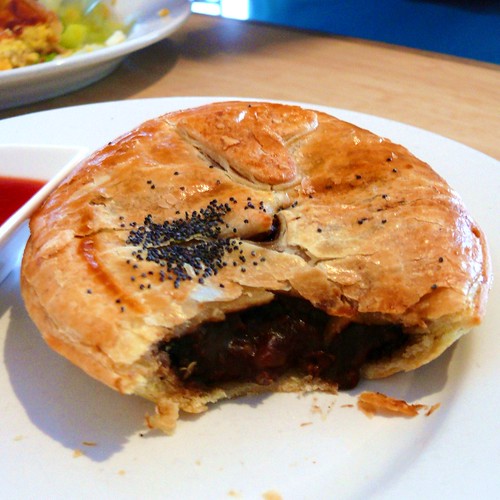
It's been a couple of months since I last ate a pie and PiEcon, the meat pie blog, has languished in favour of a multitude of other tasks. Then over the weekend while touring potential wedding venues on the peninsula I caved in to a pie craving and duly recorded it. Drop over for a visit if you're in the mood for a bit of the crust.


14 July 2008

Comfort Food. The price of humility


I long to accomplish a great and noble task, but it is my chief duty to accomplish humble tasks as though they were great and noble. The world is moved along, not only by the mighty shoves of its heroes, but also by the aggregate of the tiny pushes of each honest worker. HELEN KELLER


Each day I thank the universe for the good fortune of living in a country where at my fingertips I am able to source the most wondrous fresh produce with origins from nations around the globe.


And when I pause for thought, I wonder why so many people turn their backs on this to trawl supermarkets for the sake of convenience, looking for products that will enhance the flavour of the lacklustre commercial produce that fills their trolleys...


...While others are willing to pay a chef $90 for the same simple meal that I have placed on my own dining table at a fraction of that cost.


My meal
- five serves total cost $22.


Roasted whole Milawa Free Range Chicken, hand raised in the Ovens Valley of Victoria, fed a diet of mixed grain, pasture and Spring water, chemical and hormone free, sustainable and Slow Food.


Under the skin and in the cavity:
usufruct Lemons from a neighbour, plus lemon thyme, Murray River Salt and Currawong Robust Extra Virgin Olive Oil. In the pan to deglaze - Gooramada Riesling from Rutherglen.


Pan juice gravy made with my own thirty month old Masterstock consisting of Milawa chicken carcasses, cassia bark, coriander pods, star anise, fennel seeds, spring onions, ginger, garlic, Fernleigh Farm celery, carrots and parsley stems.


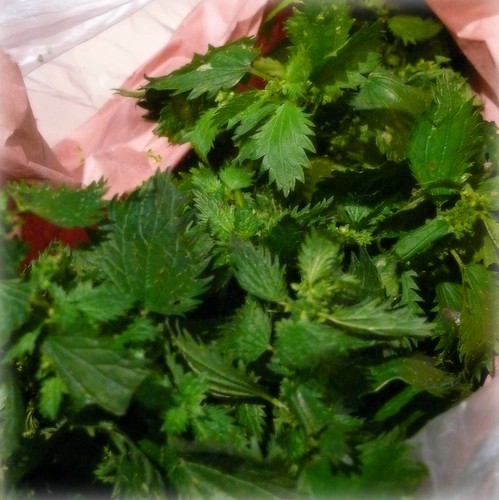
One bunch of Nettles from Glenora Heritage Vegetables, Toobanac, Victoria, blanched and drizzled with Lemon infused Olive Oil from South Australia.
Mashed Royal Blue Potatoes from Gordon Jones, Warragul, Victoria.


Photo reproduced from Gourmet Traveller


For two
people at Bistro Guillaume
- cost $90:

Whole Barossa Valley chicken, purée de pommes and sauce à la chasseur (Chicken, mashed potato with a demi glace mushroom sauce, no vegetables)


In our household, when we choose to dine out we have two streams of thought:


Moderate to cheap and cheerful food, usually from another culture, consisting of good produce cooked with traditional or regional pride.


Secondly there is the more expensive food that astounds us with its imaginative and passionate approach. Food that requires a kitchen brigade, food I would not cook at home.


So with that in mind and having studied the menu, Mr Stickyfingers and I will not be going to Bistro Guillaume. I know a number of local bloggers have already been and shared their positive experiences, but as nice an outing as it might be to sit in the chi-chi surrounds of this much vaunted venue, quite frankly Monsieur Brahimi's menu resembles the food we eat at home. Well, those dishes along with our
favourite Asian and Hungarian meals in my repertoire.


Perhaps if I were unable to acquire such good produce for myself, I might consider it. Given the marvellous concepts, innovation and exploration of new produce happening on the food scene here in Melbourne, I think that it would not be high on our list. In fact there are a number of more humble French establishments that I might choose in preference to it.


I know that although my home is small and simply furnished, the providence of the produce in our pantry is as good - and my techniques are sound. Our roast chicken was as succulent and as flavourful as you could wish for, plus we had the benefit of easily staggering to the lounge for semi-horizontal post-prandial relaxation. There was minimal prep time. Cleaning up pretty much required just throwing everything into the dishwasher.


Perhaps I am stuck up and naive but nothing could compel me to part with $90 for the same meal that I eat regularly at home.


Are the diners of Melbourne suffering from a case of
'The Emperor's New Clothes' - being hoodwinked by our fascination for the new and by the hype stirred up
following the arrival of celebrated Sydney chefs?

What do you think?


11 July 2008

Caught on a snag


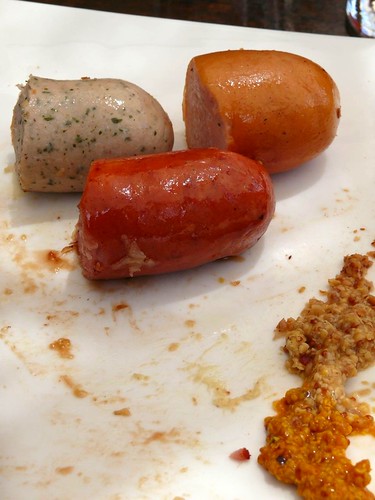
The sausage is
one of the first ever convenience foods with the etymology of its name being derived from the Latin salsus - or salted. The German word 'wurst' is derived from the Latin vertere, to turn, to roll, indicating the shape of the item.


The Romans are the first credited with its production in Europe and noted by the premier Gourmand of the time, Apicius, in 1AD as being pounded meat with herbs, spices, fat and pine kernals being drawn out thinly in a pig's intestine, then hung up to smoke. The Chinese are said to have been eating them a lot longer than the Europeans, while the French claim the 'wet sausage' as their own creation.


Have you been lured unsuspectingly
into hardware stores on the weekend? Many Australians have, and it's not necessarily by the promise of fabulous DIY projects at great prices, but thanks to our olfactory senses.


It's the whiff of a sausage on a storefront BBQ manned by zealous charity fundraisers. It's our 'Sausage Sizzle' nostalgia that the smell summonses - of smoke in the eyes, greasy cheap slightly burnt sausages, a slice of nasty commercial white bread, butter and lashings of tomato sauce.


OK, if you're not a local this probably sounds hideous of course, but what omnivorous Aussie can resist it? And when the proceeds go to charity, it seems pointless to resist. This meaty affliction lurks deep in the Aussie psyche, coiled in the corner that reminisces about hanging out with Dad or going to BBQ's as kids and running wild fueled by excitement and too much raspberry cordial. It's a memory locked in there along with 'Hundreds and Thousands' sandwiches, ready to bring us weak kneed into the hardware store car park.


But hard on the heels of being told that Australia is debatedly the fattest nation in the developed world, the iconic sausage sanga has now been analysed by the Australian Division of World Action on Salt and Health (AWASH). There's no prizes for guessing that the subject of our adoration is actually not good for us. After all the name is derived from 'salted' - no?


AWASH is launching a strategy of working with the food industry to reduce salt in foods by 25% over five years, requiring a high level of commitment from the food industry and the development of individual company action plans. AWASH is also inviting views on proposals for developing targets for salt levels for specific products and focusing on processed meats, bread and the fast food sector.


But back to the sausage sanga. Here are the results:

Only 2% of sausages in Australian supermarkets meet acceptable salt levels.

Australian Division of World Action on Salt and Health revealed that one single sausage sandwich at your local barbecue could contain as much as 6 grams of salt; 100% of the maximum daily recommended amount for adults and almost double that recommended for children.


The product overview shows that other products commonly eaten at barbecues, such as hamburger patties, tomato sauce and some white breads, are also high in salt. It shows huge variations in the salt content of different brands of similar products, with some sausages containing over three times as much salt as others.

FOODWEEK


Now you see it doesn't stop at the snag, it includes the bread Aussies typically love, in addition to the commercial Ketchup and BBQ sauces which also contain far too much sugar.


It's said that the average Aussie is currently consuming 9grams of salt a day, with acceptable levels being a much lower 6grams - or a single sausage sanga as your one meal of the day. Much of the mainstream Aussie salt intake is coming from packaged convenience foods and although some multinational food companies now have salt reduced products, I don't believe that they are a particularly popular choice in the main.


I wasn't surprised when I read that AWASH has stated in their press release
“The food industry in Australia is committed to further action to reduce salt in foods. The Government now needs to make salt a national health priority and lead negotiations on maximum salt targets for different products. Only then will Australians have a chance of reducing their daily salt intake to recommended levels.”


Everyone leaps on the 'government needs to do something' bandwagon after all. It reminded me of 'Fat Chance' the first episode of The Hollowmen by Working Dog Productions, where bureaucrats use the issue of obesity to generate the kind of hype that lobby groups love, but are consequently easily manipulated into helping to temporarily drive up government popularity polls.


On Wednesday night in Australia you have a chance to see how The Naked chef Jamie Oliver is tackling healthy eating with his show
'Jamie Oliver's Eat to Save Your Life'. The show was intended to shock the living daylights out of British couch potatoes and now their colonial cousins get prodded in order pierce their junk food overloaded reverie.


"Yeah. Triffic darlin'. Right you are then - stop wrapping yer chops aroun' the sav sarnies and Bob's yer uncle. Orright?".


For me, the bare bones of this issue is that although the intention is good and it is honourable to draw attention to the impact on one's health, it is our problem - not the government's - to eat sensibly and to teach others. We seem to be living in a time of blame. The national mentality is not to look at where we ourselves are going wrong, but to look for scapegoats like advertising, TV shows and governments.


If we have no idea, then we must look to others for guidance to read and learn how to eat better, so that at the very least we do the best we can by our families. And that does not include eating packaged processed food and frequenting Quick Service Restaurants for fast food, whether the labelling says 'salt reduced' or not.


I know it's the horse I generally ride in on, but when our household returned to eating SOLE foods, I discovered that we have less need for flavour enhancers beyond fresh herbs and spices. Salt doesn't play a big part in our diet. Neither does refined cane sugar. It's not hard to make the change to more of a Slow Food ethic and slow grown produce equals more filling and sustaining meals with smaller portions, so it also makes economic sense. At the end of the day I have proof that we are healthier for it too.


Sorry AWASH, for all your scare mongering, I will still on the rare occasion be lured into a Hardware store car park with the promise of a filthy sausage sanga that will comfort me temporarily before spending money on gadgets that I don't need. But I will do it in the knowledge that my diet is good, my heart is healthy and my blood pressure is normal. After all, it's about having a balanced approach to life, isn't it?


(Oh and mind out for the Prick with a fork!)


06 July 2008

For Duncan - Les Macarons de Patissier Menard


A macaron is a traditional French pastry from Nancy, a commune of the Meurthe et Moselle département, in northeastern France. Dating back to the 18th century, the macaron is made of egg whites, almond powder, icing sugar and sugar.

This sweet pastry came out of the French courts' baker's oven as round meringue-like domes with a flat base.
In the early 1930 the tearoom and pastry-shop Ladurée in Paris started selling the new creation of Pierre Desfontaines, grandson of Louis Ernest Ladurée: two traditional dome halves sandwiched with a sweet filling between: the ganache.

This resulted in giving the
new macaron [1] a larger size, the possibility of flavored garnishes, and a newfound moistness that came from the garnish. Whereas the traditional macaron was sweet and dry and crunchy, the new macaron had the added attraction of being delicately crunchy on the outside, while moist, chewy, and flavourful on the inside.
WIKIPEDIA


Melbourne Food Bloggers
seem Macaron Mad. I can't explain it. I just blame
Duncan for blowing our minds with them at last year's Bloggers Banquet. But it seems to be a global affliction. My photo of those particular mini morsels still rate as one of the highest individually viewed images in my Flickr account. To date, it's had 75 views, about 100 less than the chart topping image of Gordon Ramsay's omelette recipe, but enough to make it a niche subject.


The search for local perfection seems to end in Duncan's kitchen for some bloggers, but I have my local favourites. By chance I stumbled into David Menard's Noisette this morning after a ninety minute 7.30am workout and a detour to South Melbourne Market - yes, on a Sunday and the sun was rising when I began - crazy. At the shop there were 20 pastel morsels on the counter. To me they're much prettier than the Pierre Herme Macarons everyone seems to swoon over.


I took five - pictured - presuming that Guillaume Brahimi had probably either been short changed or that extras had been made.
I also walked out with two croissant to further undermine my diligent physical exertions.


So how did they taste? A crisp smooth shell gave way with a gentle shattering to a strongly flavoured, soft and airy yet finely granular almond cake. Then the sensuously creamy filling creeps across your palate, giving a silky finish to the experience. C'est magnifique - vraiment!


Noisette also had a number of new puff pastry based tartes on the counter. Gorgeous glistening, golden rectangular slices with various toppings cut from a rather long mother tart. I must give them a shot soon.
So Duncan, this is pour toi cheri.


Noisette Boulangerie & Café
84 Bay Street, Port Melbourne, Victoria.
ph +613 9646 9555


Duncan Markham's Syrup and Tang
His posts about Macarons, including recipes and helpful guidance for mastering the technique via the comments section.


03 July 2008

Likin' Daikon - Char Kway Kak

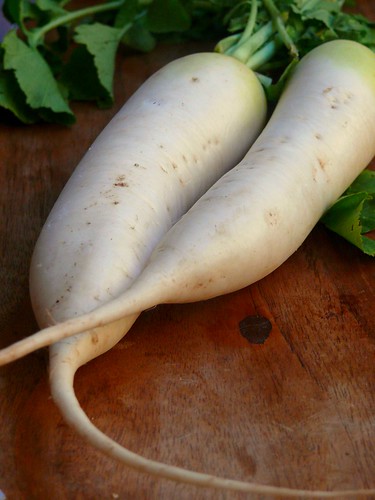
Organic daikon from Fernleigh Farm, Victoria.


WEEKEND HERB BLOGGING:

Daikon
(from Japanese daikon 大根)

Literally "large root" is a mild-flavored East Asian giant white radish. Though most widely known as daikon, the radish is also known under other names, including mooli in Hindi, Punjabi, nepali, bihari, daikon radish, Japanese or Chinese radish, winter radish, Korean or moo (Korean), moorro (Gujarati), moolah (Bengali), lobak, loh bak, lo-bok, or lor bak (Cantonese), labanos (Tagalog), rabu, phakkat-hua, and củ cải trắng[2] (Vietnamese).

WIKIPEDIA


It's breakfast time in Penang, Malaysia. My skin feels like tofu deep fried in the scorching sun.


Our new expat Aussie friend Kylie leads us off Burma Road down a side street and into a bustling tiled cafe crammed with Laminex tables. I'm puzzled. There seems to be no seats left here. Diners have their heads in bowls, eating with a seriously studied approach, but Kylie is striding purposely down to the back of the venue. We follow obediently, smiling at the staff and walking straight through the kitchen, out the back door and into the food hawker section of the Pulau Tikus wet market.


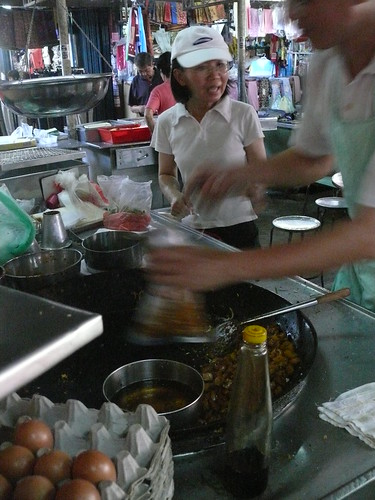
Immediately we are assaulted by robust spicy aromas, booming voices and the clang of cooking implements. We're in a large dark shed. Pools of light stream through holes in the iron roof onto the well worn concrete floor and plastic tables with low stools encircle an island of hawkers, each cooking just one specialty. As I adjust my vision to the gloom, I see that we have surfaced near the vendor of one of my favourite, peculiarly local Hokkien style dishes, Char Kway Kak - savoury fried daikon cake.


It's my lucky day. This is no ordinary Char Kway Kak stall, but Tan Choo Hoon's - a retiree in his 60's who four years ago took over the stall from the previous owner Ng Kim Siak who had begun the business in the 1970's. This famous Char Kway Kak has a big following and is a favourite of Malaysian dignitaries, state officials included.


As Kylie waved to another hawker for her standing daily order of soup noodles, I watched Mr Tan and his wife Lau Yeow Choo at work. Lithe and well practiced, the speed at which they belted the ingredients around in the enormous searing griddle plate manifested as a percussive blur of hands and steam. I watched the daikon cake being cut up roughly and fried; eggs and seasonings added in deftly. The smell made my mouth well with salivary anticipation and a cloud of chilli fired steam took my breath away - quite literally.


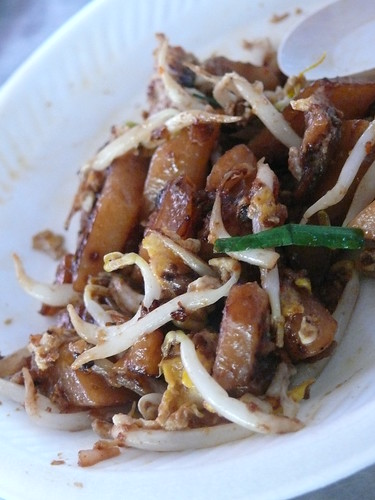
I sat down, the rest of our party were slurping on Koay Teow Th'ng and picking at crispy skinned roasted belly pork. When my plate of Char Kway Kak arrived, eyes widened like saucers. I felt smug. It was in short, delicious and unctuous. Slippery yet crunchy, savoury and filling with chilli tingling the sides and tip of my tongue, I could see why this simple version had loyal fans.


This is a dish which like many South East Asian meals juxtaposes contrasting textures to add another dimension to the pleasure of the flavours. Char fried cubes of steamed solid daikon paste are flavoured with garlic, palm oil or lard, chilli, dark soy sauce and garlic chives.


The balance of textures come from other ingredients - always there is egg and crisp bean shoots - but the optional extras that some people like to add include clams, Chinese Lup Cheong sausage, shrimp and even Chinese Cha Siu BBQ'd pork. Mr Tan's version comes without meat - perfect for breakfast - and I happily recreate it at home, where we eat it later in the day. My own version (
photograph below) includes some chicken and Chinese sausage in the mix. I tend also to garnish it with fresh coriander (cilantro) and fried shallots.


I am sharing this simple recipe with you as my first ever submission to Weekend Herb Blogging.


For non blogging readers this is an event initiated by Kalyn's Kitchen for Bloggers around the world to share insight and recipes on unusual herbs or plant ingredients. It's been around for a couple of years and is a fascinating look at home cooking around the world.


The host of this particular event is Blogger Pam of Sidewalk Shoes, where the entries will be showcased after the closing date on July 6. For bloggers, it appears to be a great way to introduce new readers to your site and to find others of interest to you in the online food community.


Many people - Asians included are often at a loss as to how to cook the long white radish commonly known as Daikon, or in my Cantonese speaking family, Lor Bak. Often it is used incidentally as a mild textural filler or added late in cooking for contrast in a braise or clear soup while the vegetable's flavour is still
sharp. You will also see it in Asian pickles and chutneys.


Most often I serve the daikon cake - in Cantonese, Lor Bak Goh - with some reconstituted dried shrimp in the mix, then sliced and pan fried crisp in yum cha style. I also like to use it fried in Fusion cooking as a bed for roast duck, served with crisp fresh lotus root and red cabbage with Pomegranate sauce.


If you can't be bothered or are in a hurry, you may even find the cake pre-made in Asian Grocers (see above). It is really quite simple to make with a bit of planning however. Choose fresh Daikon that are not bruised and avoid those with big cracks in them.


MY RECIPE

Char Kway Kak
Hokkien style fried daikon cake


DEALBREAKERS:
1/ You may need to source some ingredients from Oriental Grocers.
2/ The daikon cake needs to be made at least 4hrs in advance.


FOR THE CAKE (MAKES 1KG):

175g rice flour
1 tbsp Tapioca flour
500ml water

1 tbsp cooking oil (I use canola or peanut oil Malays use palm oil traditionally)
2 cloves of garlic
175g peeled and shredded daikon

1 tsp salt
1 tsp white pepper
2 tsp sugar


In a large jug or bowl combine the two flours and water to form a smooth batter. Set aside.

In a pan or wok, saute the garlic in the oil until fragrant then add the daikon, fry until soft. Pour in the batter and season with the salt, pepper and sugar. Stir until the mixture is thick.

Remove from heat and pour mixture into a 23cm diameter greased tray, to a depth of roughly 4cm. Steam this for 30minutes over a wok of hot water or in a steamer. Once done leave to cool and set. This can take 4 to 6 hours, so is best to leave overnight in your fridge. Daikon cake keeps well refrigerated.


FOR THE FINAL DISH:

400g radish cake cut into 2cm cubes
1 large clove of garlic, smashed & minced
3tsp chopped preserved radish (optional)
2.5 tsp roasted chilli paste (Sambal Oelek) or to taste
2 tbsp light soy sauce
1 tbsp dark soy sauce
2 tsp Ketchup Manis
1 tbsp chicken stock OR a large pinch of powdered chicken stock (either optional)
2 large duck eggs (chicken is ok)
150g bean shoots

50g chopped garlic chives white pepper to taste


Heat and oil a large griddle or wok and fry the daikon cake over high heat until browned. Remove from wok. If adding in any seafood or meat do so at this stage, heat through and remove from pan. Repeat with garlic and preserved radish, when the aromas lift, add in chilli paste to warm through.

Return the radish cake to the pan and add the seasonings and sauces. Turn quickly to coat the cake well, then push to one side.

Add the 2 eggs to the pan and stir to scramble over the heat until they begin to solidify, then mix them back through the daikon cake. Return seafood or meat to the pan if using and then toss in the bean shoots and garlic chives. Heat through briefly and serve immediately.


02 July 2008

Tastespotting is live again


* no longer a part of notcot, tastespotting is back.
and apparently, we love daring bakers. also, follow updates here *
TASTESPOTTING

It's raining and I am putting off installing software, building the network and transferring files over to my new laptop - what a drudge. So after popping some toast in my gob, I thought I'd check my various email accounts and took a look at Statcounter, to see how my new post on the Vanilla Slice Blog was going.


It was then that I noticed on my stats for this blog that amongst the people who are still reading about the TasteSpotting Stalker, I had been paid a visit from a viewer in
Coquitlam, British Columbia, Canada, who had come to me through TasteSpottting itself. They had clicked through from there to my old post on Braeside's incredible breakfast featuring corn fritters. So I followed the trail back to the source and it took me to a Tastespotting search which I expected would be a Google archive of the site, but it turns out that it wasn't.


So guess what? The TasteSpotting site's back and apparently under new ownership. You can read about it on the
Tastespotting Twitter feed - mentioned above. The new owner of the site had dropped by and placed a comment on my last post on the subject, but I had not anticipated that it would be up and running so soon. Good job!


Thinking that I should immediately restore their widget to my sidebar, I logged in and the first thing I was greeted with this:


Welome Back, stickyfingers!(sic)

We're in the process of making everything all crispy and clean here, which includes letting you know about the Terms and Conditions of using TasteSpotting. Click the "accept terms and conditions" link below if you agree. Thanks, and again, welcome back!


Here are the Terms:


While we finish getting all buttoned up, please read the following Terms. If you have questions, feel free to email
love@tastespotting.com.

1. By accessing TasteSpotting.com or using any part of the site or any content or services on the site, you agree to abide by these terms and conditions. If you do not agree to all the terms and conditions, then please do not use TasteSpotting.com.


2. TasteSpotting reserves the right, at its sole discretion, to modify or replace the Terms of Use at any time. If it's a major change, TasteSpotting will notify you by posting an announcement on the Site. Use of the Services by you following such notification constitutes your acceptance of the terms and conditions of the Terms of Use as modified.

3. Please register. In order to submit, you are required to register with TasteSpotting and select a password and username. You are responsible for maintaining the confidentiality of your TasteSpotting password.


4. As a condition of use, you promise not to use the Services for any purpose that is unlawful or prohibited by these Terms of Use, or any other purpose not reasonably intended by TasteSpotting. Be nice to other users, okay?


5. Have integrity. You are responsible for your Submissions and the consequences of posting or publishing them. Make sure you have permission to submit a picture, either because you own it, or you have permission to post it. TasteSpotting will remove submissions if it infringes on another's rights. If you are an owner and have an issue with your photos being submitted to this site, please email
love@tastespotting.com


So if you're one of the thousands of people who have visited Deep Dish Dreams mourning TasteSpotting, your misery is over. Sign in, sign up or just go and perve. If you're registered you can collect your favourite images there too. Or if you've got some porny food shots - get 'em up there! (Or Food Gawker where many fans have thronged in the interim)


Back to the subject of their widget, I wonder how I can retrieve it?


My meagre TasteSpotting submissions are located
in my profile on their site-
here - but I feel the urge
to also submit something from recent posts today.

What should it be?


POSTSCRIPT July 6:

Well it took a few days to appear but my photo of the Saffron Milk Cap mushrooms popped up on July 5 - after I had thought they had been rejected. So if you've uploaded an image, hang in there, all may not be lost. I'm hoping that my flaming satay photo makes it in over the next few days.

I know it's impossible to please everyone, but I must admit that I'm not a fan of the new format on the site, which clusters posts or images of like subjects. I can also imagine that for vegetarians - for example - looking at a dozen grill pictures in a row might be quite disconcerting. The old jumbled approach with colour synchronicity was much more stimulating. After all, you can do a search there for grills or berries or chocolate etc if you want a mass selection of similar themes.


Also worth a look: The 'Food Interviews' Blog has posted an interview with TasteSpotting's new owner - Sara J Gim - where she candidly discusses the selection process, hints, tips, rival sites and her plans for improving the new TasteSpotting.


01 July 2008

FoodBuzz fairy


“The greatest gift you can give another
is the purity of your attention.
”


The Food Buzz fairy has been again.


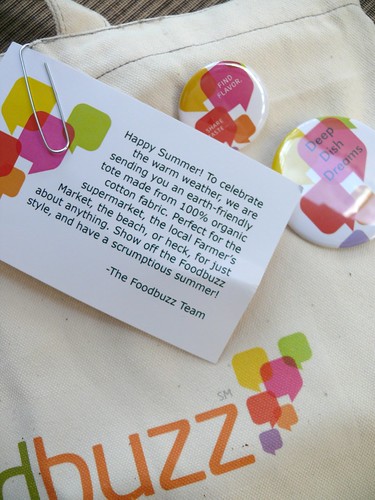
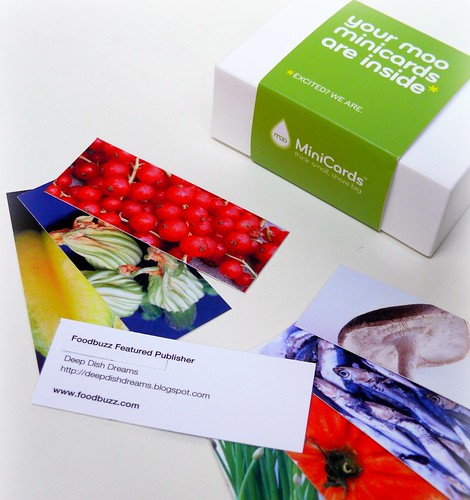
The first time was to send me little business cards with which to promote my blog, and I was well chuffed. Then today a 100% organic calico bag arrived, with a badge stamped with my blog name. I liked it and guess the badge will come in handy to wear to Bloggers Banquets. It will be an effective way for FoodBuzz to get their name into the minds of those fascinated with food.


Now that's good thinking Marketers. After seeing so many people trying to hook clumsily into the blogging culture, these people actually get what makes us tick. No sock puppetry, no spamming - nice work.


If you've not heard of FoodBuzz, it is still in its Beta phase as a fairly new form of social networking among food bloggers. Via seeding, your blogs can be viewed there and it still count as views to your site. You also have a feed reader facility there to keep abreast of your favourites and primarily it is an excellent way to discover other like-minded sites and bloggers both locally and globally.


Clicks through to FoodBuzz from your site earn remuneration via PayPal, but I'm not fussed about that. I just enjoy browsing there and seeing what's happening in the Blogosphere. I suppose it's a move on from Tastespotting where rather than just perving, you can interact and show your interests in other people's posts by 'buzzing' them. You receive newsletters which direct you to the sites with the most buzz and email updates on how things are going with the development of the site.


If you like podcasts, FoodBuzz show theirs on BlipTV, which can be subscribed to on iTunes and downloaded to your Pod. I love watching these sorts of things when I'm flying - it generally beats the inflight telly.


So thanks again FoodBuzz - love your work.


View Melbourne Bloggers on FoodBuzz here.

View posts on Melbourne

Sign up here